
Navigating Growth and Complexity: CBRE’s Strategic Positioning in the 2025 Real Estate Recovery
CBRE Group's 2025 performance reflects the interplay of diverse revenue streams, strategic acquisitions, and market dynamics amid a recovering commercial real estate market.
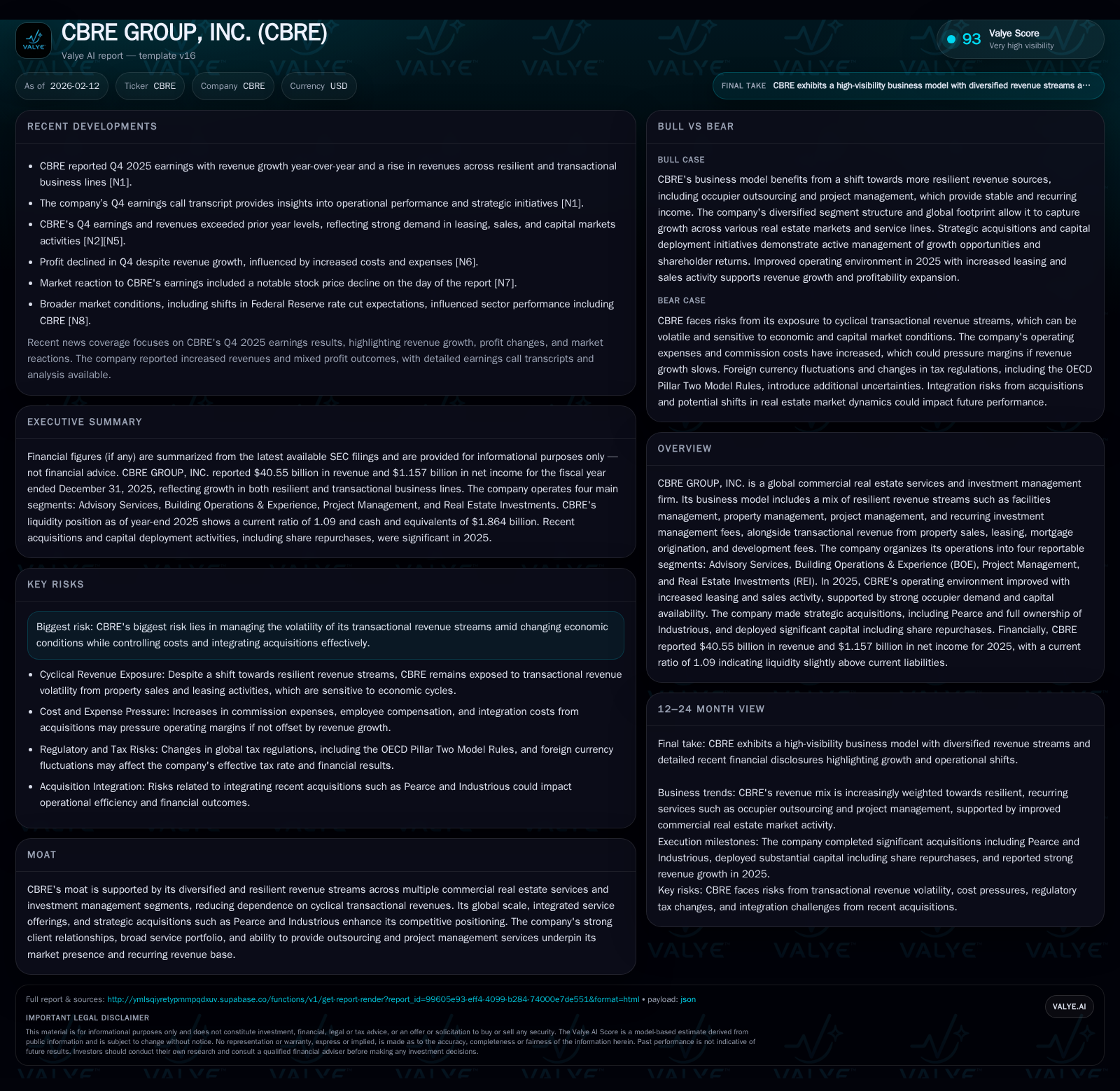
In 2025, CBRE Group, Inc. achieved a robust 13.4% revenue increase supported by both resilient recurring services and transactional activities, bolstered by strong occupier demand and capital availability. Strategic acquisitions of Pearce and full ownership of Industrious expanded its service footprint, enhancing its competitive advantage. Despite strong full-year growth, CBRE experienced a Q4 profit dip, highlighting ongoing challenges related to transactional volatility and integration risks in a complex and evolving market environment.
CBRE at a Glance: Scale, Scope, and Business Model
CBRE Group stands as a dominant global player in commercial real estate services complemented by investment management operations. Its business structure is organized into four reportable segments: Advisory Services, Building Operations & Experience (BOE), Project Management, and Real Estate Investments (REI). This segmentation enables the firm to weave together diverse offerings—from facilities and property management to complex project oversight and recurring investment fees—creating an interlocking revenue base that tempers exposure to cyclical market swings [S1][F1].
Facilities management alone accounted for over half of the 2025 revenues ($20.65 billion or roughly 51%), underscoring the scale of outsourced operational services underpinning steady cash flow streams. Project management ($7.66 billion) and advisory leasing ($4.5 billion) further contribute meaningful slices, depicting a company whose breadth spans from transactional brokerage activities to service-heavy contractual relationships that persist across economic cycles [S1][F1].
This multi-dimensional model constitutes CBRE’s moat—diversification across geographies, asset classes, and service modalities reduces dependence on any singular revenue stream while fostering sticky customer relationships anchored in expertise and scale.
Takeaway
CBRE’s broad platform creates inherent resilience; understanding this layered model is key to contextualizing its recent financial results and strategic initiatives.
Navigating 2025’s Commercial Real Estate Landscape
The operating backdrop for CBRE in 2025 was notably stronger than the prior year. U.S. markets witnessed an uptick in occupier demand across office, industrial, and data center assets fueled by improving macroeconomic conditions including enhanced capital availability and lower borrowing costs [S1]. This environment incentivized increased transactions—a tailwind for CBRE's advisory segments—and elevated demand for outsourcing solutions under BOE.
News coverage affirmed this positive momentum; Q4 earnings beat estimates as revenues rose year-over-year driven by stronger-than-expected leasing activity alongside expanding outsourced services contracts [N2]. The ongoing real estate recovery enabled CBRE to leverage cross-segment synergies while benefiting from investors’ renewed appetite for commercial property investments.
Takeaway
2025’s macro improvements provided fertile ground for CBRE’s multifaceted services but also raised expectations for sustainable profit growth amidst structural shifts toward outsourcing.
Revenue Streams: Resilient vs. Transactional Dynamics
A defining characteristic of CBRE’s financial profile is the duality between resilient recurring revenues associated with long-term outsourced services (e.g., facilities management) versus more fluctuating transactional revenues tied to property sales, leasing commissions, mortgage originations, and development fees.
In 2025, both categories expanded at similar rates — roughly a 13.4% increase in resilient businesses accompanied by a parallel 13.6% rise in transactional activities [S1][F1]. However, the traditional seasonality seen in fourth-quarter transaction spikes has diminished owing to the growing proportion of recurring revenue sources diluting transactional weight.
This diversification simultaneously moderates risk exposure to market downturns yet presents complexity in managing margins: resilient contracts often yield steadier but lower margin returns compared with higher-margin brokerage deals subject to timing volatility.
Takeaway
CBRE’s balancing act between stable service fees and episodic commission gains affords both growth opportunities and cost discipline challenges—critical considerations when dissecting quarterly results.
The Role of Strategic Acquisitions: Pearce and Industrious
In 2025 CBRE allocated approximately $2.7 billion in capital deployments with key acquisitions reshaping its footprint:
- Pearce ($1.2 billion): This addition fortified CBRE’s technical services within digital power infrastructure—a rapidly growing niche essential for managing smart buildings and data centers [S1].
- Industrious ($468 million for remaining equity): Securing full ownership bolstered flexible workplace offering capabilities aligned with evolving tenant demands for hybrid work environments.
These moves underscore a strategic pivot toward integrating technologically advanced solutions alongside expanding workplace experience platforms [N1]. Such integrations present opportunities for cross-selling but also call for smooth assimilation of differing corporate cultures and systems at scale.
Takeaway
Acquisitions serve as accelerants expanding CBRE’s addressable market beyond traditional brokerage; execution effectiveness herein will materially impact future competitive positioning.
Financial Health Deep Dive: Growth, Margins, and Capital Deployment
CBRE reported full-year revenues of $40.55 billion in 2025 — up 13.4% — coupled with net income rising nearly 20% to $1.157 billion [F1]. Core EBITDA climbed by over 22%, reflecting operational leverage amidst top-line growth [S1]. EPS metrics also surged by approximately 25%, bolstered further by a $956 million share repurchase program removing roughly seven million shares.
Yet while annual figures impressively advanced versus 2024 benchmarks, Q4 profitability slipped—a conundrum that analysts attribute partly to elevated transaction-related expenses combined with integration costs from recent acquisitions [N10][N3]. This profit deceleration introduced investor caution notwithstanding underlying operational strength.
Takeaway
Financial results paint a nuanced picture where sustained growth coexists with short-term margin pressures demanding vigilant cost control strategies going forward.
Cybersecurity and Risk Management in a Digital Age
With extensive reliance on technology platforms spanning tenant data management to property operations monitoring, cybersecurity emerges as a paramount risk vector for CBRE.
The Board maintains direct oversight through its Audit Committee while engaging regularly with the Chief Information Security Officer (CISO) who leads global cybersecurity strategy deployment [S1]. Formal escalation protocols ensure material incidents are reported promptly at the highest governance levels.
Regular system audits paired with incident response planning safeguard continuity amid increasing cyber threats targeting real estate infrastructure — an essential competency given CBRE’s custodianship over sensitive asset information worldwide.
Takeaway
Effective cyber risk governance remains integral to sustaining client trust and operational stability within CBRE’s digitally interconnected ecosystems.
Market Response and Investor Sentiment Post-Q4 Earnings
Despite beating consensus revenue estimates at quarter-end, CBRE shares declined sharply following its Q4 earnings release [N8]. The sell-off was attributed largely to concerns over slipping profitability coupled with broader sector rotation pressures noted during that trading session [N9]. Technical analyses highlighted oversold conditions potentially signaling near-term valuation resets [N11][N12][N13].
This disconnect underscores how episodic profit softness can disproportionately influence sentiment even when fundamental indicators remain robust—a reflection of heightened market sensitivity during transitional phases within cyclical sectors such as commercial real estate services.
Takeaway
Investor psychology post-earnings reveals tensions between confidence in long-term fundamentals versus apprehension about short-term margin variances and macro uncertainty.
Outlook: Opportunities and Pitfalls Ahead
Looking ahead into 2026, several threads emerge shaping CBRE's trajectory:
- Growth Drivers: Persistent occupier appetite combined with integration benefits from Pearce’s technological expertise and Industrious’ flexible workspace solutions should propel service differentiation [S1][N1].
- Risks: Ongoing transactional volume volatility remains a key profit swing factor alongside complexities inherent in assimilating large acquisitions without diluting margins or client experiences [S1].
- Operational Vigilance: Maintaining rigorous cybersecurity standards alongside disciplined cost controls will be pivotal amid heightened digital risks counterbalanced against expansion ambitions.
CBRE’s strategic story is one of managed evolution—leveraging scale and diversity while navigating cyclical sensitivities intrinsic to global commercial real estate dynamics.
Final Takeaway
CBRE’s multifaceted platform combined with purposeful capital deployment positions it well within an improving market context; prudent risk navigation will determine how fully these advantages translate into sustainable shareholder value gains.
This analysis is based on publicly available information as of early February 2026 including company filings ([S1], [F1]) alongside recent news coverage ([N1]–[N13]). It does not constitute investment advice or recommendations.
Disclaimer: This is research-only, informational analysis and not investment advice. It may include AI-generated interpretation and general industry context. Always verify important details using primary sources.

Comments