
CBRE Group Advances Integrated Real Estate Services Amid Shifting Transaction Landscape
CBRE’s Q2 2026 results highlight growth driven by recurring service revenues, strategic capital deployment, and broad service diversification.
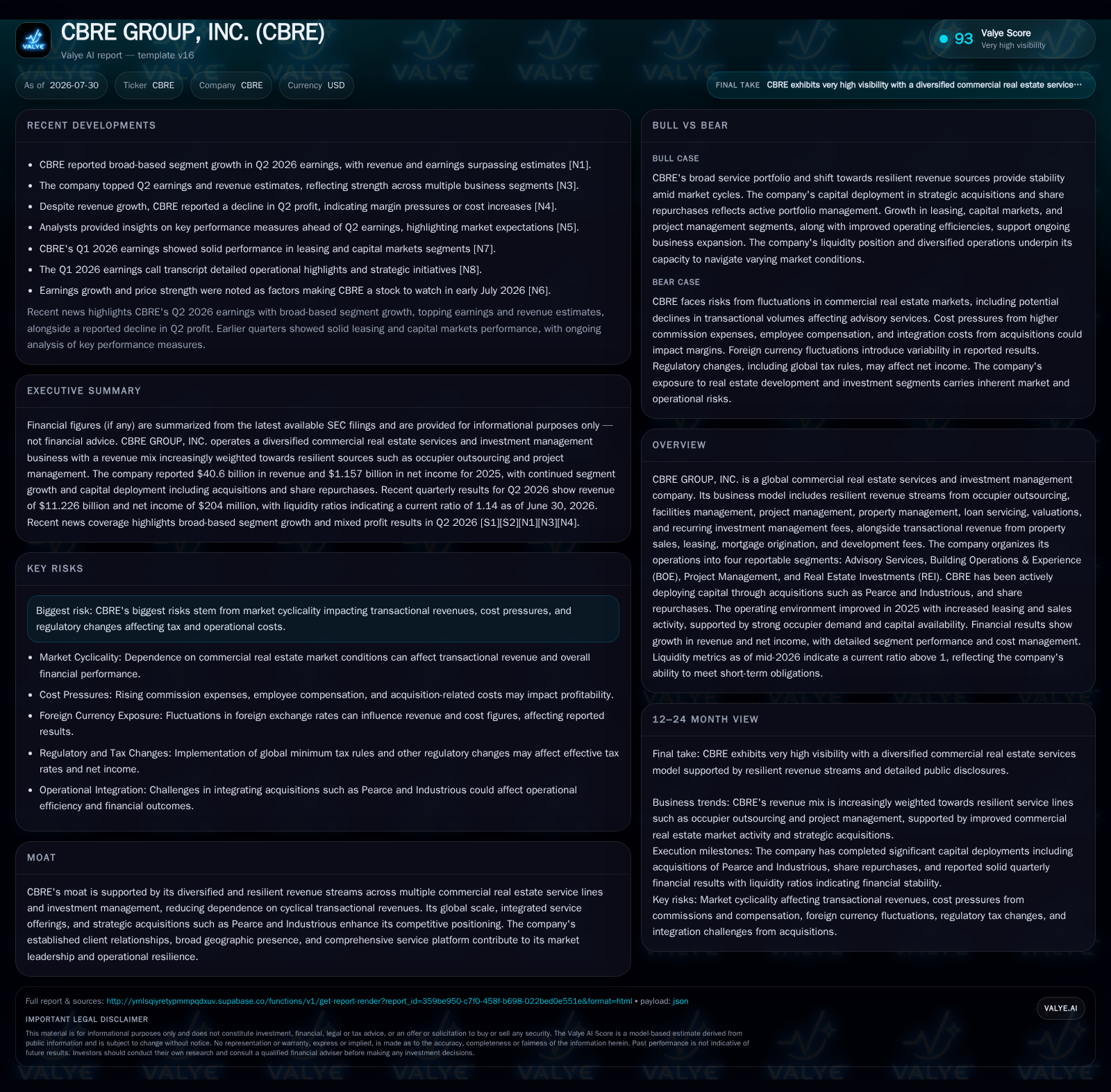
In its latest quarterly filing, CBRE Group reported a notable shift toward resilient recurring revenue streams amid softer transactional activity. The company continues to leverage its integrated service platform—ranging from occupier outsourcing to project management—to sustain growth and margin expansion despite ongoing market cyclicality. Strategic acquisitions, such as Pearce and the full acquisition of Industrious, underpin expansion into technical infrastructure and flexible workspace sectors. While cyclical risks and cost pressures remain, CBRE’s diversified business model and global scale bolster its competitive moat and position it well in an evolving commercial real estate environment.
Q2 Earnings Reveal Shift Toward Recurring Fees Balancing Cyclical Transaction Revenue
CBRE’s latest quarterly filing dated July 29, 2026 ([S2]) illustrates a meaningful shift in its revenue mix favoring resilient recurring fees over cyclical transactional commissions. Facilities management, occupier outsourcing, property management, and project management segments exhibited robust growth in the quarter reflecting persistent client demand for outsourcing services despite continued uncertainty in real estate transaction activity [S1]. Meanwhile, transactional revenues—encompassing property sales commissions, leasing commissions, mortgage origination fees—showed more modest performance due to softer market dynamics post-peak transaction cycles evident since late 2025 [N1].
This trend is significant because it reduces CBRE's exposure to volatile deal volumes that have historically driven swings in its earnings profile. Recurring revenue streams generally feature higher retention rates and more predictable contract structures tied to multi-year engagements with institutional investors and occupiers [S9]. Confirming sustainability will hinge on consistent quarter-to-quarter renewal metrics particularly in facilities management contracts and stable or growing assets under management (AUM) within investment management divisions
Integrated Services Model Anchors Client Demand and Margin Expansion
CBRE’s broad service platform encompassing occupier outsourcing, valuations, loan servicing, investment management fees alongside traditional brokerage activities constitutes a competitive moat enhancing client stickiness [S1]. By bundling advisory services with operations-related offerings like project and property management under long-term contracts, CBRE secures multiple touchpoints within client organizations that raise switching costs.
Margins benefit from scale economies realized across these segments where fixed infrastructure investments yield operating leverage as volume increases. For example, the transfer of data center project work into the Building Operations & Experience segment reflects strategic integration designed to streamline delivery and boost cross-selling capabilities between technical facilities management (via Pearce acquisition) and project oversight functions [S20]. Continued margin improvement depends on preserving high retention rates in outsourcing contracts alongside efficient backlog execution in project management [N3].
Industry Competitive Dynamics: CBRE’s Scale Versus Peers’ Service Footprint
Within the competitive landscape typified by peers such as Jones Lang LaSalle (JLL) and Cushman & Wakefield—which also offer full-service commercial real estate solutions—CBRE leverages superior geographic reach with operations across more than 100 countries serviced by over 155,000 employees [S23].
This geographic diversity mitigates regional economic downturns reasonably well compared to peers concentrated more heavily in select markets or individual service lines. Moreover, CBRE's expansions via strategic acquisitions provide entry into niche but growing sectors; for instance, Industrious positions CBRE favorably against flexible workspace competitors such as WeWork by embedding workplace experience offerings into its broader service ecosystem [S1], enhancing relevance amid evolving office usage trends.
Strategic Capital Deployment Fuels Growth Across Advisory and Flexible Workspace Units
Capital deployment remains central to CBRE’s growth strategy with approximately $2.7 billion invested during 2025 across acquisitions and share repurchases [S1]. The $1.2 billion purchase of Pearce—the digital power infrastructure services leader—augments CBRE’s capabilities to serve critical infrastructure clients requiring advanced technical facility solutions.
Similarly, acquiring the remaining stake in Industrious for roughly $468 million underscores CBRE's pivot towards high-growth flexible workplace formats supporting hybrid work models. These capital moves strategically diversify revenue beyond traditional brokerage commissions towards higher-margin technical services and workplace experience domains.
Share repurchases totaling $956 million in 2025 reflect ongoing capital returns balanced against reinvestment needs [S1]. Monitoring return on invested capital (ROIC) from these acquisitions will be important to assess the long-term value creation attributed to this capital allocation approach.
Risks: Market Cyclicality, Cost Pressures, and Regulatory Headwinds Remain Key Watchpoints
Notwithstanding diversification gains, CBRE remains exposed to macroeconomic cycles that drive transaction volumes—the most sensitive component of its revenue base [S1],[S2]. Downturns in commercial real estate sales or leasing could disproportionately impact property sales commissions and advisory fees.
Additionally, rising labor costs coupled with technology investment requirements for proprietary platforms increase operational expense pressures potentially compressing margins if not offset by pricing power or efficiency gains [S1]. Regulatory developments affecting tax treatment of real estate investments or labor laws impacting outsourcing contracts represent further uncertainties flagged by company disclosures
These risks underscore the imperative for vigilant cost control measures alongside initiatives to deepen resilient recurring fees that better insulate earnings from market volatility.
"Eyes on Execution" — Monitoring Client Retention Rates, Project Backlog, and Leasing Volumes for Signals
Near-term operational indicators bear watching for insights into underlying business momentum. Contract renewal rates in facilities management signal client satisfaction levels critical for sustaining steady fee income streams [S9]. Likewise, maintaining strong project backlog levels provides visibility on future revenue flows from development-related activities.
Leasing volumes tracked within advisory services indicate health at the transactional end; strengthening trends here would confirm early recovery signals post recent softness [N3]. Confirmation or deterioration of these KPIs in coming quarters will directly impact near-term earnings trajectories.
Financial Profile Discussion: Supporting Context on Liquidity and Leverage
As of June 30, 2026, CBRE held $1.49 billion in cash and equivalents against total debt approximating $5.87 billion resulting in net debt near $4.38 billion [F1]. The company maintains a current ratio of approximately 1.14 which reflects adequate short-term liquidity relative to current liabilities of about $11.32 billion versus current assets around $12.91 billion [F1].
CBRE Group's demonstrated ability to pivot towards more stable recurring revenue streams complemented by targeted capital investments strengthens its positioning within the commercial real estate services sector. The firm's vast integrated platform alongside global scale affords competitive advantages versus peers struggling with uneven transaction markets. That said, watchpoints remain around market cyclicality impacts on transactional volumes plus the cost environment which could test margin progression going forward. Ultimately, execution on client retention in outsourcing contracts alongside successful integration of recent acquisitions will materially influence near- to medium-term performance outcomes.
Disclaimer: This analysis is for informational purposes only and does not constitute investment advice or research views.
Disclaimer: This is research-only, informational analysis and not investment advice. It may include AI-generated interpretation and general industry context. Always verify important details using primary sources.

Comments