
Cerebras Systems' Latest Quarter Highlights AI Semiconductor Ambitions
The Q1 2026 filing underscores Cerebras’ robust liquidity and R&D commitment amid ongoing operational losses, spotlighting its strategic efforts in AI hardware innovation.
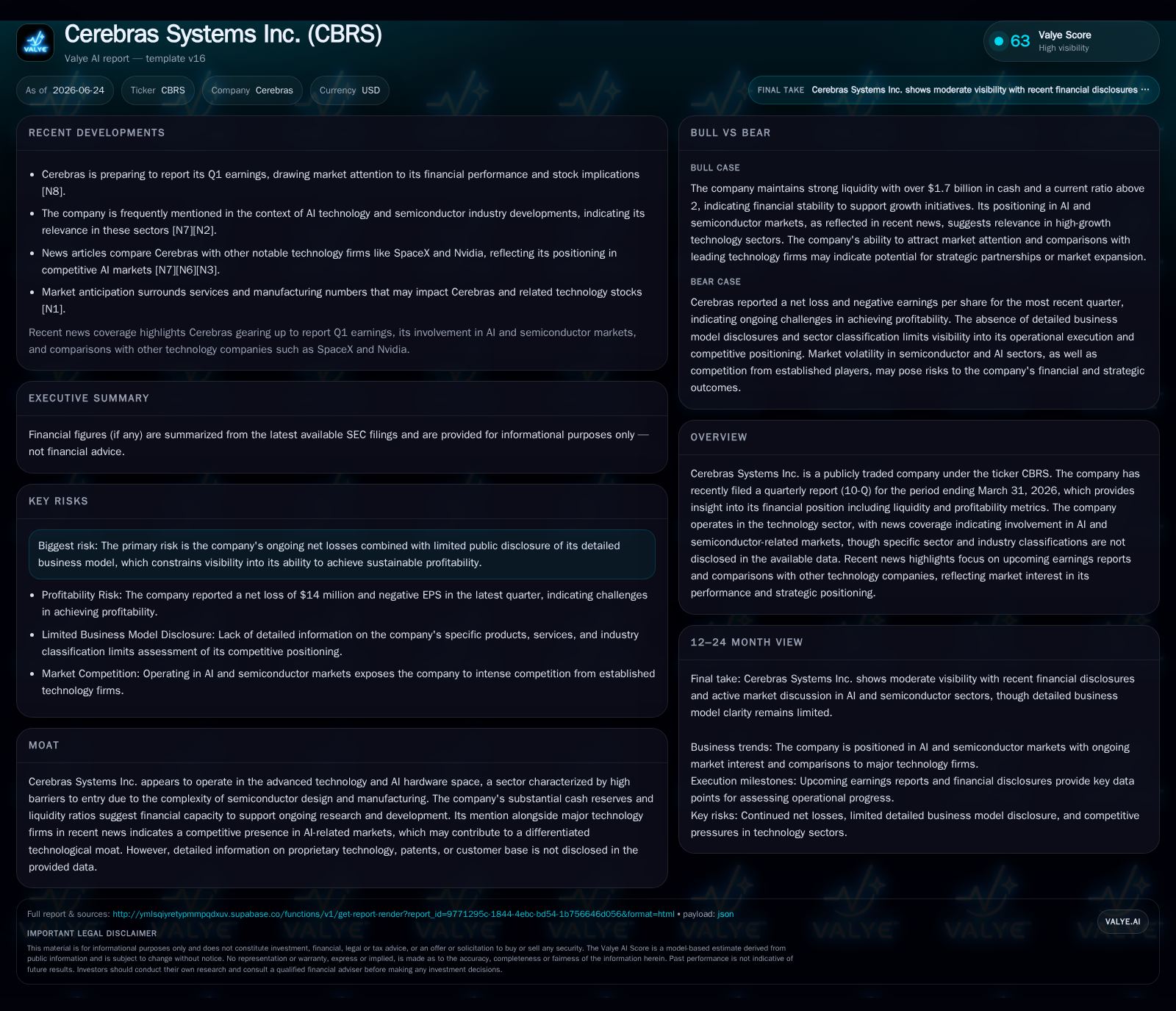
In its most recent quarterly 10-Q filing for Q1 2026, Cerebras Systems reported a net loss of approximately $14 million and operating losses near $15 million, reflective of continued investment in its AI semiconductor development rather than near-term profitability. The company maintains a solid balance sheet with $1.7 billion in cash and equivalents alongside modest debt, supporting a healthy current ratio of 2.5 that underpins sustained R&D intensity. Cerebras’ business model centers on designing proprietary AI accelerators optimized for high-performance workloads, relying on third-party foundries for wafer fabrication—a sector norm that introduces supply chain risks. Positioned within the competitive but rapidly expanding AI semiconductor ecosystem, Cerebras faces both growth opportunities from increasing AI adoption and execution challenges inherent to capital-intensive innovation cycles.
Q1 Operating Update: Financials and Performance Highlights
Core Business Model: Technology Focus & Revenue Drivers
Cerebras operates at the vanguard of AI semiconductor hardware by designing proprietary AI accelerators tailored specifically to the demands of modern machine learning workloads [S2]. Its chip architecture differentiates through scale and specialization aimed at enterprise customers, cloud providers, and advanced research laboratories who require high throughput and efficiency beyond general-purpose GPUs.
Revenue generation stems primarily from product sales encompassing these purpose-built hardware platforms. Winning new design contracts—termed design wins—is vital as it signals successful integration into customer ecosystems which converts into orders over lengthy sales cycles. These design wins translate into building backlog pipelines that forecast future revenue inflows.
Like many in the semiconductor sector, Cerebras relies on third-party wafer fabrication foundries to produce its chips [S2]. This foundry dependency shapes supply chain allocation dynamics and manufacturing lead times limiting direct capacity control but enabling advanced node process technology access without the capital burden of owning fabs.
Customer concentration presents sensitivity risks typical in B2B hardware environments where large contract sizes with fewer clients can introduce revenue volatility if any major customer reduces spending.
Industry Structure and Competitive Dynamics in AI Semiconductor Hardware
Within the expanding ecosystem of AI semiconductor hardware suppliers, Cerebras positions itself as a niche innovator with a unique chip architecture contrasted against incumbent GPU giants like Nvidia which dominate general AI acceleration using established GPU designs. Similarly, Intel and AMD offer competitive high-performance compute chips with deep manufacturing and scale advantages.
Startups such as Graphcore focus on innovative architectures akin to Cerebras but vary in node technology adoption and system integration approaches. Competition is intense around balancing compute power efficiency with fabrication complexity amid rapid product cycle turnover.
Supply chain constraints—especially wafer fab capacities strained by broad semiconductor demand surges—pose critical bottlenecks that can delay product shipments or affect pricing. Pricing pressures are endemic to capital-intensive semiconductor hardware sectors where customer leverage can influence margin expansion prospects.
Growth Catalysts: Innovation Pipeline and Market Demand Trends
The exponential increase in AI adoption across multiple industries fuels demand for high-performance accelerators with specialized architectures [S2]. As AI models grow more complex, requiring greater compute density and energy-efficient processing for inference and training tasks, Cerebras’ offerings address this niche need.
Advancements in node process technology—smaller fabrication nodes such as 7nm or below—can materially improve chip performance per watt metrics and cost profiles if harnessed effectively. Cerebras’ ability to align its design pipeline with foundry capabilities is fundamental to competitiveness.
Cloud infrastructure expansion further drives hardware demand as service providers invest heavily in upgrading compute clusters tailored for emerging workloads like large language models and real-time analytics.
Integration with complementary software ecosystems enhances attach rates whereby customers deploy both hardware and optimized frameworks increasing switching costs for alternatives.
Risks and Execution Challenges Ahead
Cerebras continues to disclose risks associated with sustained net losses necessitating ongoing capital infusion or improved sales scale for sustainable profitability [S5][S2]. Dependence on third-party foundries introduces supply chain uncertainty especially amid global fab capacity constraints that could delay time-to-market or increase costs.
High customer concentration exposes revenue streams to order variability impacting forecast reliability. Efficient inventory management is crucial to avoid channel overstocks harming financial metrics during sales slowdowns.
Regulatory considerations including export controls typical in semiconductor sectors add compliance burdens though not detailed explicitly here.
Price competition from larger incumbents with broader portfolios may constrain margins limiting free cash flow generation critical for long-term R&D funding autonomy.
What to Watch: Upcoming Milestones and Market Signals
Market attention will focus on forthcoming design win announcements serving as leading indicators for revenue growth potential [N1][S2]. Changes in book-to-bill ratios reported next quarter will reflect momentum or softness in order intake versus shipments providing real-time demand signals.
Gross margin evolution offers insights into production efficiencies or pricing power shifts influenced by supply chain conditions or product mix optimization. Adjustments in R&D expenditure may highlight shifting priorities between incremental innovation versus scaling commercial deployment.
Customer contract updates affecting backlog composition will be important to evaluate future revenue visibility amid a complex sales environment requiring long lead times.
Financial Overview: Liquidity, Losses, and Capital Position
Overall, the financial framework enables Cerebras to navigate the capital-intensive nature of advanced AI semiconductor development while pursuing strategic market positioning amidst evolving industry dynamics.
Disclaimer: This analysis is based solely on publicly available information from Cerebras Systems’ SEC filings dated June 23-24, 2026 ([S2], [S3], [F1]) as well as contextual industry knowledge. It does not constitute investment advice or endorsement of the company’s securities. The information herein reflects conditions as of mid-2026 without forecasting future financial performance or market outcomes.
Disclaimer: This is research-only, informational analysis and not investment advice. It may include AI-generated interpretation and general industry context. Always verify important details using primary sources.

Comments