
Commerce Bancshares’ 2025 Growth Fueled by Loan and Deposit Expansion Against Rising Credit Provisions
Commerce Bancshares demonstrated solid earnings growth in 2025, supported by diversified loans and deposits, while managing increased credit costs and maintaining strong capital ratios.
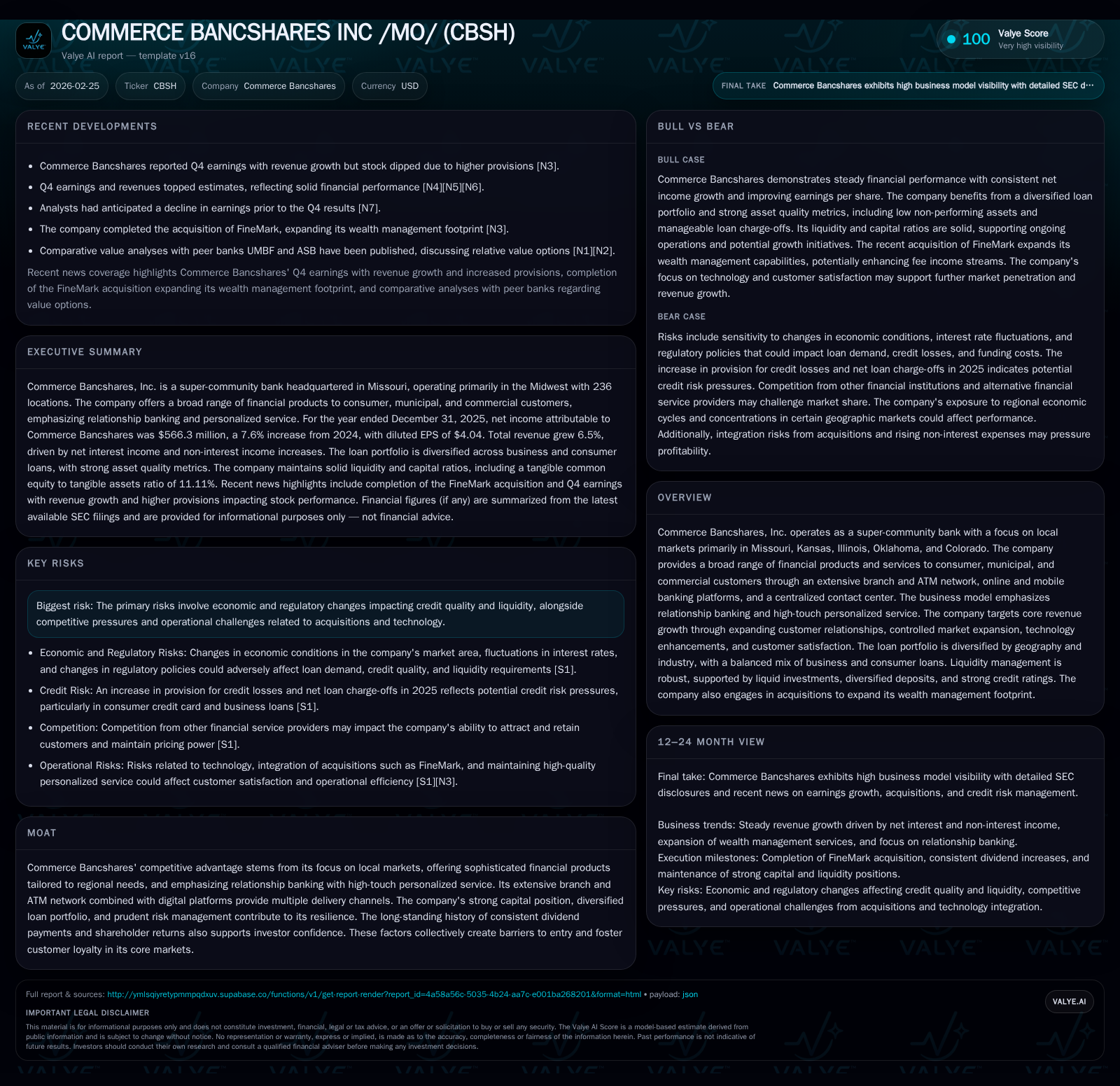
In 2025, Commerce Bancshares Inc. (CBSH) recorded a 7.6% increase in net income to $566 million, driven primarily by expanding business and consumer loan portfolios and growth in core deposits. The bank’s localized super-community model focuses on relationship banking across several Midwestern states, with a balanced mix of commercial and consumer loans. Despite rising provisions for credit losses due to higher charge-offs in select categories, CBSH maintained robust asset quality, liquidity, and capital adequacy. Its capital allocation priorities continue to balance dividend growth and active share repurchases amid a stable funding base and sound risk management. Going forward, growth prospects hinge on controlled market expansion, technology adoption, and navigating credit risk in a competitive regional environment.
Overview
Commerce Bancshares Inc. operates as a super-community bank concentrated mainly in Missouri, Kansas, Illinois, Oklahoma, and Colorado, delivering comprehensive financial products via an extensive branch network complemented by digital platforms [S1]. The company's competitive advantage lies in localized market focus combined with relationship-driven personalized service, allowing it to maintain loyal client bases despite regional competition.
As of December 31, 2025, Commerce operated approximately 236 branches coupled with ATMs serving consumers, municipalities, and commercial clients [S1]. This broad presence supports its diverse loan portfolio which balances consumer finance with substantial business lending.
Historical Performance and Growth Drivers
Commerce’s net income grew from $526 million in 2024 to approximately $566 million in 2025—a solid 7.6% increase derived largely from core activities [F1][S1]. Diluted earnings per share also advanced nearly 10%, indicative of both operational growth and capital efficiency.
Revenue drivers included a noticeable lift in net interest income (+$71.6 million) attributable to higher yields on investment securities alongside disciplined deposit cost controls [S1]. Non-interest income meanwhile grew $36.7 million thanks to increased trust fees and deposit account charges offsetting some declines in card-related fees.
On the loan front, average business loans increased by roughly $386 million (+6.4%), prominently led by commercial & industrial loans along with corporate card balances [S15]. Consumer lending exhibited more nuance: declines were seen in auto loans and personal real estate loans while fixed-rate home equity lines expanded moderately.
Deposit balances grew steadily with core deposits (non-interest bearing plus interest checking/savings accounts) rising by approximately $348 million to $23.25 billion at year-end—supporting more than 90% of total deposits [S10][S11]. The loan-to-deposit ratio remained conservative near 70%, underscoring prudent liquidity management.
Despite these expansions, provision for credit losses edged up by about $1.8 million when compared to the prior year due mostly to elevated charge-offs within auto loans and credit cards but remained consistent relative to total loans at approximately .23% annualized charge-off rate [S1][S21]. Non-performing assets continued to hold at very low levels around .10% of loans outstanding.
Incremental operating expenses reflected increases primarily from compensation (salaries & benefits), professional services fees, technology support costs tied to payments systems, and legal expenses—all partially offset by savings from lower deposit insurance charges [S1][S13].
Annual Financial Summary
Historical performance (annual)
| FY | Rev | Net ($mm) | CFO ($mm) | Capex ($mm) | Net YoY |
|---|---|---|---|---|---|
| 2025 | 0 | 566 | 645 | 53 | +7.6% |
| 2024 | 0 | 526 | 578 | 46 | +10.3% |
| 2023 | 0 | 477 | 489 | 88 | -2.3% |
| 2022 | 0 | 488 | 559 | 65 |
Note: Omitted columns lack sufficient annual XBRL coverage in the provided tags (need ≥2 annual points): OpInc. Source: SEC companyfacts cache [F1].
Capital returns and efficiency (annual)
| FY | Div ($mm) | Buybacks ($mm) | FCF ($mm) |
|---|---|---|---|
| 2025 | 150 | 208 | 592 |
| 2024 | 145 | 170 | 532 |
| 2023 | 76 | 401 | |
| 2022 | 187 | 494 |
Source: SEC companyfacts cache [F1].
Note: Revenue figures are not available from provided tags; operating income is also not reported in XBRL data.
Business Segments Analysis
Commerce organizes its operations into three principal segments: Retail Banking (formerly Consumer), Commercial Banking, and Wealth Management [S6][S7].
- Retail Banking experienced pressure on pre-tax income driven by lower net interest income due to decreased allocated funding credits despite some increase in loan interest income; non-interest income declined slightly due to reduced card fees while expenses rose mainly due to technology investments [S21].
- Commercial Banking showed steady growth supported by increased business lending including corporate card products; improved net interest margins were achieved through lower deposit funding costs; this segment also includes the Commercial Tradable Products division focused on bond underwriting and securities safekeeping [S13][S26].
- Wealth Management contributed through trust fees and asset-based revenues aided by expanding client relationships though detailed segment financials remain undisclosed beyond aggregate data [S7].
Capital Structure & Liquidity Positioning
The Company maintains strong capital metrics well above regulatory minimums: Tier I leverage ratio near 12.65%, Tier I common risk-based capital ratio above 17%, total risk-based capital exceeding 18%, providing resilience against economic stress scenarios [S18][S14].
Liquidity is robust with highly liquid assets totaling approximately $12.7 billion including Federal Reserve balances (~$2.7 billion), resale agreements ($850 million), and available-for-sale debt securities exceeding $9 billion that carry high-quality collateral but reflect unrealized losses linked primarily to mortgage-backed securities given current rate environments [S8][S10][S22].
Approved unsecured lines of credit amount to roughly $4.3 billion offering flexibility while borrowings principally comprise federal funds purchased ($129 million) and repurchase agreements ($2.86 billion), fully collateralized with investment securities [S5][S9][S29]. Core deposits represent over 90% of total deposits underpinning funding stability despite a moderate decline (~$0.8 billion) in uninsured deposits largely attributed to corporate client fluctuations year-over-year [S9][S29].
Foreclosed assets remain minimal (~$17 million), reflecting strong asset quality controls [S1]. The loan portfolio is geographically diversified across multiple sectors such as manufacturing, retailing, agribusiness reducing concentration risks effectively [S12][S26].
Capital Allocation & Shareholder Returns
During fiscal year ending December 2025:
- Cash dividends paid totaled approximately $150 million representing a nearly 7% increase over prior year dividends paid; payout ratio stands just below 26% based on net income levels signaling balanced return of capital policy aligned with earnings outlook [F1][S18].
- Treasury stock repurchases totaled about $208 million corresponding with about 3.6 million shares bought back under Board-authorized programs aiming at enhancing shareholder value amid steady earnings growth dynamics [F1][S18].
Growth Prospects & Risks
Drivers:
- Controlled geographic expansion within core markets combined with cross-selling opportunities leveraging ongoing technology enhancements is expected to underpin incremental revenue growth trajectories [N2][N3][N4][S1].
- Growth of fee-based services particularly within wealth management alongside increasing deposit balances diversifies revenue sources beyond traditional net interest margin components [S13][N2].
- Enhancement or introduction of digital payment solutions could further bolster non-interest income streams.
Constraints:
- Macroeconomic volatility including rising interest rates may pressure corporate deposit levels as clients seek alternative yields potentially impacting funding mix beyond stable retail deposits base [S20][N1].
- Elevated provisions for credit losses driven by stress signs in consumer loan segments like auto loans require ongoing disciplined underwriting; local economic downturns could exacerbate credit risk despite currently low non-performing asset ratios [N1][N5][S24].
- Regulatory changes affecting liquidity or capital buffers might restrict dividend policies or share buyback programs constraining capital deployment options.
Monitoring Points & Forward-Looking Considerations (Analysis)
Investors should track quarterly developments in:
- Net interest margin trends influenced by evolving interest rate environments impacting yields on sizable debt securities portfolio alongside deposit cost dynamics.
- Credit quality indicators including allowance adequacy relative to charge-off patterns especially within consumer segments exhibiting recent provision increases.
- Fee revenue growth rates within wealth management versus potential declines in transactional banking fees.
- Share repurchase activity relative to Board authorizations signaling management confidence or caution on valuation.
- Technology investments announcements enhancing digital capabilities aligned with omnichannel customer engagement strategies.
Conclusion
Commerce Bancshares continues delivering steady regional bank performance through consistent loan and deposit growth combined with prudent risk management yielding improved earnings results for fiscal year ended December 2025. Strong capitalization supports resilience amid rising credit costs while its moat rooted in local market expertise fortified by personalized relationship banking remains a key differentiator against larger national competitors focused on scale rather than service quality. Careful observation of macroeconomic trends affecting credit quality alongside execution on strategic initiatives like technology modernization will be critical for sustaining long-term growth beyond immediate financial outcomes.
This analysis is based solely on publicly available data from SEC filings through February 24, 2026 ([F1], [S#]) and relevant news sources ([N#]). It does not constitute investment advice or recommendations.
Disclaimer: This is research-only, informational analysis and not investment advice. It may include AI-generated interpretation and general industry context. Always verify important details using primary sources.

Comments