
Capital City Bank Group’s Regional Banking Model Sustains Growth Through Interest Margin and Diverse Fee Streams
Q2 2026 results highlight steady profitability driven by net interest income and mortgage banking amid a community-focused model operating in Florida, Georgia, and Alabama.
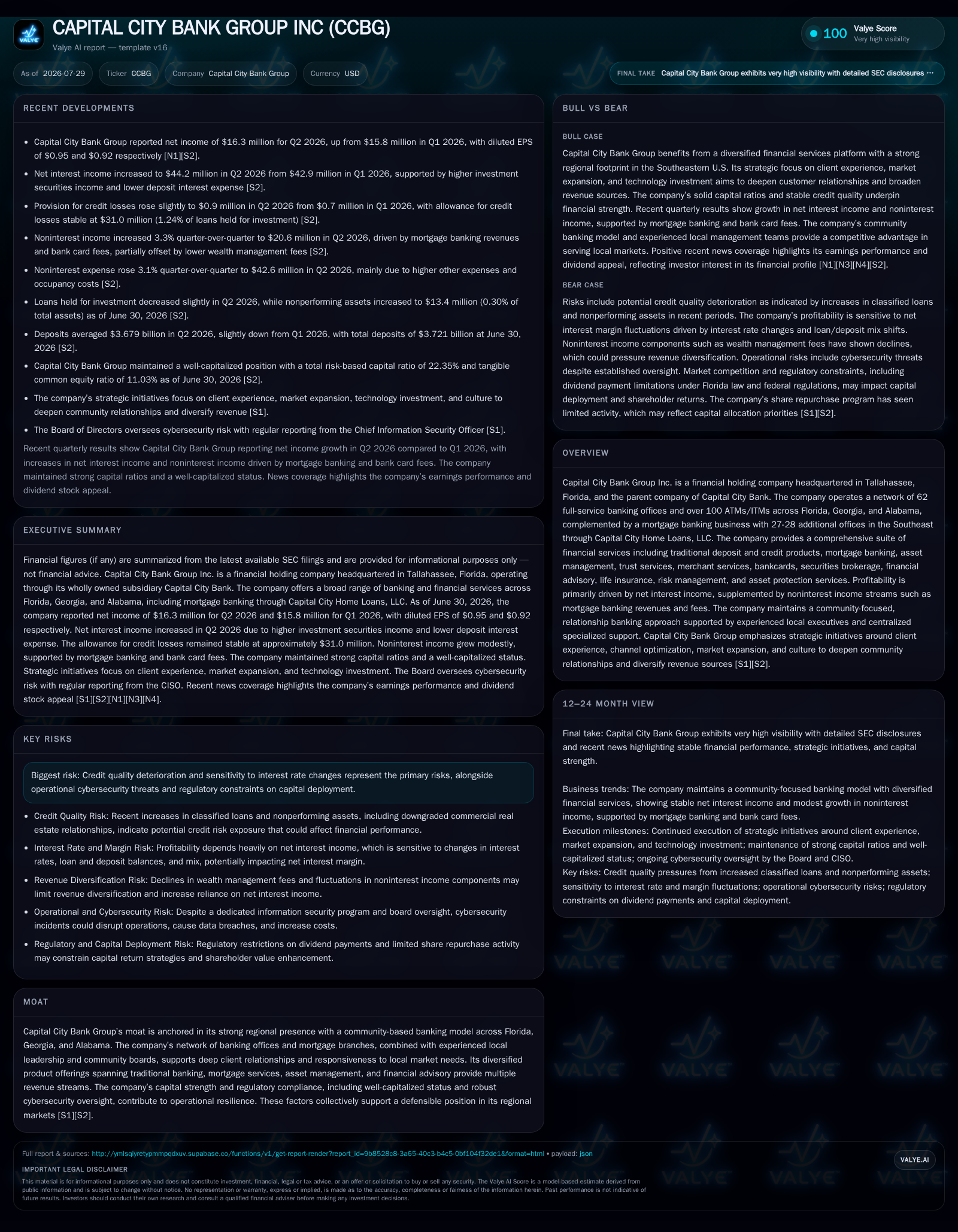
Capital City Bank Group Inc. (CCBG) reported a solid Q2 2026 with income tax expense stable at $5.0 million and liquidity supported by a high-quality investment portfolio of government and municipal debt securities. The bank operates a network of 62 branches and nearly 110 ATMs/ITMs, supplemented by mortgage offices in the Southeast, enabling diversified revenue from traditional deposit and credit products as well as mortgage banking, asset management, and advisory services. Its strong regional presence underpins deep client relationships while net interest income remains the primary profitability driver. Key risks include credit quality sensitivity and interest rate volatility. The company’s capital and liquidity profiles remain sound with contingency plans for stress scenarios.
Recent Operating Update
Capital City Bank Group Inc. (CCBG) reported steady financial results for Q2 2026, with income tax expense holding at $5.0 million and an effective tax rate of 23.4%, consistent with prior quarters and year-ago periods [S2]. This stability underscores ongoing profitability within its core banking operations. The company’s liquidity position remains robust, with approximately $1.721 billion available through contingent sources beyond the $413 million overnight funds balance. These sources include federal funds purchased lines, Federal Home Loan Bank borrowings, brokered deposits, and access to the Federal Reserve Discount Window. Additionally, CCBG’s investment portfolio—comprised primarily of U.S. Treasury securities, government agencies, municipal debt, and corporate bonds—can be pledged as collateral or sold to support liquidity needs, providing flexibility to manage funding under stress scenarios [S2]. A recent Form 8-K filing included an investor presentation update but did not materially alter operational guidance or introduce new risks [S3].
This quarter’s results reflect operational resilience supported by a diversified funding base and high-quality liquid assets, which together underpin regulatory capital compliance and balance sheet flexibility essential for loan growth and deposit management.
Business Model Overview
Capital City Bank Group operates as a regional banking holding company headquartered in Tallahassee, Florida, with its primary subsidiary, Capital City Bank, delivering traditional community banking services. The bank’s product suite includes retail and commercial deposit accounts, a diversified loan portfolio spanning commercial and industrial loans, consumer loans, residential mortgages, and construction loans [S1][S2]. Mortgage banking is conducted through Capital City Home Loans LLC (CCHL), which operates approximately 27 offices across the Southeastern U.S., focusing on mortgage originations and servicing to meet homeowner credit demand [S1].
Beyond lending and deposits, CCBG offers asset management, trust services, securities brokerage, financial advisory, life insurance products, risk management consulting, merchant services, and bank card products, generating diversified noninterest income streams. This multi-product approach helps mitigate reliance on net interest income, which remains the primary revenue driver. Net interest income arises from the spread between yields on loans and securities versus the cost of deposits and borrowings, typically accounting for roughly two-thirds or more of total revenues in regional banks like CCBG.
The bank’s physical footprint includes 62 full-service branches concentrated in Florida, with additional presence in Georgia and Alabama, supported by a network of over 100 ATMs and interactive teller machines (ITMs) [S1]. This branch network facilitates deep local client relationships, a key competitive advantage in community banking, enabling personalized service and cross-selling opportunities.
Capital allocation focuses on maintaining an optimal loan-to-deposit ratio to balance net interest margin optimization against credit risk exposure. Compared to larger national banks such as Wells Fargo or Truist Financial, CCBG leverages localized underwriting and decision-making tailored to regional economic conditions and niche commercial sectors.
Industry Structure and Competitive Position
Within the U.S. regional banking landscape, Capital City Bank Group competes with peers such as Regions Financial Corporation, Synovus Financial Corp, and Fifth Third Bancorp, which share similar Southeastern U.S. footprints and diversified financial service offerings. These peers also balance net interest margin pressures with fee income diversification strategies.
Regional banks like CCBG differentiate themselves through community engagement and branch network presence, which support underwriting quality and customer loyalty. The branch network scale at CCBG is sufficient to achieve operational efficiencies while preserving local discretion critical for credit decisions aligned with regional economic drivers.
Mortgage banking via CCHL is a strategic revenue enhancer, benefiting from purchase originations tied to population growth in Florida and Georgia, as well as refinance activity when interest rates stabilize or decline. However, this segment remains sensitive to interest rate volatility and Federal Reserve policy shifts, which influence mortgage demand nationally.
Efficiency metrics such as the efficiency ratio (operating expenses to total revenue) are closely monitored to manage branch operating costs amid wage inflation and to fund technology investments that improve customer experience and operational resilience.
Cybersecurity is a material focus area, with CCBG’s Corporate Security Department led by a Chief Information Security Officer (CISO) possessing over 15 years of experience in financial sector cybersecurity risk management. The department oversees risk assessment, defense operations, incident response, and compliance, with regular reporting to senior management and the board, reflecting the institution’s commitment to mitigating cyber threats [S1].
Growth Drivers
Capital City Bank Group’s growth prospects are supported by several factors:
- Loan and Deposit Expansion: Leveraging strong community ties to attract small and mid-sized business credit demand within its regional footprint, reducing competitive pressure from national banks.
- Mortgage Banking Growth: Expansion of CCHL’s office network and favorable demographic trends in Southeastern states drive increased mortgage originations and servicing fee income.
- Fee Income Diversification: Growth in wealth management and financial advisory services enhances recurring fee revenue and cross-selling opportunities, providing earnings stability amid loan portfolio cyclicality.
- Net Interest Margin Management: Effective management of interest rate sensitivity to capture favorable spread dynamics when short-term funding costs lag loan yield adjustments.
- Technology Investments: Enhancements in digital platforms and branch technology improve client experience and operational efficiency, supporting retention and competitive positioning against fintech entrants.
- Capital Adequacy: Maintaining regulatory capital buffers enables opportunistic dividend payments and supports organic growth or strategic acquisitions within core markets.
Risks and Watchpoints
Key risks and monitoring points include:
- Credit Quality: Economic downturns could elevate loan loss provisions, particularly in commercial and construction loan segments sensitive to cyclical pressures [S1]. Monitoring nonperforming assets and net charge-offs is critical.
- Interest Rate Volatility: Rapid increases in deposit costs relative to loan yields could compress net interest margins, while rate declines may reduce loan pricing power and revenue growth.
- Regulatory Capital Constraints: Compliance with capital adequacy requirements may limit leverage capacity and influence growth strategies.
- Cybersecurity Threats: Persistent cyber risks necessitate ongoing investment; material breaches could disrupt operations and damage reputation [S1].
- Operational Costs: Rising labor and branch network expenses may pressure efficiency ratios if not offset by revenue gains.
- Competitive Pressure: Fintech and digital-only lenders pose challenges for younger demographics, though CCBG’s community banking model and physical presence provide some insulation.
What to Watch Next
Investors and analysts should monitor:
- Quarterly net interest margin trends relative to Federal Reserve policy shifts to assess spread dynamics.
- Provision for credit losses and nonperforming asset ratios as indicators of credit quality trends.
- Mortgage origination volumes and fee income from CCHL to gauge sustainability of noninterest revenue.
- Efficiency ratio developments reflecting cost management and technology investment impacts.
- Utilization of contingent liquidity sources signaling balance sheet resilience amid economic uncertainty.
- Board commentary on capital management and dividend policy reflecting financial flexibility.
Financial Profile Discussion
As of June 30, 2026, CCBG reported liquidity sources totaling approximately $1.721 billion, excluding an overnight funds position of $413 million, drawn from diverse borrowing facilities and brokered deposits [S2]. The investment portfolio, dominated by U.S. Treasury and government agency securities alongside municipal and corporate debt, serves as a high-quality liquidity buffer that can be pledged or sold to meet funding needs [S2].
While current total debt figures are limited beyond historical data showing nominal debt near $314,000 as of December 2023 [F1], the company’s stable effective tax rate around 23.4% across recent quarters evidences consistent profitability [S2]. Operating expenses remain aligned with revenue growth, with ongoing investments in cybersecurity and technology overseen by experienced leadership and board committees [S1][S2].
Overall, Capital City Bank Group maintains disciplined balance sheet management, supporting sustainable growth within its regional markets while preserving capital and liquidity buffers to withstand external shocks typical for mid-sized regional banks.
Disclaimer: This analysis is for informational purposes only and does not constitute investment advice. All data and statements are based on publicly available filings and documents as cited.
Disclaimer: This is research-only, informational analysis and not investment advice. It may include AI-generated interpretation and general industry context. Always verify important details using primary sources.

Comments