
Cardiff Lexington: Extended Receivable Cycles, Niche Healthcare Ambitions, and the Realities of Cash Flow Strain
Cardiff Lexington Corp’s strategy of acquiring plaintiff-focused orthopedic clinics in the Southeast exposes the company to long receivable cycles, ongoing losses, and liquidity pressures. The business model’s dependence on legal settlement timing and external financing defines both its upside potential and its acute risks.
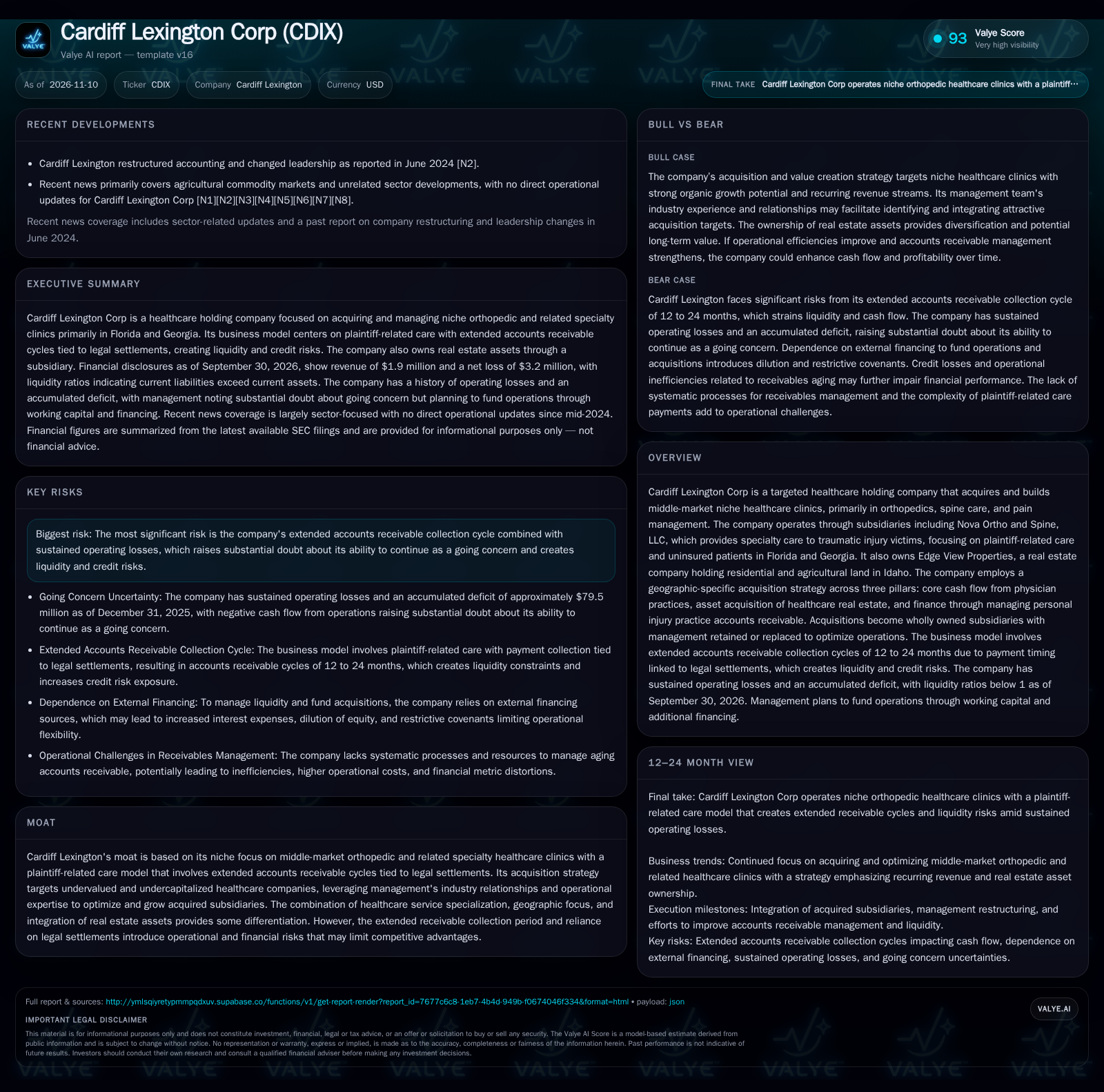
Cardiff Lexington Corp operates as a healthcare holding company specializing in the acquisition and management of niche orthopedic and pain clinics, primarily serving traumatic injury victims whose care is tied to legal settlements. As of September 30, 2026, the company reported $1.9 million in revenue and a net loss of $3.2 million, with current liabilities exceeding current assets and a cash ratio of just 0.02. With an accumulated deficit of $79.5 million and ongoing operating losses, management has expressed substantial doubt about the company’s ability to continue as a going concern. The extended 12–24 month collection cycle on receivables is the central business risk, driving reliance on external financing and complicating efforts to scale or stabilize the platform. Future performance depends on Cardiff Lexington’s ability to accelerate cash generation, improve operational execution, and secure additional funding.
Cardiff Lexington Corp’s acquisition-driven healthcare strategy is built around the consolidation of niche orthopedic and pain management clinics—primarily targeting plaintiff-related care where payment is often delayed until legal cases are resolved. This approach exposes the company to unusually long collection cycles, which, combined with sustained operating losses and a highly leveraged balance sheet, leaves Cardiff Lexington at a financial crossroads. The company’s future hinges on its ability to either accelerate cash conversion from receivables, achieve operational turnaround, or secure sizable new funding to underwrite its ambitions.
Recent Financial Snapshot Reveals Persistent Losses and Liquidity Pressure
As of September 30, 2026, Cardiff Lexington reported revenue of $1.9 million and a net loss of approximately $3.2 million for the first nine months of the year [S2]. The company’s current assets ($24.2 million) are outstripped by current liabilities ($28.5 million), resulting in a current ratio of 0.85 and a cash ratio of 0.02 [S2]. Management has noted substantial doubt about the company’s ability to continue as a going concern, given its accumulated deficit of $79.5 million and recurring negative cash flow from operations [S2]. These facts underscore the company’s acute dependence on external funding and the urgent need to improve cash conversion from its core healthcare operations.
How Extended Receivable Cycles Define Cardiff Lexington’s Economic Model
Cardiff Lexington generates revenue primarily from specialty orthopedic and pain management clinics serving traumatic injury victims, many of whom are plaintiffs in legal cases. Payment for services is typically tied to the settlement of these legal cases, creating a structural lag in cash collection that can last 12 to 24 months [S2]. This extended cycle means revenue recognized today may not translate into cash inflows for up to two years, creating persistent working capital strain and heightening liquidity risk.
The company’s three-pronged acquisition strategy—buying physician practices for cash flow, acquiring healthcare real estate, and financing through management of personal injury receivables—relies on integrating new clinics and extracting operational efficiencies. However, the need to finance long-dated receivables, support acquired clinics, and cover corporate overhead creates a high fixed-cost base with little short-term flexibility. This model amplifies operating leverage in both directions: successful receivables recovery and steady patient volume could eventually drive margin expansion, but any slowdown in settlements or increase in credit losses could rapidly erode financial stability.
The real estate subsidiary, Edge View Properties, provides some asset diversification, but with no current development plans, it does not contribute to near-term liquidity or earnings [S2]. Overall, Cardiff Lexington’s economics are capital-intensive and vulnerable to timing mismatches between revenue recognition and cash realization.
Specialization and Geographic Focus Offer Differentiation—But Do Not Eliminate Structural Risks
Cardiff Lexington’s competitive positioning is built on targeting middle-market, undercapitalized orthopedic and specialty clinics in Florida and Georgia. By focusing on plaintiff-related care and uninsured patients, the company addresses a less crowded segment of the healthcare market, where large hospital systems and national clinic chains may have less presence.
This niche focus, combined with management’s industry relationships, could facilitate access to attractive acquisition targets and enable operational improvements post-acquisition. However, the business model’s dependence on legal settlements for cash flow is not unique and is shared by other plaintiff-care-oriented providers. Competitors with stronger balance sheets or more efficient receivables management may be better positioned to weather the inherent cash flow volatility.
Further, the lack of a systematic, technology-driven process for managing aging receivables could limit Cardiff Lexington’s ability to scale relative to larger or more digitally enabled peers. Substitution risk also exists: alternative care providers, direct-pay clinics, or evolving insurance/payment models could encroach on the addressable market for plaintiff-related care if reimbursement practices shift.
If Receivables Acceleration and Operational Efficiency Take Hold, Cash Flow Could Turn
A favorable scenario for Cardiff Lexington would see the company materially improve its receivables management—reducing the average collection cycle closer to the lower end of the 12–24 month range or even below. This could occur via process automation, more aggressive legal follow-up, or selective factoring of receivables to accelerate cash conversion (albeit at some discount).
If operational integration of acquired clinics yields cost synergies and higher patient throughput, Cardiff Lexington could see positive operating leverage, with cash flows eventually outpacing fixed costs. An improvement in the legal settlement environment, such as faster case resolution or more predictable outcomes, would also support this outcome.
Concrete evidence confirming this upside would include a sequential reduction in days sales outstanding (DSO), improved operating cash flow, and a narrowing of net losses. Announcements of new financing on favorable terms or asset sales at attractive valuations would further reduce going concern risk and provide capital for growth.
Operating Under Strain: Incremental Progress but Continued Reliance on External Funding
In the most likely near-term scenario, Cardiff Lexington continues to operate under liquidity strain, with incremental improvements in receivables collection offset by ongoing cash flow mismatches.
Operationally, Cardiff Lexington could achieve some efficiency gains through better integration of subsidiaries and gradual improvements in receivables follow-up, but the fundamental timing lag in plaintiff-related care payments remains. Real estate assets are likely to remain non-core and illiquid without a change in development plans or a sale event.
If Cash Conversion Falters or Financing Dries Up, Viability Is at Risk
The adverse scenario centers on a further deterioration in receivables collections—due to slower legal settlements, increased credit losses, or operational missteps—combined with an inability to secure new external financing. Under these conditions, Cardiff Lexington could face acute liquidity shortfalls, leading to delayed payments to vendors, staff reductions, or forced asset sales at distressed prices.
A prolonged mismatch between recognized revenue and actual cash inflows could trigger covenant breaches on any existing debt or limit access to new capital. If operating losses persist and the company cannot bridge the gap through asset monetization or equity issuance, the risk of restructuring, bankruptcy, or liquidation increases.
Evidence supporting this downside would include rising days sales outstanding, worsening current or cash ratios, inability to close new financing rounds, and explicit warnings in filings about imminent liquidity shortfalls.
Developments That Will Determine Whether Cardiff Lexington Can Escape Its Cash Flow Bind
Trends in days sales outstanding (DSO) for healthcare receivables—if disclosed—would provide a direct measure of progress in accelerating cash conversion.
Operating cash flow reported in future SEC filings: a shift toward positive or less negative cash flow would signal improved business health.
Announcements of new debt or equity financing, especially on non-punitive terms, are critical for near-term viability.
Any material asset sales, particularly of real estate holdings, that could provide liquidity or reduce debt.
Changes in the legal settlement environment for plaintiff-related care—such as faster case resolution or regulatory shifts—would impact receivable cycles.
Integration milestones for newly acquired clinics, including cost synergies or revenue growth, would help test the roll-up thesis.
Disclosures around credit losses or write-offs on aging accounts receivable, which would indicate risk to recognized revenue.
Disclaimer: This is research-only, informational analysis and not investment advice. It may include AI-generated interpretation and general industry context. Always verify important details using primary sources.

Comments