
Clean Energy Technologies Faces Nasdaq Delisting Risk Amid Compliance Challenges
Nasdaq’s notice of non-compliance with quarterly filing deadlines raises near-term liquidity and market access concerns for Clean Energy Technologies, while its patented waste heat recovery and waste-to-energy technologies underpin a focused growth strategy in small to mid-sized international renewable projects.
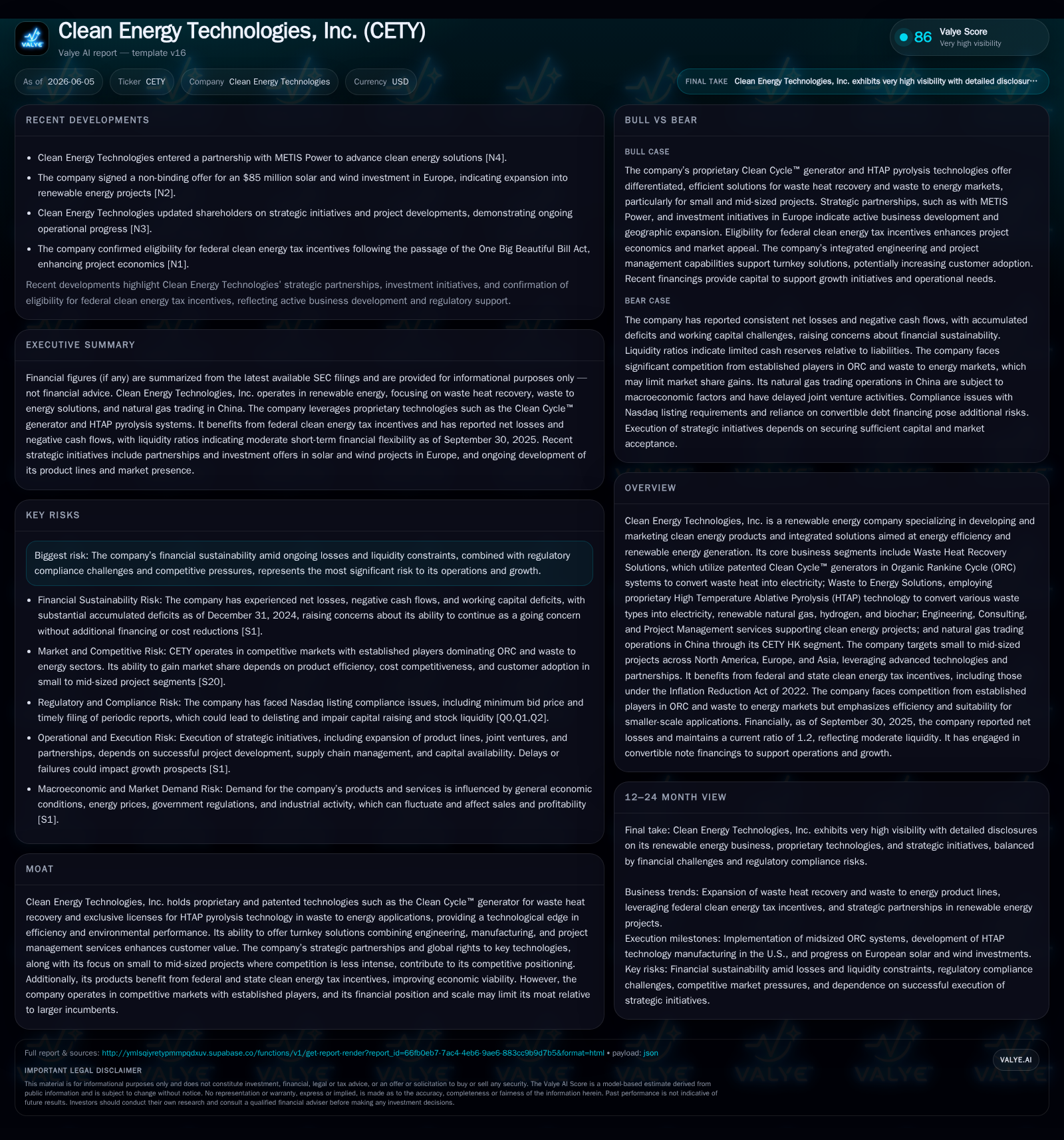
Clean Energy Technologies, Inc. recently received a formal notice from Nasdaq citing non-compliance due to delayed quarterly filings, exposing the company to delisting risks that could impair liquidity and financing capabilities [S3]. Despite financial headwinds including ongoing losses and limited working capital, the company operates a differentiated business model centered on patented Clean Cycle™ generators for industrial waste heat recovery and exclusive High Temperature Ablative Pyrolysis (HTAP) technology for waste-to-energy conversion [S1]. Its strategic focus on small to mid-sized projects across North American, European, and Asian markets leverages advanced technologies and turnkey engineering services, complemented by natural gas trading ventures in China [S1]. The juxtaposition of regulatory uncertainty against promising technology-driven growth potential defines the company’s near-term trajectory.
Nasdaq Compliance Notice: Immediate Regulatory and Liquidity Concerns
On May 26, 2026, Clean Energy Technologies, Inc. received a formal notice from Nasdaq’s Listing Qualifications Department indicating non-compliance with Nasdaq Listing Rule 5250(c)(1) due to failure to file its Quarterly Report on Form 10-Q for the quarter ended March 31, 2026 [S3]. This non-compliance triggers a delisting threat that carries material consequences: reduced liquidity and depressed market price of the common stock, diminished investor interest, impaired ability to raise equity financing, and restricted access to public capital markets through registration statements. The company is reportedly working diligently to resolve this compliance issue but faces an urgent short-term operational risk that conditions its capacity for strategic execution.
This filing delinquency underscores underlying financial pressure points. The Nasdaq notice is therefore not merely procedural but reflects intertwined issues that could constrain liquidity needed for operational continuity.
Core Technologies and Product Suite: Clean Cycle™ Generators and HTAP Pyrolysis
At the heart of Clean Energy Technologies’ value proposition lies two proprietary technology platforms driving its revenue streams:
Clean Cycle™ Generators: These Organic Rankine Cycle (ORC) systems convert industrial waste heat—often discarded as thermal energy at manufacturing plants or power generation facilities—into usable electricity which can be stored or sold back to the grid. As of the latest filings, over 123 units have been deployed globally comprising applications such as biomass/waste-to-energy projects (88 units), diesel electric generation (4 units), turbine electric generation (3 units), and industrial power production (26 units) [S1]. This track record evidences scalable utilization of patented generator technology delivering operational efficiency gains.
Waste to Energy Solutions using HTAP: The company holds exclusive rights for High Temperature Ablative Pyrolysis technology which processes diverse waste inputs—including agricultural residues and wastewater treatment plant outputs—into multiple forms of clean energy: electricity, renewable natural gas (RNG), hydrogen fuel, and biochar. This multi-product suite addresses increasing environmental regulations pushing circular economy solutions while offering customers diversified energy outputs tailored to their needs.
Complementing these core tech products is an Engineering, Procurement, and Construction (EPC) service offering that provides turnkey project design, consulting, and management solutions enabling industrial clients and municipalities to implement clean energy installations seamlessly. Such end-to-end solutions add switching cost advantages and improve client retention prospects.
Market Focus: Small to Mid-Sized Project Strategy Across Global Regions
Unlike large-cap renewable players who primarily target utility-scale infrastructure projects exceeding hundreds of megawatts, Clean Energy Technologies concentrates on smaller scale projects primarily situated in North America, Europe, and Asia. This segmentation includes:
- Industrial customers seeking onsite efficiency improvements via waste heat reclamation.
- Municipalities requiring cost-effective waste-to-energy conversions aligned with sustainability goals.
- Agricultural sectors generating biomass residues suitable for pyrolysis conversion.
This focus enables the company to avoid head-to-head competition dominated by incumbent energy giants while addressing fragmented markets underserved by large-scale project finance models. Geographically, regulatory frameworks such as federal/state tax incentives in the US/EU support investments in small clean energy projects; similarly in China—where CETY HK operates—it benefits from government policies encouraging natural gas adoption alongside renewables infrastructure expansion particularly in provinces like Sichuan and Yunnan [S1].
Competitive Dynamics: Patents, Partnerships, and Market Penetration
Clean Energy Technologies’ competitive moat derives fundamentally from its exclusive technological IP rights:
- The Clean Cycle™ generator patent portfolio provides technical differentiation through enhanced efficiency in ORC-based waste heat reclamation compared with standard thermoelectric methods prevalent among competitors.
- Licensing agreements for HTAP pyrolysis technology grant strategic market entry especially in China—a critical region given its massive industrial base coupled with stringent emissions regulations.
Strategic partnerships amplify reach beyond pure technology sales by incorporating engineering services that bundle design-build-operate capabilities under single contracts—a value proposition appealing to smaller customers lacking internal expertise. Pricing power appears modest but benefits from federal/state tax incentives that improve project economics relative to competitors reliant solely on capex-intensive fuel switching.
However, despite these advantages there are challenges related to scale. Larger incumbents command deeper balance sheets enabling aggressive pricing or long-duration contracts; meanwhile Clean Energy Technologies’ relatively limited installed base (~123 generators) suggests constrained capacity utilization versus major OEMs in industrial heat recovery or traditional energy firms diversifying into waste-to-energy segments [S1]. Its niche targeting partly mitigates this but also caps addressable market size absent rapid installation pace acceleration.
Growth Drivers: Scaling Installations, Expanding Waste-to-Energy Demand, and Chinese Natural Gas Ventures
Growth prospects hinge on multiple trajectories:
- Increasing Installation Volume: Currently operating at a steady installation pace of approximately 6-8 Clean Cycle™ units per year with plans supported by fundraising efforts aiming to roughly double annual sales volumes moving forward [S1]. Scaling unit deployment reflects meaningful leverage over fixed manufacturing overheads improving margin profiles as volume grows.
- Expanding Waste Feedstock Applications: Heightened regulatory focus on circular economy principles combined with increasing industrial/agricultural waste streams expands addressable opportunity sets for HTAP pyrolysis systems producing RNG/hydrogen/biochar. These markets exhibit structural growth trends benefiting from decarbonization policies globally.
- Natural Gas Trading in China: CETY HK segment leverages procurement advantage by sourcing bulk natural gas at fixed prepaid prices typically below prevailing spot rates then selling on daily spot price contracts primarily targeting heavy-duty truck refueling stations plus urban/industrial consumption hubs. This commoditized vertical offers recurring revenue flows that partially offset volatility inherent in project-based EPC margins [S1,S3].
Key performance indicators linked directly include unit installation counts demonstrating tangible uptake; project backlog size reflecting contracted pipeline; operating losses trending down evidencing improving operational leverage; plus natural gas trading volume metrics assessing contribution stability.
Risks Ahead: Financial Sustainability and Regulatory Challenges
Despite technological promise there are substantial risks:
- Nasdaq delisting risk stemming from recent filing delays directly impacts equity market presence potentially reducing investor confidence further complicating capital raise efforts vital for scaling installation capacity.
- Regulatory compliance burdens extend beyond SEC filings into evolving energy sector policies which could affect permitting timelines or subsidy availability adversely influencing project economics.
- Competitive pressures from larger players possessing broader product portfolios may intensify pricing competition or erode market share especially if Clean Energy Technologies cannot sufficiently accelerate scale economies.
Collectively these risks represent key watchpoints threatening growth continuity absent proactive mitigation through financing strategies or partnership expansions.
What to Watch Next: Quarterly Filing Progress, Financing Efforts, and Project Pipeline Milestones
Near term developments critical for assessing trajectory include:
- Completion and filing of overdue Quarterly Report(s) restoring Nasdaq compliance status removing imminent delisting threat [S3].
- Announcements relating to capital raises including equity financings or strategic alliances potentially easing liquidity crunch allowing accelerated unit installation rollout [S3,S1].
- Contract awards or EPC project completions signaling commercial traction validating market acceptance beyond current order book.
- Operational metrics such as improved loss from operations reflecting efficiency gains supporting longer term viability.
Monitoring these indicators will clarify whether Clean Energy Technologies can translate its patented technology advantages into sustainable commercial performance amid ongoing financial headwinds.
This analysis synthesizes official SEC filings dated May 29 and June 5, 2026 ([S3],[S1]) without conjecture beyond provided data. It aims to provide a nuanced appraisal of Clean Energy Technologies’ current operational challenges alongside its distinctive technological positioning within the renewable energy sector.
Disclaimer: This is research-only, informational analysis and not investment advice. It may include AI-generated interpretation and general industry context. Always verify important details using primary sources.

Comments