
Capitol Federal Financial's Strategic Shift to Commercial Banking Powers Growth and Stability
Capitol Federal Financial, Inc. is transforming from a retail savings institution into a competitive commercial bank with strong asset quality and prudent capital management.
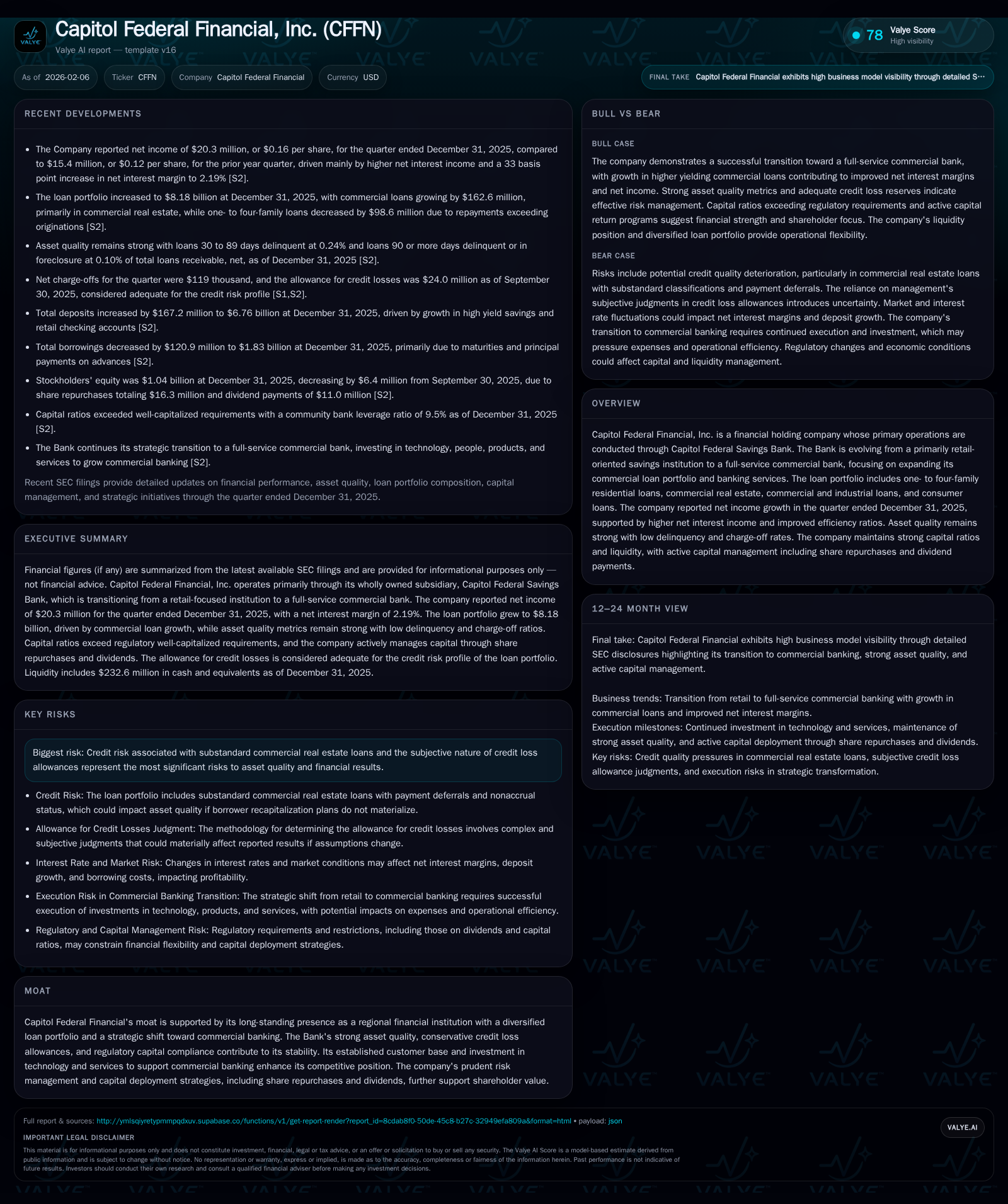
Capitol Federal Financial, Inc. (CFFN) has been methodically evolving its business model from a retail-focused savings bank toward full-service commercial banking, leveraging its diversified loan portfolio and disciplined risk management. The company has reported solid net income growth supported by rising net interest margins driven by the expanding commercial loan book. Despite subtle credit risks primarily linked to commercial real estate exposures, Capitol Federal maintains strong asset quality and regulatory capital ratios. Its liquidity position remains robust with established borrowing capacity, while shareholder value is bolstered through consistent dividends and opportunistic share repurchases. Concurrent investments in cybersecurity and technology underpin both operational resilience and future competitive differentiation.
Navigating the Path: Capitol Federal's Evolution Toward Commercial Banking
Founded as a traditional retail savings institution, Capitol Federal Financial, Inc. has embarked on a deliberate transformation to evolve into a full-service commercial bank. Historically anchored in one- to four-family residential lending aimed at community customers, the company is broadening its focus toward an expanded suite of commercial banking products that encompass commercial real estate (CRE), commercial and industrial (C&I) loans, as well as consumer financing options. This pivot reflects management’s strategic intent to capture higher-yielding assets while fostering long-term franchise growth beyond the constraints of retail lending’s relatively compressed margins [valye_report_excerpt][S2].
During the quarter ended December 31, 2025, CFFN reported notable progress indicative of this shift: net income increased by approximately 32% year-over-year driven largely by internal portfolio mix changes favoring commercial loans with stronger yields. The company’s efficiency ratio improved markedly as investments in technology and operational infrastructure began realizing benefits through streamlined servicing of new loan categories [S2].
Management’s commentary underscores that the transition goes beyond mere loan composition; it entails systemic enhancements across talent acquisition, digital platforms, compliance frameworks, and product offerings designed to support sophisticated borrower needs intrinsic to commercial banking [valye_report_excerpt]. This holistic repositioning frames CFFN’s growth trajectory as both strategic and evolutionary rather than abrupt.
Expanding Commercial Loan Portfolio: The Engine of Growth
CFFN's financial results for Q4 2025 underscore the payoff from growing its commercial loan portfolio. The bank’s net interest margin (NIM) expanded by 33 basis points to 2.19%, fueled predominantly by yield accretion on higher-return commercial loans relative to traditional residential credit [S2]. This shift naturally leverages better pricing power and amortization profiles inherent in CRE and C&I lending segments compared with historically margin-compressed retail mortgages.
Portfolio segmentation data reveals that loans exceeding $15 million—primarily CRE—though fewer in count, represent significant aggregate balances contributing substantially to interest income [S1]. Smaller-sized loans in the $1–$5 million band notably exhibit strong debt service coverage ratios averaging over 9x for recent originations, reflecting conservative underwriting standards intended to mitigate default risk.
The overall loan book now presents a more balanced composition across asset classes without excessive concentration in any single category. This diversity not only supports revenue growth but also stabilizes earnings volatility linked with sector-specific downturns. Growth-oriented investments in staffing specialized credit officers and commercially tuned underwriting processes embed further resilience [valye_report_excerpt].
Strong Asset Quality Amid Subtle Credit Risks
Despite encouraging top-line trends, Capitol Federal maintains elevated vigilance on asset quality metrics owing to the nuanced risks associated with substandard credit exposures primarily within CRE loans [valye_report_excerpt][S1]. The delinquency profile remains impressively low: loans 30 to 89 days delinquent make up about 0.15% of total net receivables—a meaningful improvement versus prior year periods [S1]. Nonaccrual loans also maintain modest absolute levels; however, an uptick in recently downgraded participation CRE loans linked by relationship concentration warrants close monitoring.
The company's allowance for credit losses (ACL) methodology continues to be one of its most critical accounting estimates due to inherent subjectivity in projecting potential losses amid uncertain macroeconomic factors [S2]. Conservative provision buffers have historically shielded earnings during economic disruptions but require adaptable calibration in line with evolving portfolio risks.
Risk management teams employ detailed categorization of loan classifications from standard to substandard and monitor coverage adequacy regularly through audit committee oversight. Efforts include stress testing multiple downside scenarios incorporating market liquidity constraints impacting CRE valuation models [S1][S2].
This disciplined approach situates Capitol Federal well amidst broader economic uncertainties; nonetheless, the increasingly sizeable commercial exposures necessitate constant vigilance coupled with prompt corrective actions when warranted.
Capital and Liquidity: Managing Stability in Transition
Maintaining strong capital adequacy ratios constitutes a foundational pillar as Capitol Federal effectuates its strategic evolution [valye_report_excerpt][S1]. The firm's balance sheet reflects substantial cash and cash equivalents totaling approximately $233 million at year-end 2025 plus significant available-for-sale securities earmarked as collateral for borrowings.
Liquidity management operates within a robust framework blending daily oversight with forward-looking stress testing aligned to interagency guidelines. Key sources include deposits—primarily core customer funds—and access to secured borrowings through the Federal Home Loan Bank (FHLB). As of September 30, 2025, borrowings accounted for about 20% of total assets well below internal policy limits capped at 55%, providing ample headroom for funding flexibility [S1].
Importantly, management employs staggered maturities on amortizing advances from FHLB that allow early repricing advantages if rates decline while mitigating refinancing concentration risk. Additional fallback sources include occasional short-term lines from the Fed discount window or brokered certificates within conservative thresholds.
This multi-layered liquidity strategy ensures Capitol Federal can meet ongoing operational demands—including maturing liabilities like certificates of deposit expected within the coming year—and extend new credit without undue balance sheet strain accompanying its business model evolution.
Driving Shareholder Value: Dividends and Buybacks in Focus
Capital deployment at Capitol Federal balances growth investment priorities against returning value directly to shareholders through dividends and share repurchase programs [valye_report_excerpt][S2]. Dividend payments have remained stable reflecting confidence in recurring profitability even amid transitional expenses related to scaling commercial banking capabilities.
Stock repurchases during Q4 2025 were executed thoughtfully; nearly 2.4 million shares were bought back across three months at an average price near $6.86 per share. The program operates under a flexible open-market mandate subject to regulatory non-objection renewals annually via the FRB of Kansas City—a prudent approach aligning liquidity availability with market conditions [S2].
This steady capital return policy suggests management's commitment both to enhancing per-share metrics over time while preserving sufficient capital buffers necessary under heightened supervision resulting from strategic shifts.
Fortifying Cybersecurity in a Tech-Driven Banking Model
As Capitol Federal accelerates its transformation into a digitally enabled commercial bank, cybersecurity emerges as an unequivocal priority underpinning customer trust and operational continuity [S1].
The Bank deploys a multilayered cybersecurity defense model integrating administrative policies (training/awareness), technical safeguards (firewalls, intrusion detection systems, multi-factor authentication), vulnerability assessments, and incident response frameworks drawing upon leading industry standards including NIST Cybersecurity Framework and FFIEC guidance.
These controls are centrally managed across IT and Compliance & Risk Management functions staffed by certified professionals who work closely with external auditors to ensure continual improvement. Participation in information-sharing alliances such as the Financial Services Information Sharing and Analysis Center enables proactive threat intelligence exchange enhancing preparedness against emerging cyber threats [S1].
Regular mandatory employee training on phishing prevention signals awareness that human factors remain critical vulnerabilities. Robust incident response planning fosters quick escalation protocols enabling timely disclosure decisions balancing transparency with reputational considerations.
Overall, this comprehensive governance structure underscores cybersecurity not merely as compliance but rather a strategic enabler powering competitive differentiation through secure client-facing digital services.
Strategic Investments Fueling Competitive Moat Expansion
Capitol Federal Financial’s moat today rests on more than geographic proximity or legacy customer relationships; it has been fortified through targeted investments designed systematically around expanding full-service commercial banking capabilities [valye_report_excerpt][S2].
Technology upgrades facilitate efficient loan underwriting workflows while improving client engagement channels essential for sophisticated borrower demands typical among mid-sized businesses. Recruitment efforts focusing on credit specialists enhance underwriting rigor and sector expertise beyond historical retail tenure.
Simultaneously, product innovation broadens fee-generating capabilities alongside interest income streams enabling revenue diversification crucial for long-term sustainability amid fluctuating rate environments.
Together these elements create higher switching costs for customers while supporting scalable growth that can withstand competitive pressures. The company's demonstrated conservative risk appetite matched with superior service provisioning forms a layered moat difficult for new entrants principally targeting the same regional footprint.
Looking Ahead: Risks and Prudence in a Transforming Market
While Capitol Federal's renewed trajectory offers clear promise backed by quantitative momentum—such as rising net income and improved operating ratios—the firm remains responsibly cautious given inherent credit risks particularly embedded within substandard CRE exposures where valuation volatility persists [valye_report_excerpt][S1][S2].
The subjective nature of allowance calculations compounds uncertainty demanding ongoing recalibration supported by robust governance oversight including Audit Committee reviews of critical accounting estimates.
Moreover, macroeconomic challenges such as interest rate variability or localized real estate market corrections require flexible capital planning able to absorb shocks without derailing growth initiatives.
Liquidity buffers combined with diverse funding sources provide important shock absorbers while efforts advancing cybersecurity resilience mitigate non-financial risks increasingly salient in digital-first banking contexts.
Fundamentally, Capitol Federal exemplifies an institution marrying steady prudence with purposeful evolution: positioning itself simultaneously for expanded commercial opportunity yet anchored firmly by disciplined risk management ensuring durable shareholder confidence amidst dynamic financial landscapes.
This analysis is based solely on publicly available company disclosures including SEC filings dated November 26, 2025 (10-K) and February 6, 2026 (10-Q), along with Valye News excerpts as of February 6, 2026. It does not constitute investment advice or recommendations.
Disclaimer: This is research-only, informational analysis and not investment advice. It may include AI-generated interpretation and general industry context. Always verify important details using primary sources.

Comments