
Core AI Holdings Advances AI Infrastructure Focus Amid Financial and Governance Challenges
Following the divestiture of its Siyata Mobile business, Core AI Holdings concentrates on scaling AI-ready data centers and innovative applications, while addressing internal control weaknesses and ongoing losses.
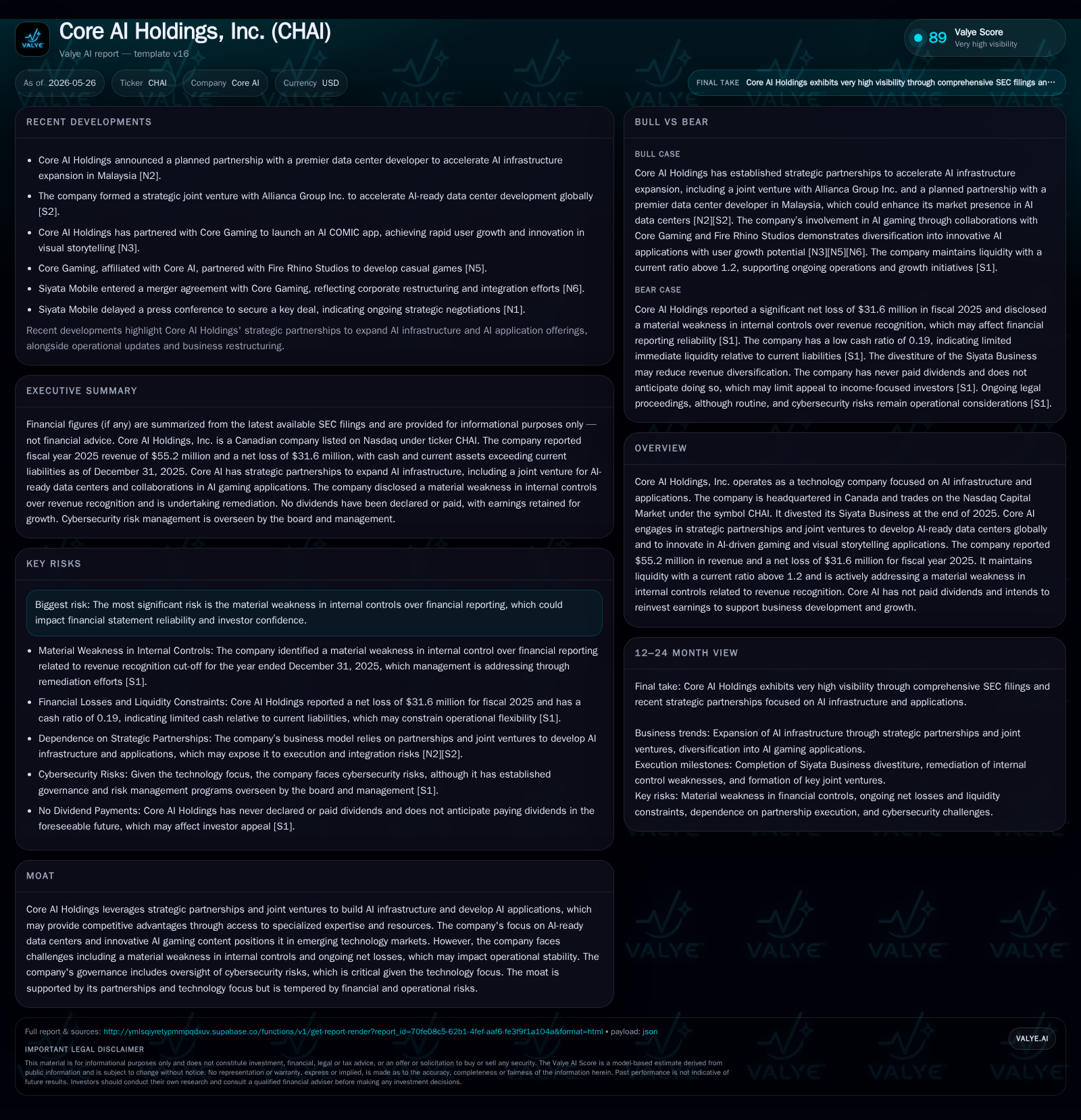
Core AI Holdings completed the strategic divestiture of its Siyata Mobile business at the end of 2025, pivoting fully to AI infrastructure development and application innovation. The company reported fiscal 2025 revenue of $55.2 million alongside a net loss exceeding $31 million. It disclosed a material weakness in internal controls over revenue recognition, which it is actively remediating. Core AI’s business model leverages joint ventures to build global AI-ready data centers and develop AI-driven gaming content but faces execution risks amid capital intensity and competition from major cloud providers. Growth depends on expanding data center deployments, deepening partnerships, and strengthening governance and operational controls.
Latest Quarterly Operating Update: Strategic Divestiture and Financial Results
Core AI Holdings’ Form 6-K filing dated May 18, 2026 provides the latest operating update for the fiscal year ended December 31, 2025 [S2]. The company completed the sale of its Siyata Mobile business at the end of 2025 through a stock purchase agreement with an affiliated director [S26]. This transaction marks a clear strategic pivot toward focusing exclusively on artificial intelligence infrastructure and applications.
Financially, Core AI reported full-year revenue of approximately $55.2 million alongside a net loss of $31.6 million for fiscal 2025 [F1]. The company maintains a moderate liquidity position with a current ratio near 1.24 as measured by current assets versus liabilities [F1]. However, it continues to operate at a net loss consistent with its early-stage investment profile.
The filing also highlighted an identified material weakness in internal controls over financial reporting related to revenue recognition processes [S12]. Management is actively engaged in remediation efforts including enhanced control design and testing to improve financial reporting reliability.
Governance enhancements include the May 2026 appointment of Sonali Garg, Co-Founder and COO of Allianca Group Inc., to the advisory board aimed at strengthening oversight during this growth phase [S3]
Business Model: Joint Ventures Driving AI Infrastructure and Application Development
Post-divestiture, Core AI’s business strategy focuses on developing next-generation AI infrastructure through strategic partnerships and joint ventures [S1]. The company specializes in constructing and operating AI-ready data centers optimized for high-performance machine learning workloads globally. These facilities provide critical infrastructure that reduces latency and enhances computational efficiency for enterprise clients deploying advanced AI solutions.
In parallel, Core AI invests in proprietary AI-driven applications targeting immersive gaming experiences and visual storytelling—areas benefiting from advancements in generative models and real-time rendering technologies [S1]. The joint venture approach enables access to external expertise while mitigating capital expenditure risks associated with large-scale data center projects.
Revenue streams derive from joint venture contracts, infrastructure usage fees, licensing agreements for developed applications, and potential milestone or royalty payments tied to commercial success. While initial capital intensity pressures margins, economies of scale from expanded deployments could improve profitability over time.
Industry Context: Capital Intensity and Competitive Pressures in Emerging AI Infrastructure
The market for specialized AI infrastructure is marked by significant capital requirements for scalable data center capacity tailored to demanding workloads involving GPUs or tensor processing units. Dominant hyperscale cloud providers compete alongside niche players offering customized solutions like Core AI’s partnership-driven model.
Barriers include technological specialization in power efficiency, cooling systems, network architecture, as well as stringent cybersecurity regulations overseen by boards incorporating cyber experts [S1]. Customer switching costs are elevated due to integration complexities but pricing competition remains intense from large incumbents.
Core AI differentiates itself through flexible partnership structures enabling accelerated rollout across diverse geographies with targeted application focuses such as gaming where larger providers may be less aggressive.
Growth Drivers: Scaling Global Data Centers and Expanding Application Footprint
Near-term growth is driven by scaling global deployments of AI-ready data centers leveraging partnerships such as with Allianca Group announced in April 2026 [S21]. This collaboration aims to accelerate facility development timelines coupled with managed service offerings targeting emerging regional markets.
Additionally, investments in synthetic media content generation within gaming ecosystems represent promising growth vectors fueled by trends toward immersive digital experiences based on generative adversarial networks (GANs) and reinforcement learning frameworks [S1], [S2].
The company prioritizes reinvestment over dividends to support strategic alliances, technology innovation pipelines, and platform commercialization efforts expected to drive long-term bookings growth [S1], [F1].
Risks: Internal Control Weaknesses, Sustained Losses, and Execution Challenges
A key risk remains the material weakness in internal controls over revenue recognition requiring comprehensive remediation including design implementation and operational testing before resolution [S12]. This issue poses potential reputational risk impacting investor confidence.
Financially, continued net losses nearing $32 million underscore challenges typical of capital-intensive growth companies investing ahead of profitability [F1]. Limited cash reserves relative to operating burn necessitate careful cash management despite a current ratio above one-times [F1], [S2].
Execution risks stem from evolving technology demands, volatility in emerging AI application markets, geopolitical sensitivities affecting cross-border infrastructure projects, and competitive responses from entrenched hyperscale providers.
Governance improvements must also effectively address cybersecurity oversight amid increasing regulatory scrutiny detailed in annual disclosures [S1].
Outlook: Monitoring Deployment Progress and Control Remediation Milestones
Investors should watch for updates on the pace of global data center deployments including commissioning milestones or expansion announcements signaling scaling progress post-divestiture [S2], [S21]. Subsequent quarterly earnings will clarify revenue growth trends versus path toward profitability improvements.
Progress on internal control remediation programs will be critical governance milestones influencing stakeholder confidence [S12]. Early customer wins or contract renewals within proprietary gaming or visual storytelling platforms will provide valuable indicators of product-market fit evolution.
Additional advisory board appointments or potential M&A activity could reveal management’s strategy for bolstering operational capacity or expanding technology capabilities under competitive pressures [S3],.
Financial Snapshot: Moderate Liquidity Amid Investment-Stage Losses
Fiscal year 2025 results show $55.2 million in revenue against an operating loss of approximately $7.1 million and net loss exceeding $31 million reflecting ongoing investment stage status rather than profitability achievement [F1], [S2]. Cash & equivalents totaled about $1.9 million with minimal reported debt resulting in a current ratio near 1.24 indicating moderate short-term liquidity sufficiency but limited financial flexibility for unexpected expenditures [F1].
Consistent with growth-focused tech enterprises, Core AI does not anticipate paying dividends in the foreseeable future electing instead to reinvest earnings into business development initiatives [S11], [F1]. Financial discipline coupled with successful remediation of control weaknesses will be essential for sustainable advancement.
This analysis synthesizes information from Core AI Holdings' most recent SEC filings including Forms 6-K dated May 18 (FY results) & May 5 (advisory board update), annual Form 20-F filed May 15 providing structural context plus companyfacts numeric snapshots as of December 31, 2025. Commentary integrates sector-relevant evaluation frameworks without extrapolating unsupported metrics or speculative forecasts beyond documented disclosures. All forward-looking statements are subject to risks enumerated by official filings [S2], [S3], [S12], [F1].
Disclaimer: This is research-only, informational analysis and not investment advice. It may include AI-generated interpretation and general industry context. Always verify important details using primary sources.

Comments