
Charter Communications: Navigating Scale, Debt, and Network Evolution in U.S. Telecom
Charter Communications operates an expansive U.S. broadband and video network under Spectrum, balancing growth initiatives with significant leverage and competitive pressures.
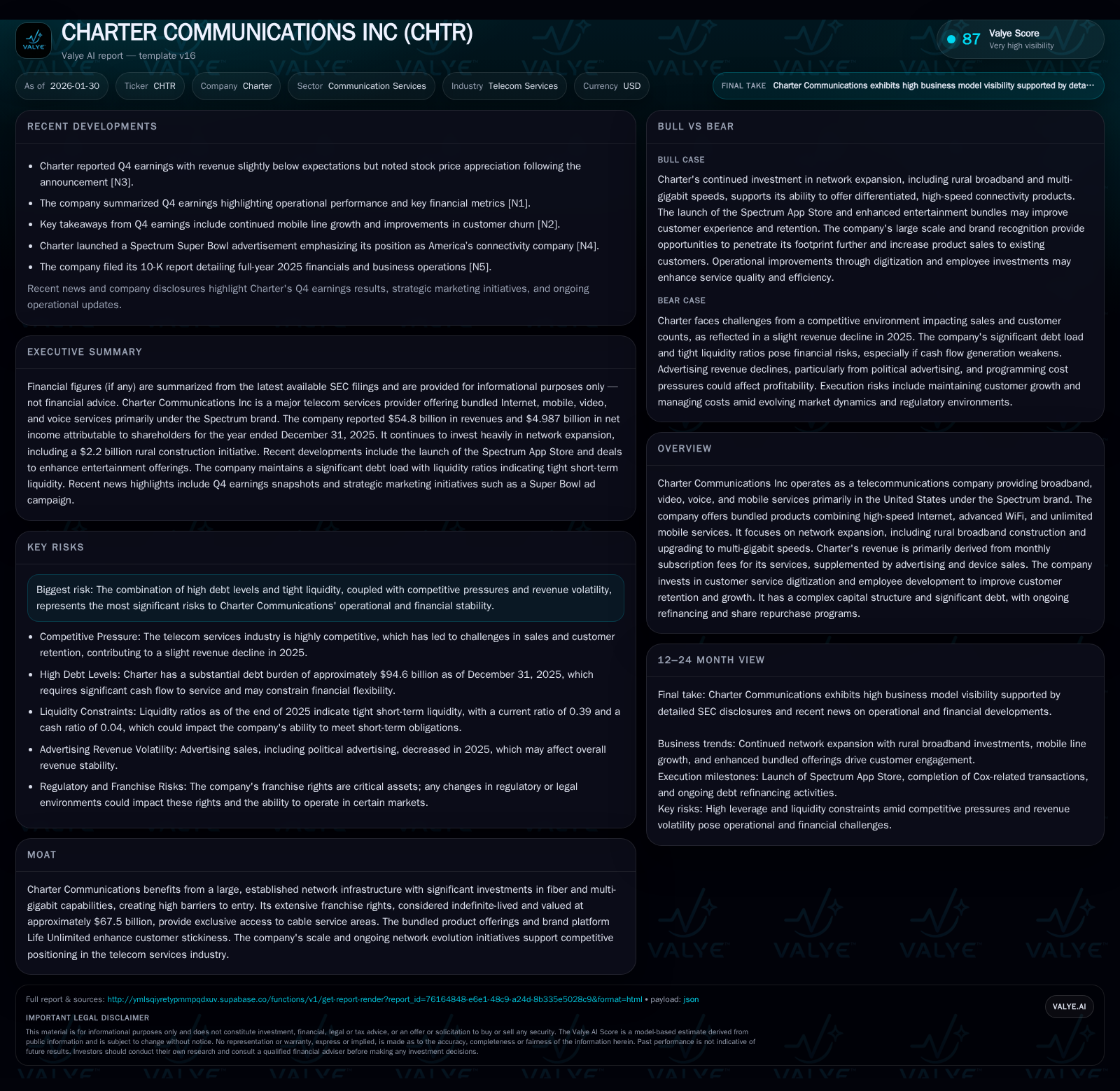
Charter Communications remains a dominant U.S. telecom player through its extensive cable infrastructure and bundled offerings under the Spectrum brand. Recent financials show stable earnings but mild revenue declines amid customer shifts and advertising softness. The company is aggressively investing in multi-gigabit network upgrades and rural broadband expansion while managing a complex debt profile heightened by recent acquisitions. Competitive dynamics include fiber deployments from telco rivals and evolving consumer demand, with Charter leveraging scale and operational digitization to sustain retention and margins.
What Changed Recently
Charter Communications reported its full-year 2025 results showing revenues of $54.8 billion, down 0.6% year over year, while adjusted EBITDA increased marginally by 0.6% to $22.7 billion. The company lost fewer Internet subscribers than expected and experienced a gain in video customers during Q4, which buoyed sentiment despite missing some sales expectations. Advertising sales were down primarily due to reduced political advertising, a common volatility factor in the sector [N1][N3][N5][N6].
On the strategic front, Charter progressed on its rural broadband initiative, investing $2.2 billion and activating approximately 483,000 subsidized rural passings during 2025. Multi-gigabit speeds are now available across parts of its footprint, with plans to extend symmetrical multi-gigabit services network-wide. The company also closed a significant acquisition from Cox Communications, adding commercial fiber and managed IT services to its portfolio for $3.5 billion in cash plus preferred convertible units, aiming to bolster its enterprise segment [S1][S2][S8].
Capital markets activity included the issuance of $3 billion in senior notes with yields around 7%, used to refinance near-term maturities and support ongoing acquisition-related expenditures. Share repurchases continued robustly, with over $3.8 billion spent in 2025, enhancing shareholder value amid elevated leverage [S5][S9][S12].
Business Model as a System
Charter operates primarily under the Spectrum brand, delivering broadband internet, video, voice, and mobile services across the U.S. The company's model is built on bundling these services to enhance customer lifetime value and reduce churn. High-speed Internet—offering up to 1 Gbps and multi-gigabit in select areas—is the core driver, supported by an extensive cable network and ongoing fiber upgrades.
Revenue streams include monthly subscription fees, advertising sales (including local and national programming), device sales (notably mobile devices), and ancillary fees such as home shopping and wire maintenance. Advertising revenues are susceptible to political cycles, impacting quarterly and annual results [S1][S3].
Charter invests heavily in network infrastructure, with capital expenditures concentrated on rural broadband expansion ($2.2 billion in 2025) and network evolution initiatives to deliver converged, multi-gigabit symmetrical speeds. Digitization of customer service platforms and workforce development are prioritized to improve operational efficiency and customer experience, aiming to lower churn and support upsell opportunities [S1].
On the corporate side, Charter has a layered capital structure with significant debt and equity components, including complex arrangements arising from the Liberty Broadband merger and the Cox Communications acquisition. The company manages leverage within a target range of approximately 3.5 to 3.75 times Adjusted EBITDA post-merger, balancing growth with financial flexibility [S5][S8][S9].
Industry Map & Competitive Battlefield
Charter competes in the highly competitive U.S. telecom services industry, primarily against incumbent telcos like AT&T and Verizon, as well as satellite and fixed wireless providers. Telcos continue to invest aggressively in fiber deployments and spectrum acquisitions to offer fiber-to-the-home (FTTH) and 5G fixed wireless services, challenging cable incumbents' traditional broadband dominance [N4].
Cable operators like Charter benefit from large, entrenched network infrastructures with high barriers to entry, including substantial franchise rights valued at ~$67.5 billion that provide exclusive access to service territories. This scale enables bundled service offerings (Internet, video, voice, mobile) that enhance customer stickiness and average revenue per user (ARPU).
Charter’s acquisition of Cox Communications’ commercial fiber and managed IT services signals a strategic move to strengthen its enterprise segment and diversify revenue beyond residential services. Meanwhile, cable’s traditional video segment faces cord-cutting trends and competition from streaming platforms, although Charter's recent video subscriber gains suggest some stabilization [S1][S2][S3].
The advertising market, a supplementary revenue source, is volatile and impacted by political advertising cycles and broader macroeconomic conditions. Mobile service, bundled with broadband, is becoming increasingly integral to consumer offerings, with device sales contributing incremental revenues [S3].
Where the Economics Become Real
Economically, Charter’s revenue growth is constrained by market saturation, customer churn, and competitive pricing pressures. The company’s strategy to mitigate these includes network upgrades enabling higher-speed tiers, product bundling, and digital customer service tools to reduce costs and improve retention.
Programming costs, a significant expense (~$8.8 billion in 2025), represent roughly 27% of operating expenses and exhibit pressure from content rights and carriage fees. However, Charter achieved a decrease in programming costs year-over-year, contributing to margin maintenance [S3].
Capital expenditures remain elevated due to rural broadband subsidies and fiber upgrades. The $2.2 billion rural construction initiative reflects both regulatory incentives and strategic expansion into underserved markets, potentially unlocking new subscription growth though with upfront capital intensity [S1].
Leverage is substantial, with Charter managing a multi-billion dollar debt load, including senior notes maturing through the 2030s and 2040s at coupon rates between 3.5% and 7%. Interest expense remains a significant line item ($5 billion annually), impacting net income and cash flow [S9][S12].
Share repurchases are a material use of free cash flow, with the company buying back $3.8 billion worth of shares in 2025 alone, signaling management confidence in long-term cash generation despite high leverage [S5][S7].
Unit economics also vary by customer segment; small business subscribers declined in 2025, while mid-market and large business segment revenues and PSU counts grew, underscoring the importance of enterprise solutions in Charter’s portfolio [S3].
Diligence Questions / Disconfirming Signals
The revenue decline and flat EBITDA raise questions about the sustainability of Charter’s growth in a competitive broadband landscape increasingly shaped by fiber and 5G fixed wireless. How durable is the current subscriber base amid ongoing cord-cutting and competition?
The impact of advertising revenue volatility—especially political advertising downturns—on overall profitability requires monitoring. Will Charter diversify or stabilize this revenue source?
The substantial debt and interest expense pose financial risks, particularly if cash flow generation is pressured by competition or regulatory shifts. How will Charter manage refinancing risk and maintain investment-grade credit metrics?
The integration and operational synergies from the Cox Communications commercial fiber acquisition and Liberty Broadband merger are not fully disclosed; what execution risks exist, and what is the timeline for realizing cost or revenue synergies?
Rural broadband expansion involves significant capital spend with uncertain return profiles. How effective is Charter’s deployment and monetization strategy in these markets?
Customer base shifts show declines in small business subscribers; what is Charter’s strategy to arrest such declines and capitalize on mid-market growth?
IRS audits covering multiple years and $835 million in unrecognized tax benefits create potential contingent liabilities. How might tax outcomes impact financials?
The evolving competitive environment with fiber-centric telcos and emerging fixed wireless providers could pressure pricing and customer retention. How is Charter adapting its go-to-market and product strategies?
Charter Communications stands as a formidable U.S. telecom operator with a vast network and bundled product offerings. Its scale and franchise exclusivity provide defensive moats, yet the company confronts substantial challenges from competition, leverage, and market shifts. The operational emphasis on network upgrades, customer service digitization, and targeted acquisitions reflect a strategic response to these pressures. However, the interplay of capital intensity, debt servicing, and revenue dynamics necessitates ongoing scrutiny. This analysis is based on publicly available earnings reports, news releases, and SEC filings as of January 2026 and does not constitute investment advice.
Disclaimer: This is research-only, informational analysis and not investment advice. It may include AI-generated interpretation and general industry context. Always verify important details using primary sources.

Comments