
Cigna Group Bolsters Growth Through Integrated Health Solutions and Digital Innovation
Cigna’s fusion of Evernorth and Cigna Healthcare, strengthened by digital tools and value-based care, underpins its recent financial momentum and competitive fortification.
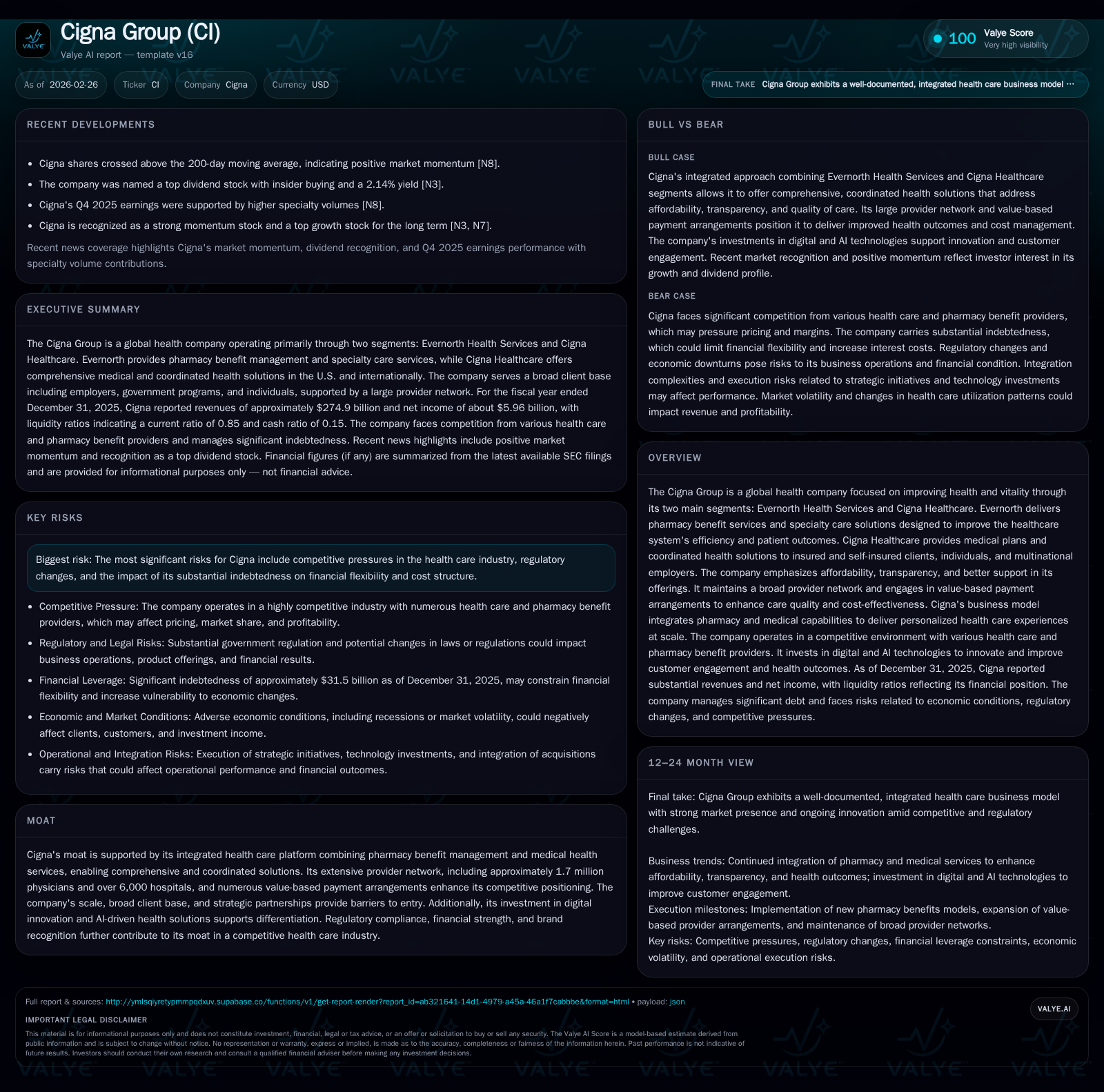
The Cigna Group has leveraged its dual-segment platform—Evernorth Health Services alongside Cigna Healthcare—to achieve robust revenue growth of 11.2% in FY2025, despite slight operating income compression. Specialty pharmacy volumes coupled with value-based payment models are central to this growth dynamic, while margin pressures persist amid competitive pricing and rebate-sharing. Digital innovation, extensive provider networks, and AI health solutions form the backbone of future expansion potential. Regulatory scrutiny and intense competition remain material risks. Capital allocation reflects a balance of steady dividends, sizable yet moderated buybacks, and reinvestment evidenced by a near doubling in capex.
Historical Growth Patterns: Revenue Surge Versus Operating Income Dynamics
The Cigna Group demonstrated a pronounced acceleration in revenue growth through FY2025, with total revenues reaching $274.9 billion—an 11.2% increase over the prior year’s $247.1 billion [F1]. This surge was fueled predominantly by rising specialty pharmacy volumes handled within its Evernorth segment as outlined in recent earnings commentary [N4]. However, despite top-line expansion, operating income contracted slightly by 2.3% to $9.2 billion from $9.42 billion in FY2024 [F1]. This divergence indicates margin compression effects consistent with heightened competitive pricing pressures and more extensive rebate-sharing arrangements with pharmaceutical manufacturers seen across the industry [S4].
Operating cash flow followed a downward trajectory from $10.36 billion in FY2024 to $9.6 billion in FY2025 (-7.4%), though it remains substantial relative to earnings [F1]. Notably, capital expenditures nearly doubled compared to prior periods (latest capex figures reflect a marked investment uptick compared to historical levels observed through FY2019) signaling strategic reinvestment into technology and infrastructure platforms aiming for long-term efficiency gains [F1]. This decoupling of revenue growth from operating income stability reflects ongoing cost management challenges typical in integrated healthcare operations amidst evolving payer-provider dynamics.
Historical performance (annual)
| FY | Rev ($bn) | CFO ($bn) | OpInc ($bn) | Rev YoY |
|---|---|---|---|---|
| 2025 | 274.9 | 9.6 | 9.2 | +11.2% |
| 2024 | 247.1 | 10.4 | 9.4 | +26.6% |
| 2023 | 195.3 | 11.8 | 8.5 | +8.2% |
| 2022 | 180.5 | 8.7 | 8.4 |
Source: SEC companyfacts cache [F1].
Capital returns and efficiency (annual)
| FY | Div ($mm) | Buybacks ($bn) |
|---|---|---|
| 2025 | 1611 | 3.6 |
| 2024 | 1567 | 7.0 |
| 2023 | 1450 | 2.3 |
| 2022 | 1384 | 7.6 |
Source: SEC companyfacts cache [F1].
Note: Capital expenditure values for recent years are discussed narratively due to limited specific XBRL disclosure post-2019.
Evernorth & Cigna Healthcare: The Engines Powering Integrated Market Leadership
Cigna operates two primary segments fostering integration between pharmacy benefits and medical plan offerings—Evernorth Health Services and Cigna Healthcare [S26][S28]. Evernorth encapsulates Pharmacy Benefit Services alongside Specialty and Care Services that prioritize enhancing healthcare system efficiency through solutions like Accredo Specialty Pharmacy and CuraScript specialty distribution [S13]. These services aim to improve patient outcomes via tailored clinical programs embedded within the broader pharmaceutical supply chain.
Conversely, Cigna Healthcare manages comprehensive medical plans for insured and self-insured clients across U.S., International Health markets, serving individual consumers as well as large multinational employers [S12][S20]. This segment focuses on delivering coordinated health solutions that balance affordability with transparency—critical differentiators given escalating industry cost pressures.
The strategic integration allows Cigna to merge pharmacy utilization data with medical care pathways enabling personalized interventions that reduce overall healthcare spend while improving quality outcomes [S26]. Value-based payment arrangements are central here—Cigna engages providers in contracts incentivizing better care coordination rather than volume-driven billing, reinforcing its moat by aligning incentives across stakeholders [S13]. This blend is supported by an extensive network comprising roughly 1.7 million physicians and over six thousand hospitals underpinning broad market reach [S26]. The ability to leverage combined medical-pharmacy data analytics platforms enhances prevention strategies and optimizes drug therapies in real-time.
Specialty Pharmacy Volumes and Value-Based Arrangements Impacting Margins
Recent quarterly results highlighted that elevated specialty pharmacy volumes have notably contributed to topline growth exceeding estimates [N4][N5]. Specialty drugs represent higher-margin products associated with chronic or rare conditions but also come with challenging cost structures requiring sophisticated clinical management.
Value-based contracts help curb runaway costs by linking reimbursement to outcomes rather than mere utilization; however, they introduce margin volatility since penalties may apply if performance benchmarks aren’t met [S4]. Sharing formulary rebates more generously with clients further compresses operating leverage on pharmacy services.[S22] Such rebate-free initiatives aim to simplify pricing models but can reduce near-term profitability.
Competitive pricing pressures amplify these effects—pharmacy benefit manager (PBM) rivals continuously vie for contract wins by lowering fees or offering broader formulary access options creating a race-to-the-bottom environment affecting operating margins industry-wide [S4]. Despite these headwinds, investment in clinical programs through Care Services aims to mitigate cost inflation while improving patient adherence—a long-run value preservative.
Future Growth Prospects Anchored in Digital Innovation and Broad Provider Networks
Looking forward, management identifies digital innovation as pivotal for accelerated growth citing AI-driven health solutions that extract actionable insights from vast claims, pharmacy dispensing, and electronic medical record data pools [N7][N10][S26]. These capabilities enable proactive risk stratification, precision medicine guidance, and enhanced member engagement pathways that differentiate Cigna’s offerings.
The company’s extensive scale aids competitive advantage—the network breadth encompassing approximately 1.7 million physicians paired with more than six thousand hospitals facilitates market penetration while enabling collaborative care models focused on population health optimization[S26][S17]. Integrated platforms formed across Evernorth’s pharmacy benefit services combined with Cigna Healthcare’s medical plans create synergistic customer touchpoints capable of delivering seamless experiences at scale.
However, growth constraints stem from client contract renegotiations where price concessions or benefit redesigns may restrain revenue enhancements [S4]. Regulatory reforms targeting drug pricing transparency or PBM practices could necessitate operational adjustments complicating execution timelines.[S22]
Regulatory Complexities and Competitive Pressures: Risks to Monitor
Cigna operates under intense regulatory scrutiny spanning multiple federal agencies—the FTC settlement in February 2026 resolved antitrust allegations concerning PBM rebate practices without monetary fines but mandates alterations to business protocols around drug affordability for its Express Scripts division [S4]. Ongoing compliance obligations extend across state insurance regulators, CMS oversight regarding Medicare/Medicaid business lines (although Medicare Advantage was divested), privacy regulation adherence amid HIPAA audits, plus cybersecurity imperatives given sensitive health data handling.[S6][S18]
Litigation exposure remains elevated; typical risk vectors include provider contract disputes involving compensation terms or network inclusion criteria; claims of marketing mispractices; ERISA-related plan administration lawsuits; as well as privacy breach litigations — all potentially costly notwithstanding insurance coverage limitations.[S4][S7][S8]
Competitive landscape shifts add complexity—consolidation among hospitals and physician groups may erode bargaining power; new entrants deploying telehealth or vertically integrated models could challenge traditional payor paradigms.[S17][S23] Pharmaceutical market reforms such as CMS’ authority under the Inflation Reduction Act present additional unpredictability influencing drug pricing benchmarks integral to contract negotiations.[S22]
Capital Deployment Strategy: Dividends, Buybacks, and Return on Equity Trends
Cigna maintains a disciplined capital allocation approach balancing shareholder returns with strategic investment imperatives [F1]. Dividends paid totaled approximately $1.61 billion in FY2025 showing modest year-over-year growth aligned with stable payout policy trends from prior years ($1.57B in FY2024). Stock repurchases amounted to $3.62 billion—down notably from the $7 billion range seen previously reflecting cautious capital conservatism amid regulatory costs and capex expansions [F1].
A pronounced near doubling of capital expenditures compared to historical baselines suggests prioritization for upgrading digital infrastructure bolstering AI capabilities critical for future competitiveness.
Return on equity hovered at an estimated healthy level of approximately 14.3%, derived from net income of roughly $6 billion versus shareholders’ equity near $41.7 billion at year-end FY2025 [F1]. Operating cash flows remained robust at $9.6 billion though declined sequentially reflecting working capital outflows or increased reimbursements while free cash flow resilience persisted near $8.5 billion after subtracting elevated capex.
Such metrics underscore efficacious capital stewardship enabling reinvestment alongside meaningful cash returns supporting investor confidence.
Investor Takeaways: Key Metrics and Indicators Ahead
Absent explicit company-provided numerical forecasts,[N11][N12] suggest bullish market sentiment acknowledges Cigna’s dual strategy combining platform scale with technological differentiation driving durable growth potential.
Investors should monitor several pivotal indicators: membership trends across core insured medical plans versus specialty pharmacy utilization rates will inform revenue mix evolution impacting margins; progress on contractual renegotiations especially client demands for lower fees or shifted risk burdens remains materially impactful; regulatory developments post-FTC settlement particularly related to PBM business conduct could re-shape legal exposure profiles; finally adjustments in capital return programs may signal evolving management confidence regarding cash flow predictability amid external uncertainties.
In summary, Cigna's coherent integration of Evernorth's pharmacy expertise with Cigna Healthcare's medical solutions orchestrated against a backdrop of digital innovation propels it forward competitively albeit within a landscape marked by rigorous regulation and pricing pressures inherent to modern healthcare ecosystems.
Disclaimer: This analysis is based solely on documented public filings and reported news without any projection beyond stated company information or independent valuation assessments.
Disclaimer: This is research-only, informational analysis and not investment advice. It may include AI-generated interpretation and general industry context. Always verify important details using primary sources.

Comments