
CitroTech's Strategic Shift in Wildfire Defense: Joint Venture Leverages Intellectual Property
CitroTech Inc. pivots its commercialization approach through a joint venture with Hexion, combining proprietary fire-retardant technology with manufacturing expertise to address wildfire mitigation.
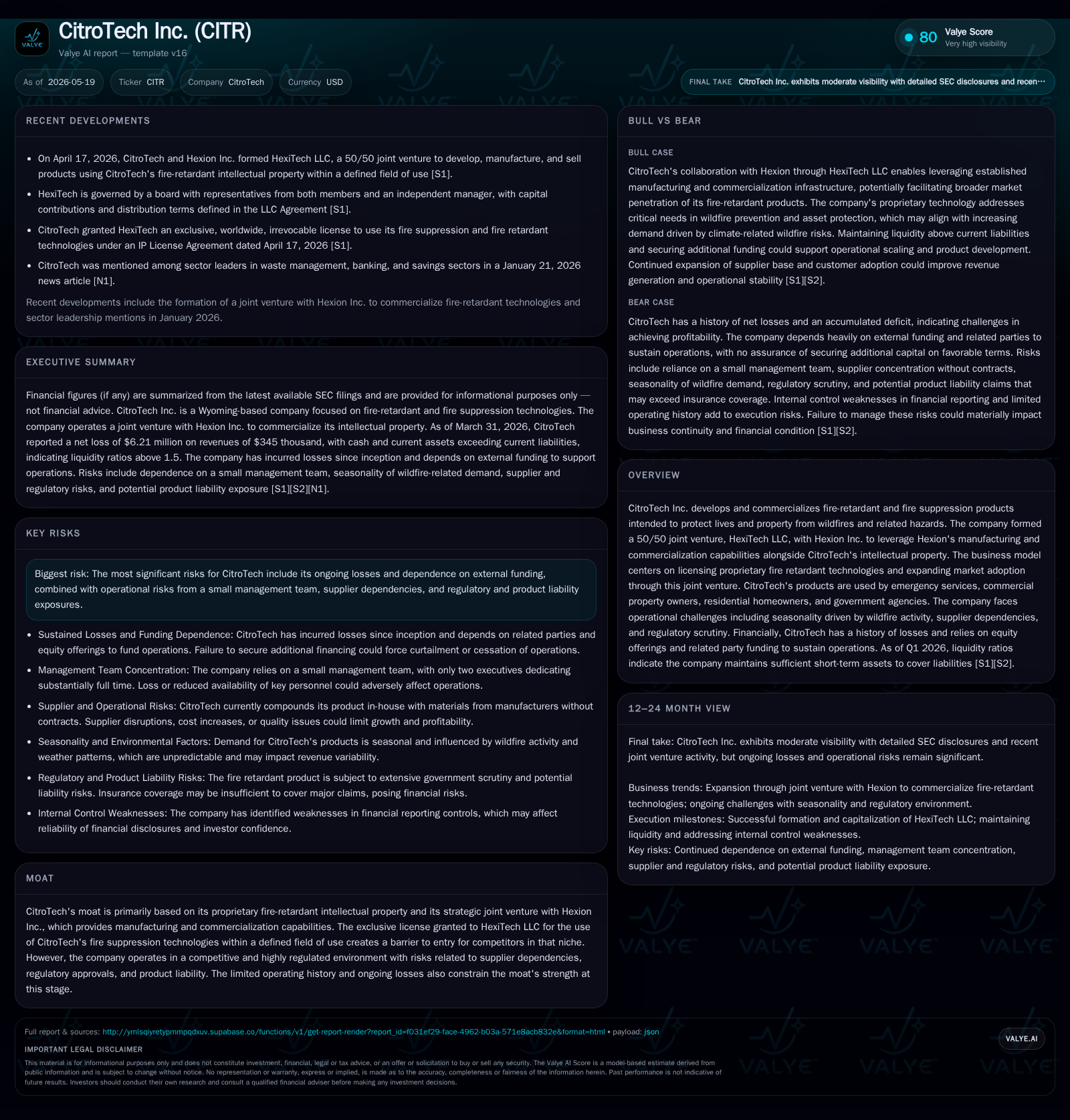
CitroTech has formed HexiTech LLC, a 50/50 joint venture with Hexion Inc., marking a significant operational pivot towards scaling commercialization of its patented fire-retardant technologies. The joint venture structure aligns intellectual property licensing with manufacturing and market execution capabilities, aiming to enhance product adoption amid rising wildfire risks and regulatory complexities. Despite this strategic repositioning, CitroTech faces ongoing challenges including dependency on external funding, seasonal demand variability, and supplier concentration. The company’s liquidity position as of Q1 2026 is adequate for its near-term plans but sustainability hinges on achieving growth milestones and successful capital contributions within the JV framework.
Latest Operating Update: Launch of HexiTech LLC and Immediate Implications
In April 2026, CitroTech Inc. entered a pivotal phase by creating HexiTech LLC—a 50/50 joint venture with specialty chemicals manufacturer Hexion Inc.—to advance the development, manufacture, commercialization, and sale of products incorporating CitroTech's proprietary fire-retardant intellectual property (IP) [S3][S6][S7]. Governed by a Board comprising one member designee from each partner plus an independent manager, HexiTech requires dual approval from both CitroTech's and Hexion's representatives for fundamental decisions, creating a governance framework designed for balanced strategic control [S3].
Funding obligations within HexiTech impose capital contributions on a pro rata basis subject to Board-approved budgets. If either member defaults on its commitment, the other may cover the required amounts via interest-bearing loans recoverable from future distributions. Critically, should CitroTech fail to repay such advances within six months, Hexion gains accelerated call options allowing it to acquire CitroTech’s ownership stake in the JV under specified terms [S3].
Economic rights within HexiTech initially prioritize Hexion heavily; the latter is entitled to receive 85% of distributions until certain commercialization targets are achieved—after which profit-sharing balances presumably normalize [S3]. The JV secures an exclusive license to use CitroTech’s fire suppression IP royalty-free during JV operations, while any exit by CitroTech triggers a perpetual license subject to ongoing royalties in the high-teens to low-twenties percentage range based on net sales [S3][S6]. This structure anchors the JV as both commercialization vehicle and a strategic IP licensing mechanism.
Business Model Overview: Licensing Innovation and Joint Venture Execution
At its core, CitroTech monetizes through licensing innovative fire-retardant technologies designed for wildfire mitigation—a market segment driven by escalating environmental hazards [S1]. The formation of HexiTech delegates manufacturing responsibilities and front-line commercial activities to Hexion’s experience-rich infrastructure while CitroTech contributes its specialized IP portfolio as an exclusive asset within the defined field of use [S7].
Revenue streams derive primarily from royalties embedded in supply contracts executed through HexiTech’s operations post product sales. Key customers encompass emergency response units requiring efficacious fire suppression solutions, commercial property owners seeking hazard mitigation measures, residential homeowners who value fire safety enhancements, and government agencies involved in wildfire prevention programs [S1]. This broad customer base underscores distinct application verticals necessitating tailored commercialization approaches.
CitroTech’s value proposition rests on proprietary technology licensed exclusively to its JV partner; this arrangement creates a moat around its innovation funnel while outsourcing the variable cost-intensive manufacturing and sales effort to a resource-equipped partner [S1][S3]. However, ongoing reliance on equity funding coupled with lack of direct manufacturing limits immediate scalability potential until commercial traction materializes fully
Product Quality and Market Relevance: Fire Retardants Addressing Growing Wildfire Risks
CitroTech’s patented fire retardants are formulated specifically for high efficacy under wildfire conditions—a sector witnessing structural growth driven by climate change realities increasing frequency and severity of wildfires [S1]. Product reliability is paramount as end users (emergency services especially) depend on materials that perform consistently under extreme environmental stress while complying stringently with safety regulations.
Regulatory oversight shapes product formulation standards significantly; compliance fosters customer trust but also imposes barriers slowing new market entry or rapid expansion. Switching costs for customers are embedded both in their operational protocols adapted around proven products and certification validation cycles ensuring consistent field performance.
The company's in-house compounding supplemented by third-party supplied raw materials renders supply chain integration critical; supplier concentration thus becomes an operational watchpoint impacting both capacity to fulfill orders timely and cost structures [S1][F1]
Industry Structure and Competitive Dynamics: Navigating a Niche with Regulatory Hurdles
The niche market for chemical fire suppression solutions comprises competitors ranging from commodity chemical manufacturers offering standard retardants to technologically differentiated specialists like CitroTech positioning proprietary formulations underpinned by robust IP rights [S1].
This specialized sub-industry grapples acutely with seasonal demand dynamics—the annual wildfire season dictates fluctuating ordering patterns that complicate inventory management. Regulatory agencies exert strong influence given the public safety implications; resultant approvals can delay product launches or require reformulations.
Supplier relationships anchor operational continuity but expose manufacturers like CitroTech (via JV) to risks stemming from raw material price volatility or availability constraints. The partnership model reduces standalone supplier risk yet introduces complexity around coordination between partners' procurement channels [S1].
Growth Drivers: Capitalizing on Wildfire Prevention Trends and JV-Enabled Scale
Fundamental growth drivers align with increasing wildfire occurrences worldwide alongside heightened governmental prioritization of hazard mitigation infrastructure funding—legislative initiatives across federal and state levels often channel resources toward advanced fire suppression technologies [S2][S3][S7].
HexiTech as the manufacturing-commercialization platform aims to harness these tailwinds through scaled production capabilities provided by Hexion combined with CitroTech's innovative products. The JV model optimizes resource deployment while targeting accelerated market penetration compared with standalone efforts.
Seasonality remains an inherent factor: peak demand coincides with regional wildfire activity windows constraining revenue smoothing but also focusing sales efforts around forecasted fire seasons [S8]. Success in meeting defined commercialization milestones will measure efficacy of this growth approach directly
Key Risks and Challenges: Funding Dependency, Supplier Concentration, Regulatory Exposure
CitroTech confronts several intertwined risks critically impacting execution feasibility. Chief among these is sustained operating losses culminating in a $36.8 million net loss during fiscal year 2025 resulting in an accumulated deficit exceeding $113 million [S1]. The firm remains dependent on continued equity infusions and related party funding commitments to finance operations absent positive cash flow generation.
The compact management team further elevates execution risk given limited bandwidth managing simultaneous challenges encompassing product development scaling alongside complex JV governance obligations [S1][S2]. Supplier dependencies introduce supply continuity uncertainty which coupled with jurisdictional regulatory hurdles could delay product delivery or approvals.
JV financing mechanisms embed additional hazards: failure by CitroTech to meet capital calls could precipitate loss of voting power or ownership dilution via accelerated Hexion call options [S3]. Distribution preferences also sway initial returns heavily toward Hexion until performance hurdles are surpassed potentially compressing early-stage profitability prospects for CitroTech shareholders
Monitoring Next Steps: Commercial Milestones, Capital Contributions, and Technology Adoption
Near-term focus centers on execution fidelity as the JV proceeds through budgeted capital calls requiring prompt funding contributions approved jointly by members [S2][S3]. Tracking timely inflows versus planned expenditures will indicate operational discipline.
Commercialization targets triggering redistribution of profit shares—initially dominated by Hexion—will serve as tangible markers signposting progress toward revenue scale capable of sustainable returns [S3]. Early sales achievements across government tenders or emergency service contracts would signal emerging market acceptance validating product relevance claims.
Additionally, maintaining alignment between partner priorities through Board approvals while preventing default scenarios will be critical to prevent dilution risks or unwanted ownership transitions underscoring prudent financial governance going forward.
Financial Profile Snapshot: Liquidity, Operating Losses, and Capital Structure
As of March 31, 2026, CitroTech held approximately $4.3 million in cash equivalents against current liabilities near $2.9 million yielding a current ratio close to 2x—indicative of short-term liquidity adequacy aligned with planned operational expenditures [F1]. Total debt was modest at approximately $173 thousand reflecting conservative leverage levels supporting financial flexibility [F1].
Nevertheless, sustained operating losses evidenced throughout fiscal 2025 highlight substantial earnings pressure not yet offset by revenue growth—the net loss exceeding $36 million underscores ongoing funding necessity largely sourced via equity offerings [$8.1 million raised late 2025] and related party support arrangements detailed under JV terms [S1][S3]
In sum, while the liquidity runway extends through fiscal year 2026 per management guidance internalized into budgets approved under HexiTech governance frameworks ensuring disciplined capital application remains imperative for longer-term viability contingent upon accelerated commercialization success.
This analysis reflects information available as of May 19, 2026 drawn primarily from recent SEC filings including quarterly (10-Q) and event (8-K) reports alongside companyfacts financial data snapshots. It is intended solely for informational purposes without investment advice or research views.
Disclaimer: This is research-only, informational analysis and not investment advice. It may include AI-generated interpretation and general industry context. Always verify important details using primary sources.

Comments