
Upscale Extended-Stay Niche Drives Chatham Lodging Trust’s Financial Momentum
Focused portfolio adjustments and disciplined capital management propel CLDT’s earnings amid modest revenue pressures.
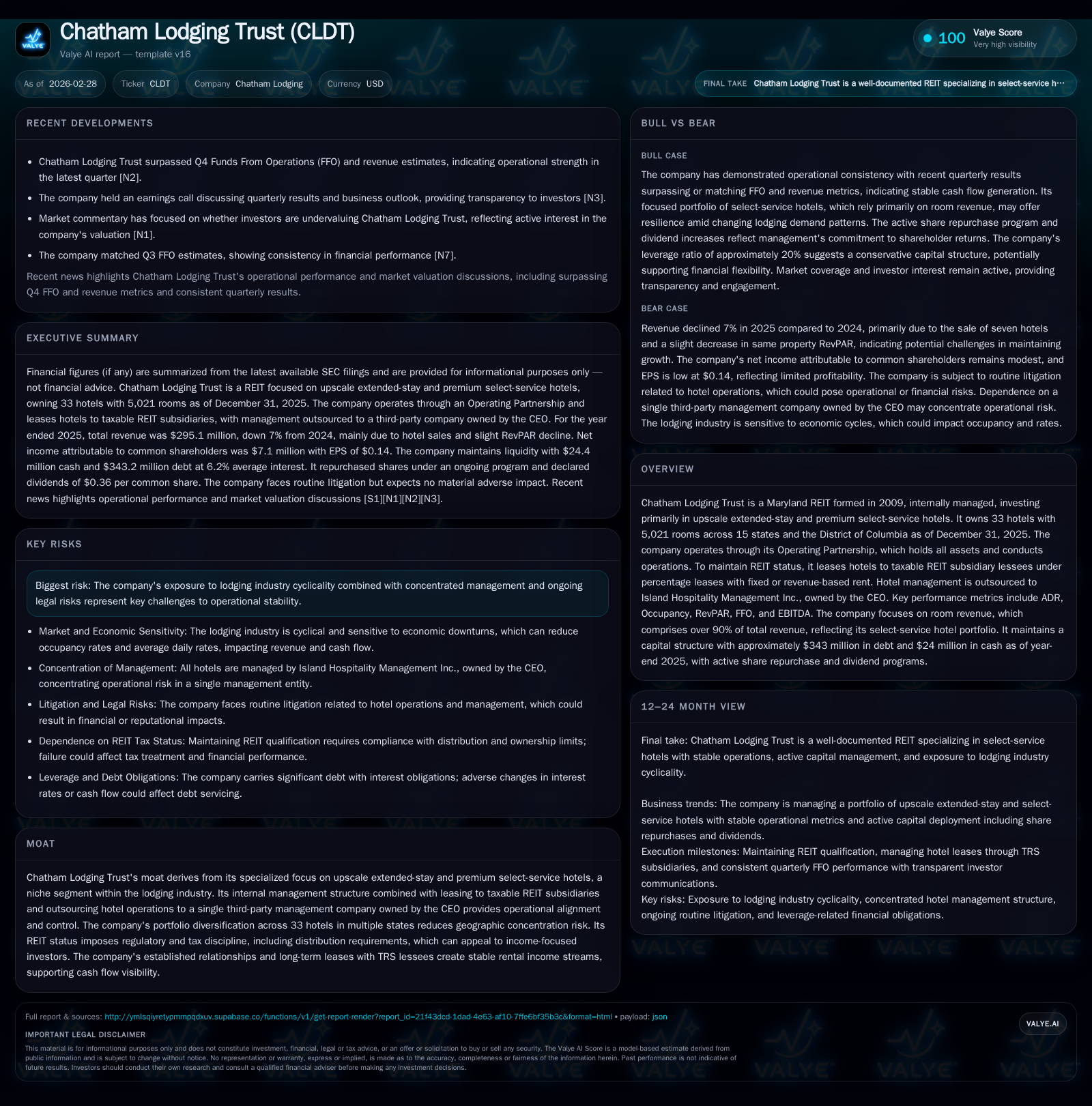
Chatham Lodging Trust’s 2025 performance reflects its targeted strategy concentrating on upscale extended-stay and premium select-service hotels. Despite a room revenue decline driven by asset sales, operating income expanded by 23%, supported by margin improvements and operational leverage. The company’s capital structure remains robust with $343 million debt, complemented by a $25 million share repurchase program and sustained dividend payments. CLDT’s CEO-aligned operating model combining internal management oversight with third-party hotel operations under Island Hospitality bolsters operational control, while its percentage lease arrangements with TRS subsidiaries underpin stable rental income streams.
Portfolio Evolution: Asset Sales, Acquisitions, and Operational Footprint
Between early 2024 and late 2025, Chatham Lodging Trust (CLDT) strategically realigned its portfolio through the sale of seven hotels located in Denver (CO), Maitland (FL), Bloomington (MN), Brentwood (TN), two properties in Houston (TX), and Billerica (MA). This divestiture reduced total rooms but concentrated the portfolio around upscale extended-stay and premium select-service assets aligned with its investment philosophy [S1][N1]. Complementing these disposals was an acquisition of one premium property in Phoenix, AZ as of May 30, 2024 [S1]. As of December 31, 2025, the portfolio comprises 33 hotels totaling 5,021 rooms across 15 states plus the District of Columbia [S1].
Financial Performance Trajectory: Revenue Decline vs Income Improvement
For FY2025, room revenue declined approximately 7.3% year-over-year to about $269 million primarily due to asset sales impacting scale [F1][S1][N1]. Despite this top-line contraction, operating income increased by roughly 23% to $40.9 million driven by margin improvements and operational efficiencies associated with a more focused portfolio [F1]. Net income rose substantially over 260% to approximately $15 million reflecting operational leverage amidst inflationary pressures [F1].
Operating cash flow decreased about 13% to $64.1 million consistent with portfolio size reduction but indicating stable cash generation capacity [F1]. Dividends paid increased to $17.6 million from $14.4 million in the prior year while share repurchases totaled nearly $9 million under a newly authorized $25 million buyback program initiated mid-2025 [F1][S4].
Historical performance (annual)
| FY | Net ($mm) | CFO ($mm) | OpInc ($mm) | Net YoY |
|---|---|---|---|---|
| 2025 | 15 | 64 | 41 | +261.3% |
| 2024 | 4 | 74 | 33 | +57.6% |
| 2023 | 3 | 76 | 29 | -73.0% |
| 2022 | 10 | 72 | 36 |
Source: SEC companyfacts cache [F1].
Capital returns and efficiency (annual)
| FY | Div ($mm) | ROE% |
|---|---|---|
| 2025 | 18 | 2.0 |
| 2024 | 14 | 0.5 |
| 2023 | 14 | 0.3 |
| 2022 | 0 | 1.2 |
Source: SEC companyfacts cache [F1].
Figures derived from [F1] and corroborated with [S1][N1].
Operational Drivers: ADR, Occupancy, RevPAR, and Management Model
CLDT monitors key hotel metrics such as Average Daily Rate (ADR), Occupancy rate, and Revenue Per Available Room (RevPAR), which influence lease-based rental revenues since leases with TRS lessees use percentage rent structures tied partly to hotel revenues [S1]. Over ninety percent of total revenue is room revenue reflecting emphasis on premium select-service hotels where ancillary revenues are modest [S1].
A unique feature is that all hotels are managed by Island Hospitality Management Inc., wholly owned by CEO Jeffrey Fisher who also serves as Chairman and President [S1]. This ownership aligns management incentives closely with shareholder interests enhancing responsiveness for performance improvement or capital deployment.
Capital Structure and Liquidity: Debt Terms and Covenant Compliance
At December 31, 2025, total long-term debt was approximately $343 million at an average interest rate near 6.2%, mainly from an unsecured revolving credit facility capped at $300 million and a $200 million unsecured term loan established in September 2025 replacing earlier facilities [F1][S5][S6]. The Credit Facility matures September 2029 with extension options and includes an accordion feature increasing availability up to $650 million.
Financial covenants include leverage ratios based on net debt relative to hotel investments at cost—this ratio improved from about 23% at end-2024 to roughly 20% at end-2025 consistent with deleveraging efforts following asset sales [S7][F1]. The company was compliant with all covenants providing liquidity flexibility.
Capital Deployment: Share Repurchases, Preferred Dividends, and DRSPP
Shareholder returns balance dividend payments on common shares totaling about $17.6 million for FY2025 alongside distributions on cumulative Series A preferred shares yielding approximately 6.625%, aggregating roughly $8 million annually paid quarterly [S4][F1].
In May 2025, CLDT authorized a new common share repurchase program capped at $25 million; during the year it repurchased nearly $9 million at an average price near $6.83 per share using about one-third of available capacity without expiration or pace constraints [S4][F1].
The Dividend Reinvestment and Stock Purchase Plan (DRSPP) remains active though participation was limited in FY2025 generating about $54 thousand from under ten thousand shares issued; equity issuance programs like DRSPP or ATM offerings remain available but were not heavily utilized recently [S8][F1].
Legal and Governance Risks Affecting Operational Stability
The company faces routine legal proceedings typical for lodging operations; management believes these matters individually or collectively will not materially affect financial condition or results [S25]. Cybersecurity risks are overseen through Audit Committee governance; escalation protocols involve reporting from Island Hospitality's executive leadership through Board channels ensuring timely responses [S1]. The CEO's ownership of the operator aligns oversight but concentrates management risk.
Future Growth Outlook: Market Exposure, Lease Structures, and Macro Dynamics
No explicit forward guidance is provided publicly in available sources [N2][N3], but growth prospects depend on optimizing upscale extended-stay lodging combined with percentage leases via TRS lessees that tie landlord returns to hotel performance benchmarks [S1]. This model offers upside when ADR or occupancy improve but retains exposure to lodging market cyclicality prevalent in premium select-service segments.
Geographic diversification across multiple states provides some resilience against localized downturns though macroeconomic factors such as inflation or travel demand shifts remain relevant near-term risks.
Key Metrics to Watch: FFO Trends, Lease Revenue Sensitivity, and Cash Flow Generation
Funds From Operations (FFO) trends post portfolio adjustments will be critical indicators of sustainable cash returns beyond depreciation recapture effects; while explicit FFO figures are not detailed here they typically correlate closely with lease rent variability tied to hotel revenues under CLDT’s lease contracts [N1][N3][F1]. Monitoring quarterly ADR and occupancy changes will provide insight into drivers affecting percentage rent components supporting core REIT income.
Operating cash flow stability amid revenue volatility evidences effective margin management making CFO versus adjusted EBITDA important metrics going forward.
This analysis is based solely on information available through February 28th, 2026 from Chatham Lodging Trust regulatory filings and related news sources without extrapolation beyond documented facts or financial disclosures noted herein.
Disclaimer: This is research-only, informational analysis and not investment advice. It may include AI-generated interpretation and general industry context. Always verify important details using primary sources.

Comments