
Celldex Therapeutics Advances Mast Cell Antibody Pipeline with Barzolvolimab Phase 3 Trials and Strategic Funding Needs
Celldex focuses on mast cell biology with lead drug Barzolvolimab progressing through multiple Phase 3 trials, balancing significant clinical milestones against capital demands and development risks.
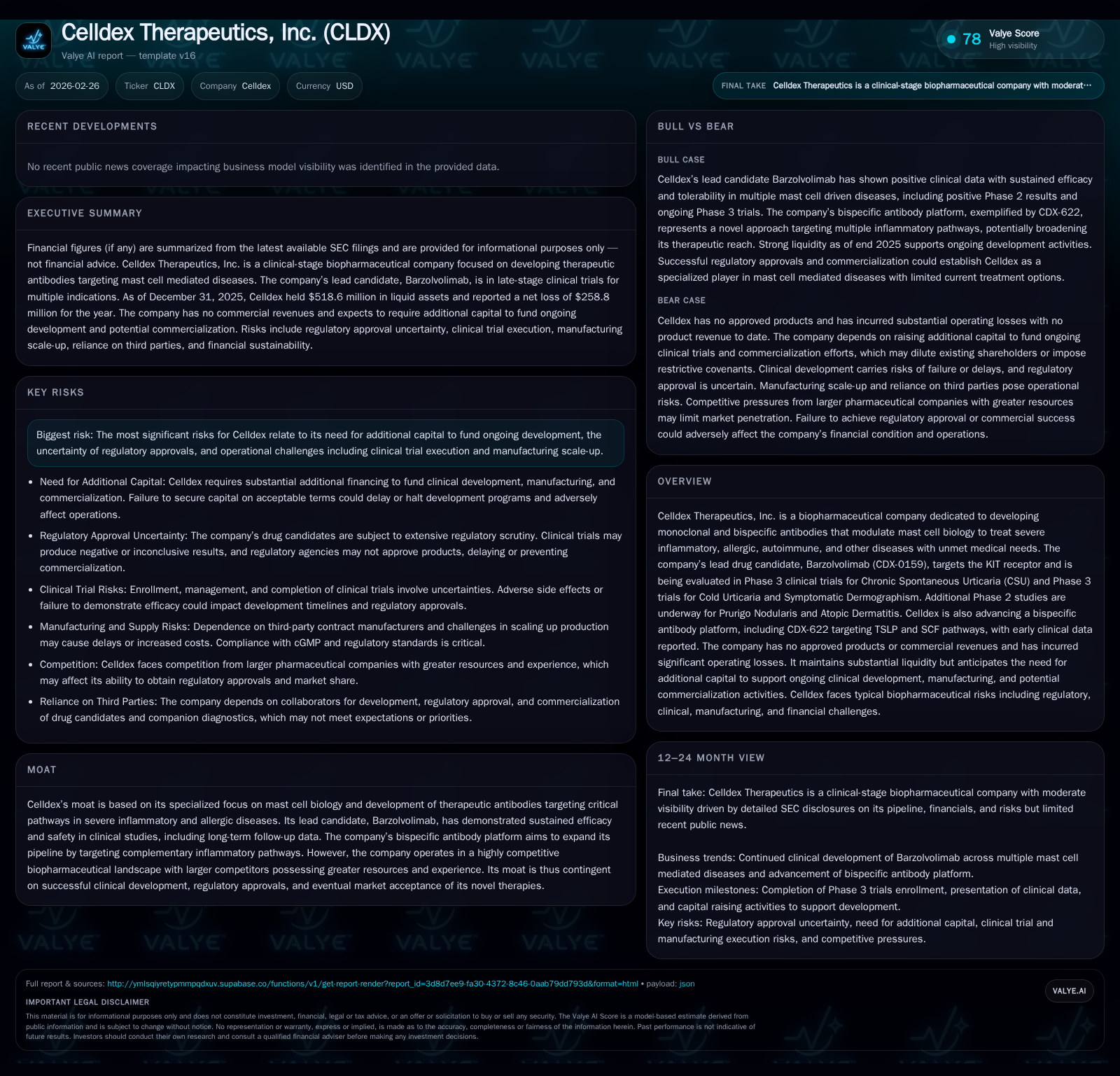
Celldex Therapeutics is a clinical-stage biopharma company specializing in monoclonal and bispecific antibodies targeting mast cell-driven diseases. Its lead candidate, Barzolvolimab, is in Phase 3 trials for Chronic Spontaneous Urticaria and other urticarias, with Phase 2 studies underway in Prurigo Nodularis and Atopic Dermatitis. The company has no approved products or meaningful revenues, reflecting continued heavy operating losses and negative cash flow as it invests heavily in R&D. Despite liquidity of approximately $519 million at end-2025, Celldex anticipates the need for additional funding to complete development and support future commercialization efforts. Risks include regulatory approvals, competitive landscape, capital requirements, and operational execution.
Company Overview
Celldex Therapeutics operates as a clinical-stage biotechnology firm focused on developing monoclonal and bispecific antibodies that modulate mast cell biology to address severe inflammatory, allergic, autoimmune, and related diseases with significant unmet medical needs [S1]. Their strategic niche leverages modulation of the KIT receptor pathway involved in mast cell activation through their lead asset Barzolvolimab (CDX-0159).
The company’s core expertise centers on immunotherapy approaches to disabling pathological mast cell activity. This differentiates Celldex within an evolving market of immune-modulating biologics competing across allergic and inflammatory disease segments.
Historical Financial Performance
Celldex has generated negligible commercial revenue historically given its developmental stage focus: total revenue was approximately $1.76 million in fiscal year 2018, reflecting early collaborations or grants rather than product sales [F1]. The absence of product approvals translates directly into steep recurring R&D expenses.
Operating losses have grown substantially as clinical trial activity accelerates. Operating income declined from -$115 million in FY2022 to -$287 million by FY2025, illustrating an intensifying investment phase in late-stage trials [F1]. Similarly, net losses mirror this trend closely (-$258.8 million in FY2025). Operating cash flow has been persistently negative since FY2022 with a nadir near -$211 million last year. Capital expenditures remain low relative to operating burn (~$2.7 million in FY2025), consistent with reliance on contract manufacturers rather than internal facility expansion [F1].
Historical performance (annual)
| FY | CFO ($mm) | OpInc ($mm) | Capex ($mm) |
|---|---|---|---|
| 2025 | -211 | -287 | 3 |
| 2024 | -158 | -195 | 2 |
| 2023 | -107 | -155 | 2 |
| 2022 | -104 | -115 | 2 |
Source: SEC companyfacts cache [F1].
Capital returns and efficiency (annual)
| FY | FCF ($mm) |
|---|---|
| 2025 | -214 |
| 2024 | -160 |
| 2023 | -109 |
| 2022 | -106 |
Source: SEC companyfacts cache [F1].
Operating income declined roughly 47% year-over-year from FY2024 to FY2025; worsening cash outflows underscore ongoing intensive capital deployment toward clinical advancement [F1]. The elevated current ratio (~10.49 at end-2025) signals strong short-term liquidity buffers relative to current liabilities but must be contextualized within high burn rates [F1].
Pipeline Development & Growth Prospects
Celldex is singularly focused on mast cell-mediated disease indications where existing therapies are limited or inadequate. Their lead candidate Barzolvolimab is positioned at the forefront:
- Chronic Spontaneous Urticaria (CSU): Enrollment completed for two Phase 3 studies by early 2026; topline results are expected by Q4 2026 [S1]. Prior Phase 2 data demonstrated statistically significant symptomatic improvements maintained through extended treatment durations with favorable safety profiles sustained up to week 76 post-dosing [S1].
- Cold Urticaria (ColdU) & Symptomatic Dermographism (SD): A combined Phase 3 trial initiated late last year; enrollment is ongoing [S1]. Earlier Phase 2 results showed statistically significant efficacy versus placebo at week 12 along with sustained tolerability over longer-term treatment periods [S1].
- Prurigo Nodularis (PN): Phase 2 study enrollment completed December 2025; topline data anticipated mid-2026 based on encouraging prior Phase 1b signals reported November 2023 [S1].
- Atopic Dermatitis (AD): Initiated Phase 2 study December 2024; enrollment finished January 2026; topline readout slated for late-2026 [S1].
Beyond Barzolvolimab, Celldex is advancing a bispecific antibody platform targeting complementary pathways such as TSLP/SCF via candidates like CDX-622 to expand therapeutic scope [S1]. Early clinical data suggest potential pipeline broadening opportunities.
Growth catalysts depend heavily on successful late-phase data readouts and subsequent regulatory approvals—processes known for complexity given stringent FDA oversight and industry-wide challenges . Further expansion into additional indications or partnerships could enhance value creation.
Regulatory & Operational Challenges
Celldex faces typical biopharma hurdles: extensive regulatory approval processes requiring robust demonstration of efficacy and safety; risks of adverse side effects during pivotal trials; competition from larger players specializing in inflammatory diseases; manufacturing consistency risks due to reliance on contract development manufacturing organizations (CDMOs) subject to cGMP inspections; plus reimbursement uncertainties influencing market adoption post-approval [S17][S18].
Compliance obligations span anti-kickback statutes, false claims laws, patient privacy regulations including HIPAA and GDPR frameworks, as well as pricing transparency rules under legislation such as the Inflation Reduction Act—all adding operational complexity during commercialization preparation phases [S11][S12][S15].
Dependency on third parties extends also to companion diagnostics development critical for patient selection accuracy impacting clinical success probabilities [S20][S23].
Capital Allocation & Financial Positioning
As of December 31, 2025, Celldex held $518.6 million in cash equivalents and marketable securities—a substantial liquidity reserve supporting near-term operations including clinical trial completion phases [F1][S16]. Nonetheless, the company acknowledges the necessity for additional financing to bring drug candidates through clinical maturity into commercialization stages.
Potential funding avenues include licensing or collaboration agreements to share risk or costs; equity or debt offerings which may dilute shareholders or increase leverage; and strategic transactions such as mergers or acquisitions affecting liquidity profiles materially [S16][S19][S20].
Operating cash flow remained deeply negative at approximately -$211 million for FY2025 despite low capital expenditures (~$2.7 million), indicating most outlays are operational/testing related rather than infrastructure investments [F1]. Free cash flow was similarly negative.
Equity decreased year-over-year due to accumulated losses but remained over $527 million providing some solvency cushion though not impervious against unexpected program delays or failures [F1].
Summary & Outlook Considerations
Celldex stands at a pivotal inflection point advancing novel antibody therapeutics targeting mast cells via Barzolvolimab poised for multiple late-stage trial readouts starting later this year through end-2026—a period critical for long-term viability.
Success would validate its differentiated biology approach opening sizeable therapeutic opportunities spanning urticarias and chronic inflammatory skin disorders with unmet needs.
Conversely, absence of approved products perpetuates high capital burn without offsetting revenues placing pressure on sustainable funding without dilutive financings or partnerships.
Key monitoring points include:
- Timelines and data quality from ongoing Barzolvolimab Phase 3 programs,
- Early signals from Phase 2 PN and AD studies,
- Progress toward commercialization capabilities,
- Capital markets environment affecting financing cost/availability,
- Competitive dynamics among immunotherapy entrants targeting similar patient populations.
While Celldex holds promising scientific credentials supported by encouraging mid-stage clinical evidence thus far, execution risks remain substantial along typical regulatory approval pathways faced by biopharma innovators lacking current marketed products.
This analysis refrains from investment advice or price forecasts and is intended solely for informational purposes based on public filings and verified data.
Disclaimer: This is research-only, informational analysis and not investment advice. It may include AI-generated interpretation and general industry context. Always verify important details using primary sources.

Comments