
Cleveland-Cliffs Navigates Steel Market Cycles with Vertical Integration and Strategic Capacity Expansion
The company’s recent quarterly results reflect operational headwinds and financial leverage amid cyclical steel demand and commodity price volatility.
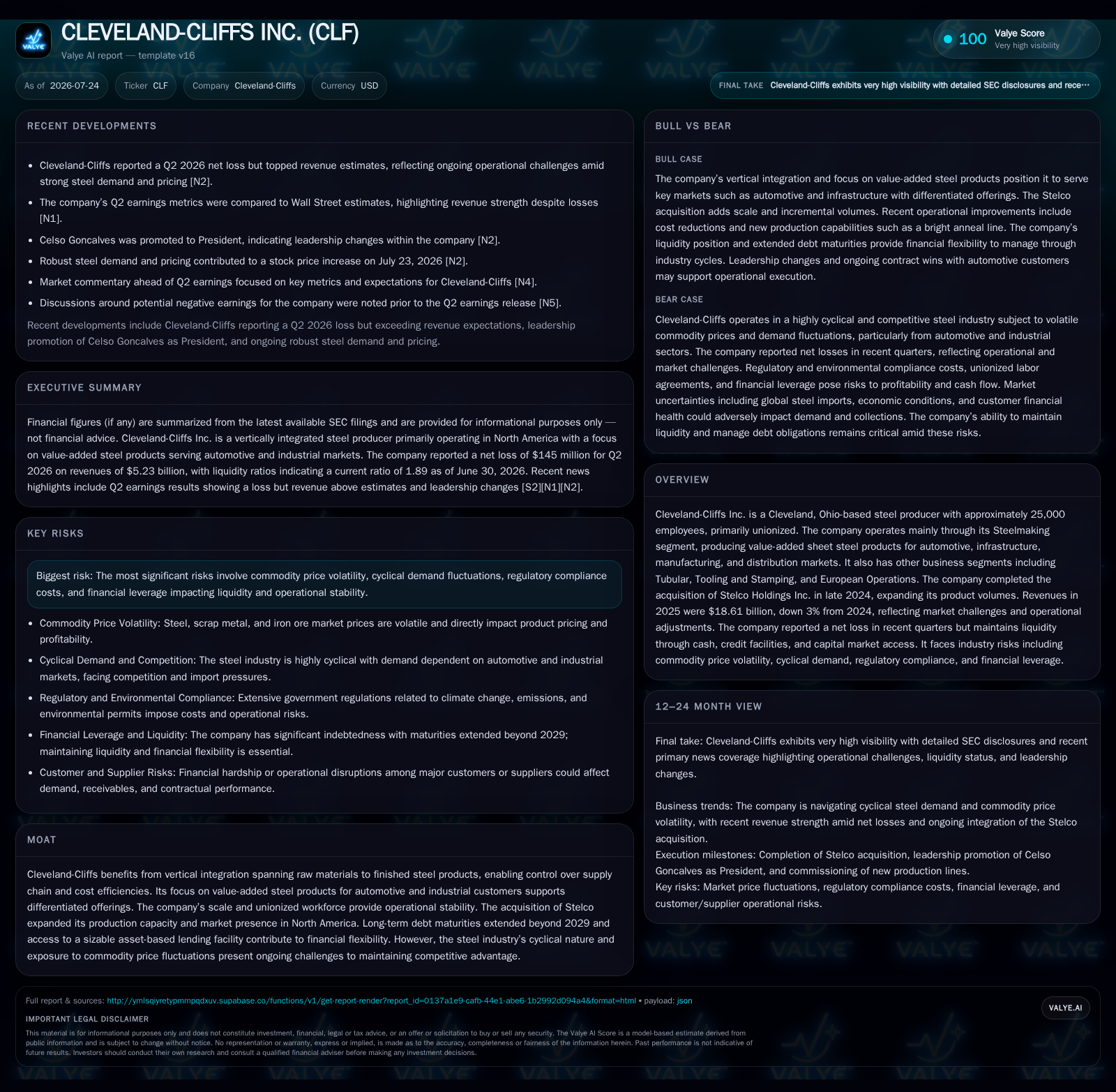
Cleveland-Cliffs Inc. reported a net loss in its latest quarter despite topping revenue estimates, driven by persistent challenges in market demand and cost pressures. The company’s vertically integrated steelmaking operations, including the strategic acquisition of Stelco, underpin its focus on value-added automotive and industrial products. However, steel industry cyclicality, volatile raw material prices, and regulatory challenges continue to compress margins. Cleveland-Cliffs’ financial flexibility is supported by extended debt maturities and a sizable asset-based lending facility, but ongoing leverage warrants monitoring. Growth hinges on improving end-market demand, trade protection policies, and operational efficiencies.
Recent Operating Update: Q2 2026 Results Reflect Market Pressures
Cleveland-Cliffs Inc.’s second-quarter 2026 earnings release highlighted a challenging operating environment marked by a net loss despite exceeding revenue expectations [S3][N2]. The company’s continued exposure to cyclical steel demand—particularly from the automotive sector—combined with elevated unit costs has pressured profitability. This dynamic sharpened in Q2 2026 amid persistent softness in vehicle production volumes offset partially by sustained pricing power driven by trade protection measures [S2][N1].
Management reaffirmed confidence in operational controls and disclosed no material changes to internal reporting or risk oversight systems for the quarter, emphasizing effective disclosure controls [S2]. Additionally, no significant adjustments to capital expenditure plans or strategic initiatives were announced concurrently [S3].
Business Model: Vertical Integration as a Competitive Anchor
Cleveland-Cliffs operates primarily as an integrated steel producer with an extensive vertical value chain encompassing iron ore mining, pelletizing, blast furnace operation, steel slab casting, rolling mills producing hot rolled coil (HRC), cold rolled coil (CRC), coated steels, along with downstream tooling and stamping capabilities [S1][S24]. This integration facilitates cost efficiencies by internalizing raw material supply risks and optimizing throughput across processing stages.
A strategic priority has been delivering value-added sheet steel products tailored mainly for automotive OEMs, infrastructure projects, manufacturing plants, and steel distributors [S1]. For instance, the company successfully completed production trials stamping exposed automotive parts using existing aluminum equipment—highlighting innovation in product application and customer collaboration [S1]. Multi-year fixed-price contracts with major auto customers further stabilize revenues through secured margins despite broader market volatility.
The late-2024 acquisition of Stelco Holdings notably expanded Cleveland-Cliffs’ production footprint into Canada, enhancing scale and access to new markets while broadening product offerings [S1][S23]. The deal involved share issuance and cash components, reinforcing shareholder alignment but contributing to increased leverage.
Industry Structure & Competitive Positioning
Within the steel manufacturing sector characterized by significant capital intensity and scale economies, Cleveland-Cliffs ranks among North America’s largest integrated producers alongside peers like United States Steel Corporation and Nucor Corporation. Unlike Nucor’s focus on mini-mill Electric Arc Furnace (EAF) technology emphasizing scrap recycling, Cleveland-Cliffs maintains traditional blast furnace-based operations complemented by electric furnaces for certain applications [S1]. This duality shapes cost structures and operational flexibility.
Trade policies remain pivotal in shaping competitive dynamics. The enforcement of steep U.S. tariffs on imported steel products has propped domestic prices above global benchmarks favorably impacting Cleveland-Cliffs’ realized selling prices [S1]. Similarly, Canada's imposition of tariff-rate quotas aids subsidiaries like Stelco against dumping risks.
Careful management of debt maturities is critical given cyclical swings may impair free cash flow generation [F1].
- Labor Dynamics: High unionization rates among hourly staff present potential negotiation risks impacting labor costs or causing disruptions.
What to Watch Next
Investors should monitor several operating markers that will illuminate execution success:
- Quarterly updates on steel shipment volumes, particularly hot rolled coil growth relative to slabs or specialty grades.
- Changes in average selling price per ton, reflecting tariff impacts or competitive pricing pressure.
- Updates on unit cost trajectory tied to raw material sourcing efficiency or technology implementation outcomes.
- Progress in expanding or renewing long-term customer contracts, especially multi-year agreements safeguarding automotive business.
- Developments in managing financial leverage metrics amid upcoming debt maturities beyond 2029.
- Regulatory updates or sustainability initiatives indicating the company's positioning relative to emerging ESG standards.
Financial Profile Discussion
As of June 30, 2026, Cleveland-Cliffs held approximately $70 million in cash against total debt outstanding near $7.77 billion resulting in net debt around $7.7 billion [$F1]. Debt maturities have been staggered prudently with senior notes extending past 2029 following refinancing activities during 2025 which also lowered near-term refinancing risk [S13][S14]. Capital expenditures are aligned primarily toward sustaining assets with planned spend roughly $700 million annually focused on regulatory compliance and selective capacity enhancements.
Operating losses reported recently underscore the margin pressure embedded within current industry cycles but ongoing unit cost reductions initiated over prior years offer some offset potential over time [S18]. Balancing capital allocation between deleveraging efforts and growth investments will be critical going forward.
Disclaimer: This analysis is based solely on publicly available information including SEC filings dated up through July 23, 2026. It does not constitute investment advice or research views regarding securities of Cleveland-Cliffs Inc.
Disclaimer: This is research-only, informational analysis and not investment advice. It may include AI-generated interpretation and general industry context. Always verify important details using primary sources.

Comments