
ClearSign Technologies Advances Combustion Efficiency Amid Regulatory Shifts
ClearSign's latest quarterly disclosures highlight operational traction in low-NOx burner deployments amid evolving emissions regulations.
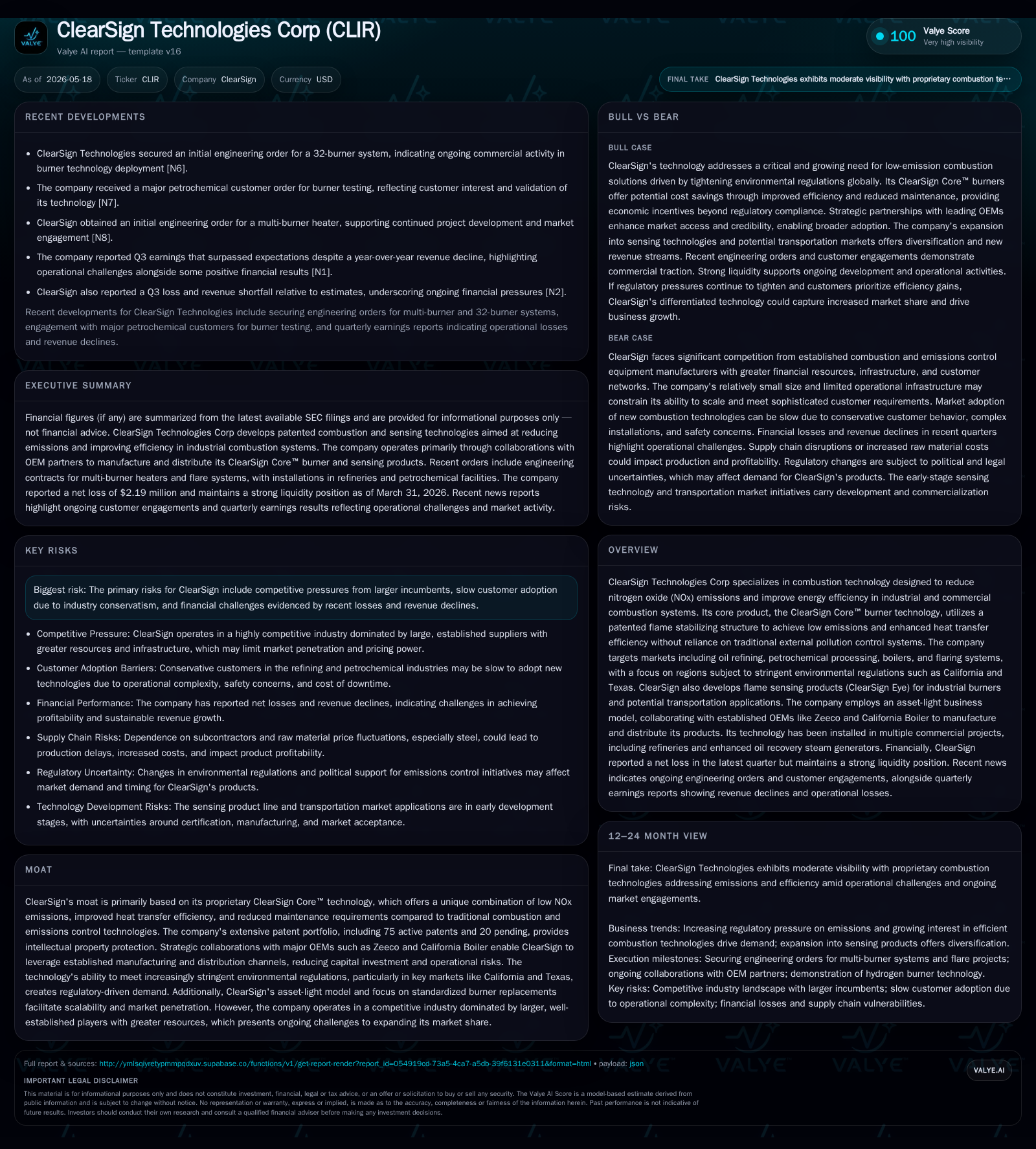
In its May 2026 quarterly filing, ClearSign Technologies Corp reported ongoing progress in expanding adoption of its patented ClearSign Core™ combustion technology, notably in retrofit flare and thermal oxidizer projects targeted at regulated U.S. markets. The company's asset-light model leveraging strategic OEM partnerships underpins its go-to-market approach in industrial combustion sectors, focusing on reducing nitrogen oxide (NOx) emissions while delivering efficiency improvements. Despite persistent financial losses reflecting early commercial scaling, ClearSign benefits from a robust intellectual property moat and favorable regulatory tailwinds at state and local levels. Key risks include slow industry adoption and entrenched competitors. Near-term catalysts hinge on execution of current bids and further installations validating technology performance and economic benefits.
Latest Quarterly Operating Update and Its Strategic Implications
ClearSign Technologies' most recent Form 10-Q filing dated May 15, 2026 ([S2]) updates on the company’s operational stance entering mid-2026. The quarter's disclosures reinforce progress in order intake for flare retrofit systems and thermal oxidizers—sectors increasingly targeted by state regulators focusing on NOx emissions reductions. These developments align with recent orders from an existing California energy customer for multiple retrofit flare components including burner fabrication, stack design, controls sourcing, CFD studies, engineering assessments, and related services.
Complementing this is evidence from a recent April 2026 conference call transcript ([S3]) highlighting management’s emphasis on advancing proposals in neighboring states with similarly stringent environmental regimes driven by regional air quality boards. Collectively, these updates signal enhanced validation of ClearSign’s technology offerings amidst tighter environmental requirements. Despite these operational strides, the filings underscore continuing financial losses—a characteristic associated with early commercialization phases underpinning risk perception among stakeholders.
ClearSign’s Core Technology and Business Model: Innovation in Combustion
At the heart of ClearSign’s offering is its patented ClearSign Core™ burner technology ([S1], Valye excerpt). This innovation leverages a patented porous ceramic or metal flame stabilizer positioned away from fuel injection planes to markedly shorten flame length and reduce nitrogen oxide (NOx) formation during combustion. Unlike incumbent solutions requiring costly external flue gas recirculation or selective catalytic reduction (SCR) systems, ClearSign's design achieves ultra-low NOx outputs inherently while simultaneously elevating heat transfer efficiency by a low to mid-single digit percentage range—validated by both customer field data and independent third-party testing.
This dual advantage facilitates both emission compliance and operational cost savings that can translate into attractive payback periods for end users—a critical value proposition in industrial combustion markets traditionally burdened by incremental product improvements limited primarily to emissions control compliance rather than efficiency gains.
The company furthers its go-to-market reach through an asset-light business strategy that partners closely with established burner OEMs such as Zeeco and California Boiler ([S1], [S21]). This approach allows ClearSign to avoid heavy capital expenditures associated with direct manufacturing while leveraging the supply chain expertise and brand credibility of major OEMs. Such collaborations ease customer concerns around vendor reliability—a nontrivial factor given industry conservatism—and facilitate scalable deployment across complex industrial installations.
Competitive Environment and Industry Regulatory Pressures
The combustion technology market ClearSign targets is intensely competitive, dominated by large incumbents supplying well-entrenched combustion and emissions control equipment including SCRs, flue gas recirculation setups, and ultra-low NOx burners ([S22]). These legacy solutions are generally commoditized with minimal differentiation beyond price—a scenario that has frustrated innovation but solidified customer expectations centered on regulatory compliance rather than operational enhancements.
ClearSign seeks to disrupt this paradigm through its differentiated clear-core burner platform guarded by a portfolio of approximately 75 active patents plus 20 pending applications spanning jurisdictions including the U.S., China, and Europe ([S4]). This intellectual property coverage provides a safeguard against large competitors attempting direct technological replication.
Regulatory dynamics add complexity but also opportunity. While federal-level greenhouse gas policy is currently uncertain following the EPA's rescission of the 2009 greenhouse gas endangerment finding ([S27]), state-level agencies in California, Texas, and others sustain aggressive programs curbing NOx emissions particularly from flares and boilers—the primary target applications for ClearSign's burners. These regulatory pressures create demand pull for novel ultra-low emission solutions able to meet or exceed anticipated standards without incurring high aftermarket cleanup costs typical of SCR installation.
Growth Drivers: Market Adoption and Regulatory Tailwinds
ClearSign's growth is catalyzed chiefly by increasing local regulations limiting NOx emissions from industrial combustion sources such as flares and once-through steam generators (OTSGs), particularly within environmentally sensitive regions.[S1],[S29] Purchase orders for flare retrofits highlight commercial traction stemming from customers seeking not only compliance but also efficiency gains that reduce overall energy usage costs.
Multiple successful installations documented via ongoing field data reporting indicate measurable fuel savings between approximately 3% to nearly 5%, with concurrent electricity consumption reductions up to 25% depending on operating conditions ([S12]). Such figures bolster product credibility among prospective adopters who historically may have regarded NOx control technologies as purely a cost imposition.
Additionally, ClearSign plans commercialization of complementary flame sensing products under the ClearSign Eye brand targeting broader burner safety monitoring markets—including retrofit opportunities beyond NOx-specific emissions control—that represent expansive volume potential given their applicability across burner types irrespective of emissions mandates ([S29]). Ongoing pilot deployments with refining customers will be pivotal for market validation.
Maintenance simplification inherent in ClearSign’s designs also constitutes a growth vector as industrial operators prioritize durable low-maintenance burners capable of sustained performance under harsh operating environments. Incremental enhancements like these support long-term retention once initial penetration is achieved.
Risks and Challenges: Adoption Friction, Competitive Landscape, Financial Position
Despite promising technical credentials and regulatory tailwinds, ClearSign confronts notable headwinds typical for disruptive cleantech ventures operating within conservative capital goods industries.[S1], Customer adoption cycles remain extended driven by risk-averse decision-making behaviors prevalent among industrial end-users accustomed to legacy suppliers.
The competitive landscape includes large incumbents with deep pockets capable of leveraging established relationships; coupled with mature product lines, they exert sustained pricing pressure impacting market entry viability ([S22]). Although patent protection mitigates direct copying risks, indirect competition via established technological pathways remains a formidable obstacle.
Financially, the firm continues to report operating losses into fiscal year-end December 2025 with an operating income deficit close to $6.7 million per year ([F1]). Cash reserves stood at approximately $7.7 million as of March 31, 2026 against nominal debt (~$98k), resulting in a current ratio of about 4.05 times coverage indicating healthy short-term liquidity but necessitating continued capital raises or improved cash flow generation going forward.[F1]
Legal exposure exists around a Delaware court case involving former directors’ advancement fees estimated near $319 thousand; management currently views this as unlikely to materially impair operations ([S23]). Regulatory uncertainties at the federal level create some macro unpredictability but are partially offset by stable state-driven enforcement leading adoption incentives.[S27]
Key Upcoming Milestones and Investor Watchpoints
Investor focus should center on successful conversion of current bid pipeline into firm contracts across targeted flare retrofit projects in California and expansion into Texas markets demonstrated in recent disclosure ([S3], S29). Validation milestones include third-party confirmation of emission reductions alongside operational uptime metrics post-installation critical for wider acceptance.
Progression from pilot phase towards commercialization of the flame sensing product line will provide additional revenue diversification beyond core burners ([S29]). Monitoring ongoing strategic engagement levels with OEM partners will be essential given their pivotal role in scaling manufacturing capacity without adding company capital burden.[S21]
Any shifts in local environmental regulations imposing stricter NOx limits would serve as potential accelerants; conversely delays or rollbacks could dampen momentum despite strong structural drivers.[S4]
Summary of Financial Position and Liquidity Snapshot
As per the latest publicly available data covering up to March 31, 2026 ([F1]), ClearSign maintains cash reserves totaling roughly $7.7 million juxtaposed against minimal long-term debt approximated at $98 thousand recorded previously though no later debt figure was published.
Nonetheless, recurring net losses persist with operating income recorded at negative $6.67 million per fiscal year ending December 2025 reflecting ongoing investment phases necessary to commercialize its technology suite. Absent immediate revenue scale-ups or additional capital infusion strategies disclosed recently, sustaining extended R&D efforts or sales expansion remains materially dependent on funding resources.
---
This analysis incorporates information extracted solely from publicly filed SEC documents up to May 18, 2026 without projecting future performance or providing investment advice.
Financial position in context
As of 2026-03-31, companyfacts shows $7.7 million in cash and equivalents [F1]. Current assets of approximately $8.78 million and current liabilities of $2.17 million imply a current ratio near 4.05x for 2026-03-31 [F1].
Disclaimer: This is research-only, informational analysis and not investment advice. It may include AI-generated interpretation and general industry context. Always verify important details using primary sources.

Comments