
Climb Bio’s Clinical-Stage Growth Hinges on Budoprutug Trials and Capital Runway to 2028
Climb Bio pursues immune-mediated diseases with novel monoclonal antibodies targeting B cells, balancing clinical advances against significant capital needs and competitive pressure.
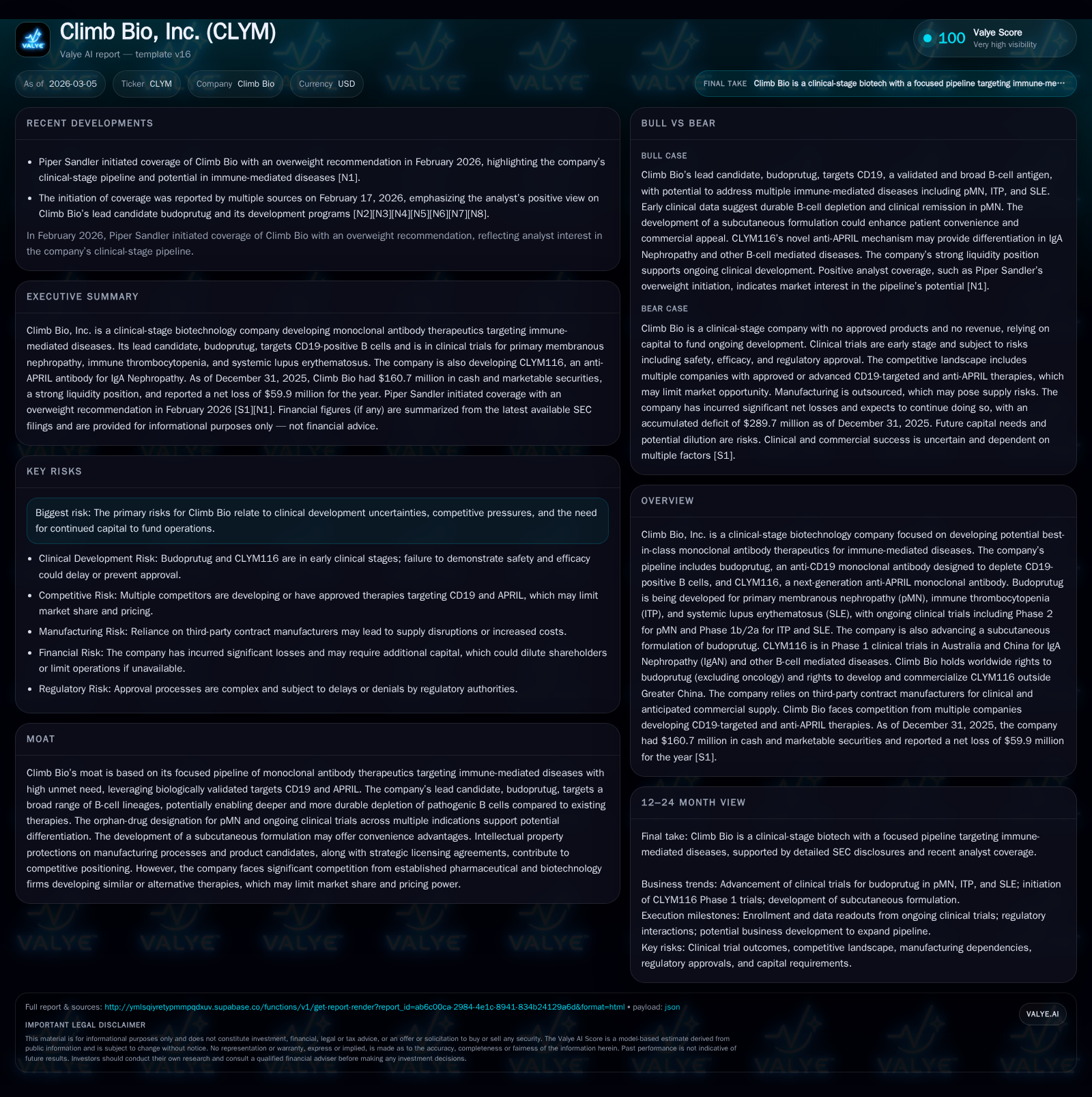
Climb Bio, a clinical-stage biotech, focuses on potentially best-in-class monoclonal antibodies for immune-mediated diseases, primarily through its lead candidate budoprutug targeting CD19-positive B cells. The company improved operating losses from $82 million in 2024 to $67.9 million in 2025, supported by over $160 million in cash and equivalents expected to fund operations into 2028. Budoprutug’s Phase 2 pMN trial and Phase 1b/2a ITP and SLE studies, alongside early trials of CLYM116 in IgAN, form key growth catalysts but remain subject to typical biotech clinical and regulatory risks. Climb Bio navigates a competitive landscape with established pharma players while managing high R&D expenses and complex regulatory environments.
Company Overview
Climb Bio, Inc. is a clinical-stage biotechnology company developing monoclonal antibody therapeutics targeting immune-mediated diseases. Its lead candidate is budoprutug, an anti-CD19 monoclonal antibody designed to deplete CD19-positive B cells — crucial drivers of pathology in diseases such as primary membranous nephropathy (pMN), immune thrombocytopenia (ITP), and systemic lupus erythematosus (SLE). Budoprutug aims for durable disease modification via broad B-cell lineage targeting including plasmablasts that evade existing CD20-targeted therapies.
The company also licenses CLYM116 from Mabworks Biotech — an anti-APRIL antibody distinct mechanistically — currently at Phase 1 trials targeting IgA nephropathy (IgAN) predominantly outside the Greater China region [S1][S10]. Climb Bio holds worldwide rights to budoprutug excluding oncology indications and commercial rights for CLYM116 outside mainland China, Hong Kong, Macau, and Taiwan.
Historical Performance
As a clinical-stage entity with no approved products or commercial revenue, Climb Bio's financials reflect heavy investment in research and development combined with corporate overhead costs. Operating losses narrowed from $82 million in FY2024 to approximately $67.9 million in FY2025 — a substantial improvement though still sizable [F1]. Net loss followed suit from about $74 million to almost $60 million year-over-year signaling better cost management or milestone-driven expense timing.
Operating cash flow remained negative at roughly -$54.4 million in FY2025 amidst continued advancement of multiple clinical programs [F1]. The accumulated deficit stood near $290 million at year-end 2025 [S1]. Despite these losses, the balance sheet shows healthy liquidity with $35.7 million in cash and equivalents plus total current assets of $105.8 million sufficient to fund operating plan through at least 2028 under current assumptions [S1][F1].
Historical performance (annual)
| FY | Net ($mm) | CFO ($mm) | OpInc ($mm) | Net YoY |
|---|---|---|---|---|
| 2025 | -60 | -54 | -68 | +19.0% |
| 2024 | -74 | -16 | -82 | -110.4% |
| 2023 | -35 | -21 | -40 | +22.4% |
| 2022 | -45 | -37 | -45 |
Source: SEC companyfacts cache [F1].
Capital returns and efficiency (annual)
| FY | ROE% |
|---|---|
| 2025 | -37.3 |
| 2024 | -34.9 |
| 2023 | -32.6 |
| 2022 | -35.2 |
Source: SEC companyfacts cache [F1].
Operating income improved by ~17% YoY from FY24 to FY25; net loss improved by ~19% YoY; operating cash flow worsened reflecting increased clinical activity.
Future Growth Prospects
The primary growth drivers hinge on budoprutug's ongoing Phase 2 trial in pMN alongside Phase 1b/2a multisite studies covering ITP and SLE populations where persistent autoantibody-secreting plasmablasts represent unmet need [S1]. Development includes a subcutaneous formulation aimed at improving patient convenience over intravenous dosing if successfully developed.
CLYM116 remains at early Phase 1 stages offering diversification into APRIL-targeted therapies for IgAN — another difficult-to-treat immune-mediated kidney disorder — with potential application breadth beyond nephrology [S10].
Success will depend heavily on demonstrating superior B-cell depletion depth, durability of responses across indications relative to existing B cell therapies (particularly CD20-targeting rituximab biosimilars), acceptable safety profiles, and reimbursement feasibility amid pricing pressures facing novel biologics.
Constraints include:
- Clinical trial enrollment challenges typical for rare autoimmune renal disorders;
- Regulatory review timelines given evolving FDA/EMA guidelines for autoimmune biologics;
- Competition from large pharma developing CD19-directed CAR T therapies or bispecific antibodies plus APRIL antagonists;
- Pricing/reimbursement pressures amid healthcare budget constraints;
- Manufacturing scale-up risks relying exclusively on third-party CDMOs affecting supply consistency pre-commercial launch.
Forecasts / Milestones / Expectations
While explicit official guidance beyond cash runway has not been provided publicly [S1], key watchpoints include:
- Timing and top-line readouts from the ongoing Phase 2 pMN study,
- Safety and preliminary efficacy data from Phase 1b/2a studies across ITP and SLE cohorts,
- Progress updates on subcutaneous budoprutug formulation development,
- Early results from CLYM116 Phase 1 trials conducted internationally,
- Regulatory interactions around pivotal study designs or approval timelines.
These milestones will materially affect the risk-adjusted valuation outlook.
Returns / Capital Allocation
With no product revenue or profits yet realized, returns analysis centers on operational efficiency and capital deployment sustainability rather than shareholder yield metrics. Net losses narrowed from about $74 million in FY24 to nearly $60 million in FY25 paralleling investment scale-up [F1]. Operating cash flow was negative $54.4 million for FY25 indicating ongoing burn driven mainly by R&D encompassing external CRO/CDMO costs plus headcount expansion [F1][S15].
Climb Bio raised approximately $120 million gross proceeds via private placement concurrent with its June 2024 acquisition of Tenet Medicines supporting pipeline expansion [S10]. This equity injection alongside prudent cash management underpins the projection that current capital suffices into year-end 2028 absent unforeseen acceleration or expense spikes [S17].
No dividends or buybacks have been declared consistent with typical biotech reinvestment cycles focused solely on advancing product candidates through development.
Return on equity based on trailing figures is approximately negative -37%, reflecting persistent net losses relative to equity base [$59.9M net loss / $160.5M equity end-2025] [F1].
Competitive Positioning and Intellectual Property Considerations
Climb Bio’s competitive moat derives from narrowly targeted biologics: leveraging validated targets CD19 for broad-spectrum B-cell modulation and APRIL blockade via CLYM116 aiming for best-in-class features like profound pathogenic B cell depletion potentially overcoming limitations of CD20-resistant disease elements.
Budoprutug holds orphan drug designation for pMN underscoring niche market protection strategies aligned with unmet medical needs.
Competition includes large pharmaceutical companies advancing immunomodulators such as CAR T or bispecific T cell engagers targeting similar B-cell subsets or broader immune checkpoints potentially overshadowing monoclonal antibodies if proved more efficacious or safer [S21]. Biosimilars exert pricing pressure especially concerning CD20 classes defining benchmark therapy standards new entrants must surpass.
Intellectual property protections secured via licenses with CRH (budoprutug) and Mabworks (CLYM116) provide access to key patents and manufacturing know-how critical during clinical phases but entail patent litigation risk common in biotech that could delay commercialization or add costs [S25][S26].
Strategic development of subcutaneous formulations aims not only at efficacy/safety improvements but also enhanced real-world usability—a commercial differentiator especially relevant in chronic autoimmune diseases.
Risks Summary
Key risks include:
- Clinical Development: High failure rates inherent to late-stage biologics given unknown safety/efficacy profiles remain central existential risk.
- Capital Needs: Though current cash covers multi-year outlook under present plan, accelerated programs or setbacks could heighten financing urgency disrupting timelines.
- Regulatory: Complex global compliance without precedents adds uncertainty around timing/cost.
- Intellectual Property: Reliance on licensed patents invites challenge risk potentially undermining rights or requiring costly disputes.
- Commercialization: No internal manufacturing capacity; dependence on third-party vendors exposes supply chain volatility risks.
- Market Competition & Pricing: Presence of large-cap competitors developing alternative immune-targeting regimens may limit uptake regardless of efficacy.
- Legal & Compliance: Exposure to healthcare laws including anti-kickback statutes and data privacy regulations necessitates ongoing compliance investments mitigating sanctions risk that could impair operations .
Conclusion
Climb Bio stands at a pivotal clinical-stage biotech juncture: advancing promising monoclonal antibodies addressing underserved autoimmune diseases amid substantial financial losses typical at this phase. Progress toward data milestones over coming years alongside successful navigation of regulatory hurdles will be determinative yet challenging.
Robust liquidity offers operational security into late next decade barring unexpected developments. Stakeholders should monitor clinical data progression timelines, enrollment status updates, cash burn trends versus forecasts if program scopes shift—and competitive moves that could reshape commercial prospects upon regulatory approvals.
Disclaimer: This report does not constitute investment advice or a recommendation regarding any security or issuer and should be used solely for informational purposes consistent with Valye News policies.
Disclaimer: This is research-only, informational analysis and not investment advice. It may include AI-generated interpretation and general industry context. Always verify important details using primary sources.

Comments