
Comcast Corp’s First Quarter 2026 Operating Transformations and Strategic Recalibration
Q1 2026 segment restructuring, customer metric revisions, and network investments redefine Comcast's growth trajectory amid industry shifts.
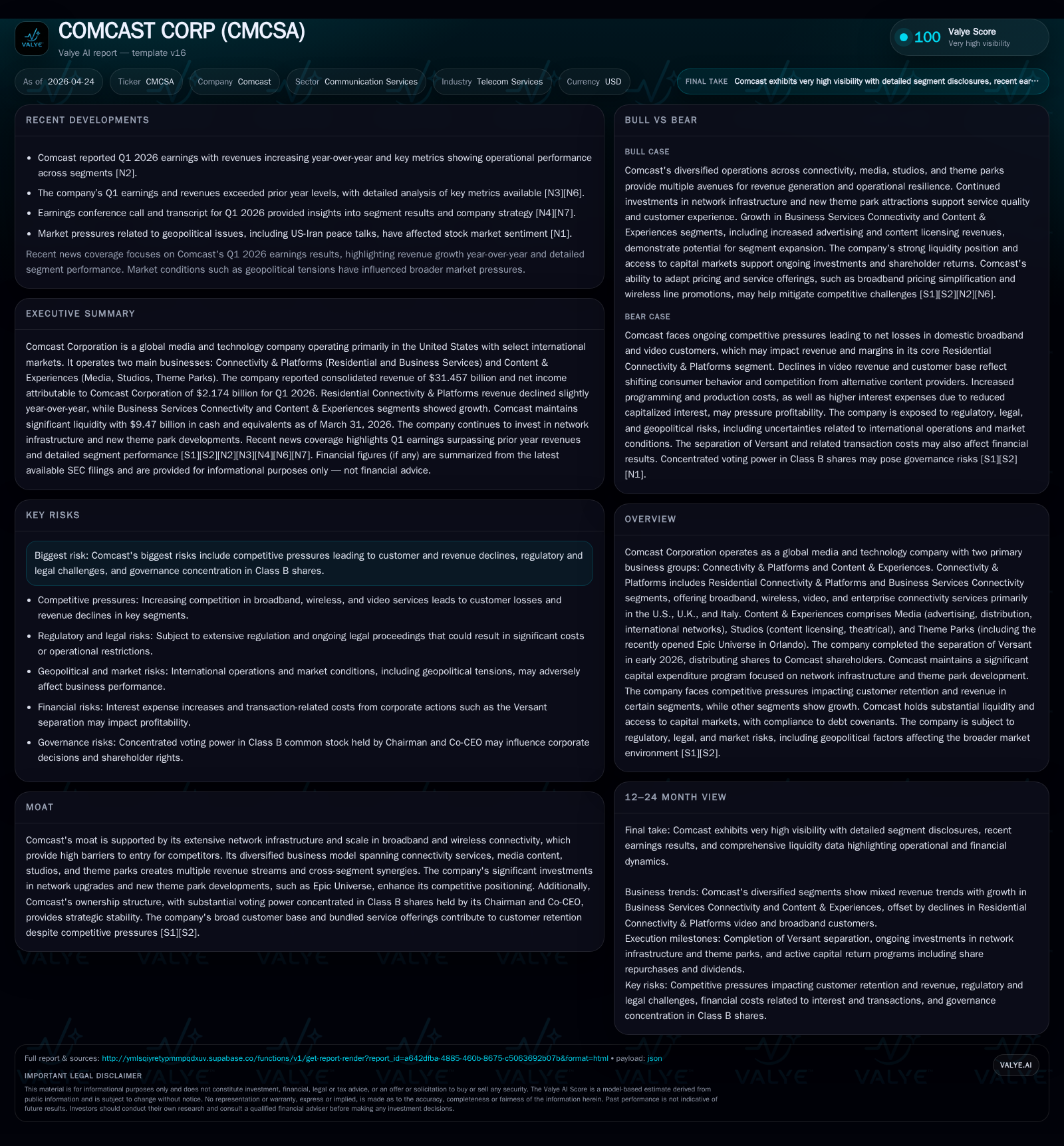
Comcast’s Q1 2026 filings reveal a strategic reset following the Versant separation, with adjusted segment reporting, updated customer counts reflecting methodological changes, and a widening content programming cost base. The company’s dual focus on Connectivity & Platforms and Content & Experiences underpins multiple growth vectors but faces headwinds from broadband subscriber declines and pricing pressures. Capital spending on network expansion and new theme park developments like Epic Universe supports longer-term positioning. Financial constraints include margin pressures despite rising revenues and a leveraged capital structure anchored by substantial programming investments and debt.
Latest Quarterly Operating Update: New Segment Reporting and Customer Trends
Comcast’s first quarter 2026 (ending March 31) disclosed in its April 23 SEC 10-Q filing [S2] reflects notable operational transformations post the January 2 Versant separation. The company realigned its segment structure into five segments—Residential Connectivity & Platforms, Business Services Connectivity, Media, Studios, and Theme Parks—excluding Versant’s historical results from Media and reclassifying regional sports networks revenue into Corporate and other [S2][S3]. A key adjustment was made to customer metrics methodology reducing total Residential Connectivity & Platforms customers by approximately 125,000 without affecting net additions comparably [S2].
Domestic residential passings (homes/businesses Comcast can connect) increased modestly to over 59 million units [S14], however broadband penetration declined from 50.3% to approximately 48.4% indicating subscriber erosion continues despite network reach expansion [S13][S14]. While broadband customers decreased by about 65,000 sequentially after methodology adjustment, domestic wireless lines rose strongly by over 435,000 [S13], evidencing ongoing shifts towards mobile connectivity within Comcast’s ecosystem.
Commercial contracts post-separation include a two-year agreement to sell linear and digital advertising inventory for Versant, recorded as net commission revenue supporting Media segment reshape [S2]. These structural reporting changes coupled with evolving customer dynamics define the current operational baseline.
Business Model and Product Ecosystem: Connectivity & Platforms Plus Content & Experiences
Comcast operates through two overarching business groups as defined in its annual disclosure [S1]: Connectivity & Platforms (Residential Connectivity & Platforms plus Business Services Connectivity) comprising broadband internet (fixed-wireline), wireless service resale/retail, video distribution assets; and Content & Experiences encompassing Media (advertising sales, domestic/international networks), Studios (licensing content), and Theme Parks including newly opened Epic Universe in Orlando [S1][S2].
The Connectivity business leverages extensive network infrastructure particularly across the United States alongside presence in the UK and Italy for international connectivity markets [S1]. Residential Connectivity generates revenue primarily from broadband subscriptions including related equipment sales/installations plus bundled wireless service additions incentivized via simplified pricing plans offering free wireless lines for retention [S4]. Business Services Connectivity has recently seen modest growth driven by enterprise solutions adoption.
Content & Experiences delivers diversified media revenues from domestic advertising resales—including via the new Versant-related commission model—distribution fees, international network carriage fees, theatrical releases under Studios, and theme parks admission/operations receipts [S7][S9]. The portfolio shift post-Versant has broadened independent content monetization while reducing prior integration complexity.
Bundled offerings across broadband/wireless/video content form an underpinning of Comcast's customer retention strategy despite secular declines in traditional video subscribers reflecting cord-cutting trends [S1][N3]. The company also capitalizes on cross-selling ecosystem synergies especially between connectivity platforms enabling OTT streaming services aligned with evolving consumption patterns.
Competitive Positioning and Industry Structure: Scale, Moat, and Market Dynamics
Comcast’s competitive moat centers around its expansive U.S. network spanning roughly 59 million passed homes/businesses end-Q1 2026 [S14], representing high capital intensity barriers to entry for rivals especially in fixed broadband delivery. This physical infrastructure advantage buttresses differentiated services including high-speed internet tiers coupled with hybrid wireless mobile offerings that partially compensate for declining cable video subs [S1][S23].
Despite this scale edge, Comcast faces realistic churn challenges with domestic broadband customers falling moderately even as wireless lines increase—a mixed unit economics profile where fixed-line revenue per customer is pressured from competitive rate cuts or promotional bundles as noted in management's commentary on simplified pricing impacts [S4][S5]. Video subscriber losses continue as OTT proliferation fragments viewing; advertising revenue similarly contends with digital ad market volatility despite incremental gains from new inventory sales deals post-Versant spinoff [S7][N3].
The industry landscape remains dynamic with emerging technologies (e.g., fiber upgrades sandwiched against DOCSIS cable deployments), regulatory scrutiny around pricing fairness (especially bundling practices), and intensified competition from satellite/5G fixed wireless providers likely constraining pricing power resilience absent further innovation or cost control [S22][N9]. Switching costs partly stem from Comcast’s bundled product mix but will require sustained investment to prevent volume erosion.
Growth Opportunities and Constraints: Network Investments, Customer Retention, and Content Strategies
Growth drivers for Comcast rest prominently on expanding residential/business passings using capital expenditure programs targeting network scalability for next-generation broadband speeds—approaching $8.7 billion spent annually in the Connectivity segment per recent disclosures—with associated equipment upgrades aimed at enhancing customer experience and lowering churn risk via service tier diversification [S19][S24].
Conversely, constraints are evident from video revenue declines driven by persistent subscriber losses (~322,000 fewer domestic video customers Q1 vs prior year) consistent with industry trends shifting consumer preferences away from traditional pay-TV models [S13]. Programming expenses inflate particularly due to licensed sports rights surging license costs (up ~99% year-on-year to $5.59 billion quarterly), pressuring margins despite revenue increases elsewhere [S2][S24].
Retention efforts such as giving free wireless lines for one year bundled with broadband subscriptions signal tactical moves addressing near-term ARPU dilution yet may improve lifetime customer value through ecosystem lock-in [S4][N3]. Theme parks contributions have accelerated post-Epic Universe opening providing experiential growth vectors outside telecom/media cyclicality while studios continue leveraging owned content licensing internationally.
Going Forward: Key Milestones, Demand Signals, and Execution Priorities
Investors should monitor customer metric trends closely given the recent methodology revision impact; actual net additions in connectivity will be critical barometers of competitive efficacy especially balancing wireless growth against broadband loss normalization going forward [S2][N3]. Increases in programming costs warrant vigilance on licensing negotiation outcomes given their disproportionate influence on overall operating income margins.
Completion stages of large-scale theme park projects such as Universal's Beijing Resort alongside enhancing monetization of content rights represent strategic execution points beyond core telecom operations worth watching for contribution visibility [N3]. Cost management discipline amidst elevated marketing/promotion spend will influence results pacing against guidance now that the historical Versant synergy effect is removed.
Overall focus includes rationalizing adjusted EBITDA margin compression via operational leverage gains as capex enters different phases; sustaining free cash flow generation to maintain dividends/share repurchases balanced against heavy infrastructure financing requirements remains pivotal.
Financial Overview: Capital Structure, Program Costs, and Cash Flow Dynamics
For Q1 2026 ending March 31 per SEC filings [S2], Comcast reported consolidated revenue of $31.457 billion—a 5.3% increase year-over-year driven largely by Content & Experiences offsetting a slight falloff in Connectivity revenues. Programming and production expenses escalated sharply by nearly $2.5 billion (+29%) versus prior year period largely attributable to licensed sports rights escalating to about $5.59 billion for the quarter up from $2.8 billion previously [S2].
Adjusted EBITDA declined notably within Residential Connectivity (down ~6%) reflecting margin contraction given cost inflation pressure; Business Services showed modest adjusted EBITDA growth of ~3.8% [S4]. The consolidated operating income declined around 27% year-over-year due predominantly to higher operating costs including marketing/promotion up ~4.5%, depreciation rising slightly (+4.6%), partially offset by lower amortization (-5.3%) [S24].
Cash & equivalents stood at approximately $9.47 billion against total debt nearing $89.2 billion yielding net debt close to $79.75 billion at quarter close; current ratio was sub-1 at approximately 0.87 highlighting working capital tightness typical for telecom infrastructure-heavy firms [F1][S16][S18]. Capital expenditures remain significant with ongoing investments targeting scalable infrastructure upgrades to support expanded bandwidth demands alongside theme park development commitments totaling about $11.75 billion spent fiscal year ended December 2025 as a backdrop [F1][S19][S24].
Dividend payouts were around $4.9 billion annually supported by over $21 billion free cash flow generation capacity (operating CF minus capex); share repurchase activity moderated relative to prior years consistent with balance sheet deleveraging cautionary stance amid rising interest expense levels (~$1.09 billion quarterly) reflected in Q1 interest charges reported [F1][S26].
| Segment Revenue & Adjusted EBITDA Q1 2026 vs Q1 2025 | Residential Connectivity & Platforms | Business Services Connectivity | Media | Studios | Theme Parks |
|---|---|---|---|---|---|
| Revenue ($ millions) | 17,323 | 2,640 | 7,280 | 3,426 | 2,331 |
| Adjusted EBITDA ($ millions) | 6,434 | 1,476 | (426) | 555 | 551 |
| Adjusted EBITDA Margin (%) | 37.1 | 55.9 | N/A | N/A | N/A |
| Revenue YoY Change (%) | -1.9 | +5.8 | +60+ | +21+ | +24+ |
| Customer Metrics Updates Q1 2026 | Domestic Broadband Customers | Domestic Wireless Lines | Domestic Video Customers |
|---|---|---|---|
| Total Customer Count (post methodology adj.) | ~28.65 million | ~9.74 million | ~10.95 million |
| Sequential Net Additions/(Losses) | -65k | +435k | -322k |
| Broadband Penetration of Passed Homes (%) | ~48.4 % | N/A | N/A |
| Programming & Production Costs Breakdown Q1 | Amount ($ millions) | YoY % Change |
|---|---|---|
| Video Distribution Programming | $2,381 | -10% |
| Owned Film/TV Content | $2,561 | -3% |
| Licensed Content incl Sports Rights | $5,589 | +99% |
| Other Programming Costs | $352 | +19% |
| Total Programming & Production Costs | $10,884 | +29% |
| Capital Expenditure & Cash Flow Summary FY2025-Q1 |
|---|
| Annual Capex FY2025 |
| Approximate Capex Spending Increase Over Prior Year (%) |
| Free Cash Flow FY2025 (Operating CF minus Capex) |
Historical performance (annual)
| FY | Rev ($bn) | Net ($bn) | CFO ($bn) | OpInc ($bn) | Rev YoY | Net YoY |
|---|---|---|---|---|---|---|
| 2025 | 20.0 | 33.6 | 20.7 | +23.5% | ||
| 2024 | 16.2 | 27.7 | 23.3 | +5.2% | ||
| 2023 | 121.6 | 15.4 | 28.5 | 23.3 | +0.1% | +186.6% |
| 2022 | 121.4 | 5.4 | 26.4 | 14.0 | +4.3% |
Source: SEC companyfacts cache [F1].
Capital returns and efficiency (annual)
| FY | Div ($bn) | Buybacks ($bn) | FCF ($bn) |
|---|---|---|---|
| 2025 | 4.9 | 7.2 | 21.9 |
| 2024 | 4.8 | 9.1 | 15.5 |
| 2023 | 4.8 | 11.3 | 16.3 |
| 2022 | 4.7 | 13.3 | 15.8 |
Source: SEC companyfacts cache [F1].
In summary, Comcast navigates a complex landscape marked by divergent trends across its connectivity services versus content-driven businesses following the Versant spin-off structural changes that refine its operating profile moving forward while grappling with fundamental cost inflation pressures amid competitive subscriber dynamics.
This analysis is based solely on publicly available regulatory filings dated up to April 23-24, 2026 ([S#], [F1], [N#]) without any forward-looking statements or investment recommendations.
Disclaimer: This is research-only, informational analysis and not investment advice. It may include AI-generated interpretation and general industry context. Always verify important details using primary sources.

Comments