
Coda Octopus Group Strengthens Market Position Through Innovative Sonar and Defense Solutions
A technology-driven firm leveraging proprietary underwater imaging and strategic acquisitions to build competitive defense and acoustic sensor capabilities.
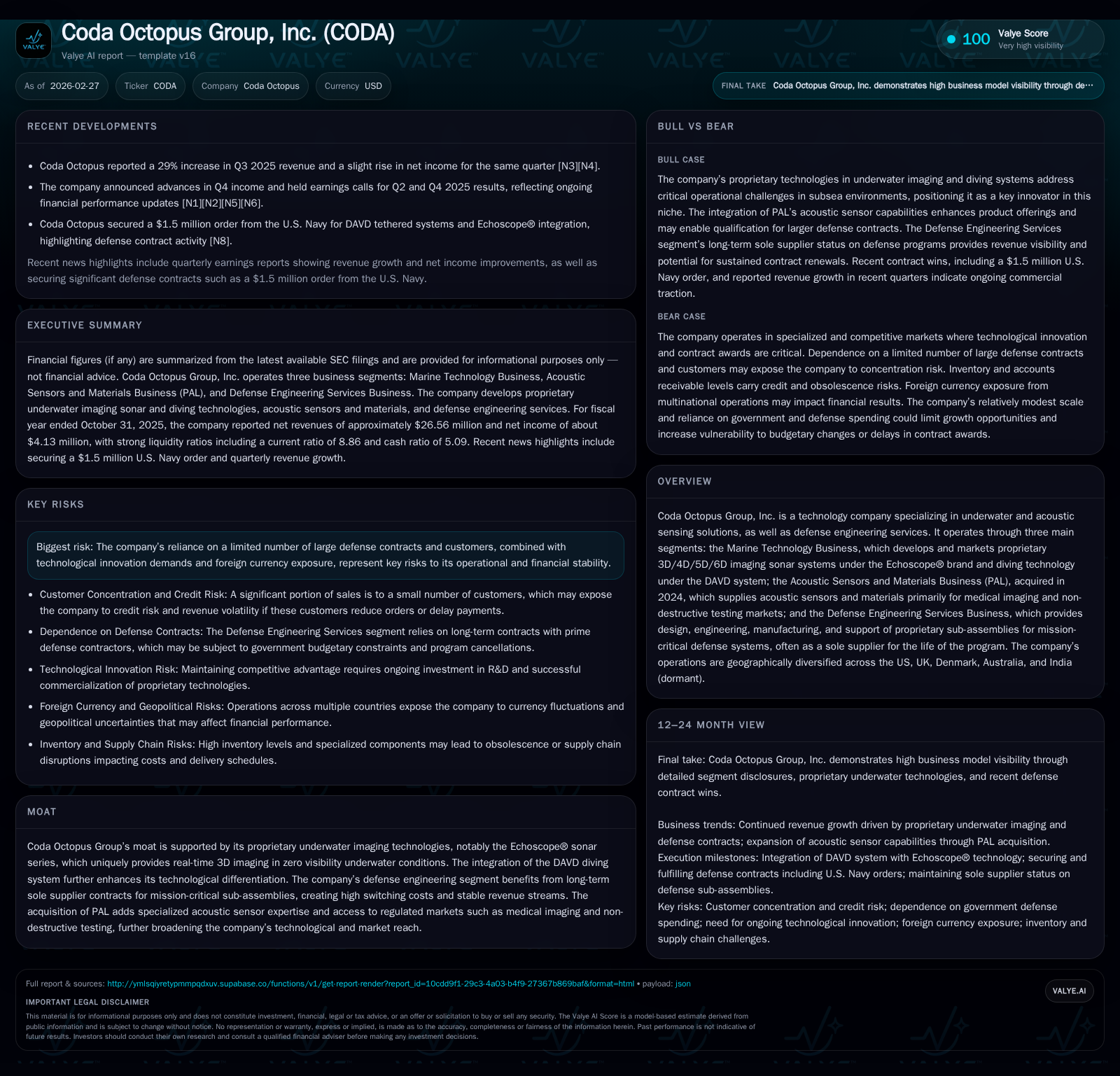
Coda Octopus Group, Inc. has solidified its niche by combining state-of-the-art real-time 3D underwater imaging technologies with defense engineering services and a recent foray into acoustic sensors through the PAL acquisition. Despite a modest dip in revenues during 2022–2024, the company demonstrated operational resilience evidenced by sharp recovery in operating income by FY25. The highly specialized segments command strong customer loyalty due to unique technological features and sole supplier contracts, though revenue concentration and currency risks remain key considerations. Prudent capital allocation marked by robust operating cash flow, moderate capex, and selective share repurchases supports ongoing R&D investments while maintaining financial flexibility.
Technology-Led Growth Drivers and Historical Financial Trajectory
Coda Octopus Group's competitive advantage is anchored by its proprietary Echoscope® series — unique real-time multibeam sonar systems capable of delivering true 3D images even in zero visibility underwater environments. This technology translates complex hydrographic data into actionable insights vital for subsea operations where traditional methods falter. Alongside Echoscope®, the DAVD diving display system introduced in 2021 further strengthens operational capability by providing synchronized underwater visuals to divers and surface supervisors, critical for challenging naval applications.
From FY2021 through FY2025, Coda's revenue experienced volatility: an initial rise from $21.3 million (FY21) peaked at $22.2 million (FY22) before dipping to $20.3 million (FY24), reflecting shifting market conditions impacting marine technology sales [F1]. However, operational leverage is evident as operating income rebounded impressively to $4.5 million in FY25—a 26.6% increase year-over-year—signaling improved cost control and margin expansion despite top-line pressures. Net income also rose to approximately $4.13 million (+13.3% YoY), underscoring sustainable profitability.
Operating cash flow mirrored this trend markedly: from a subdued ~$2.45 million (FY24), it surged to over $7.2 million in FY25 (+194%), enabling greater reinvestment capacity [F1]. The company's focus on specialized hardware-software integration coupled with sole-source engineering contracts contributed to these margin dynamics.
Historical performance (annual)
| FY | Rev ($mm) | Net ($mm) | CFO ($mm) | OpInc ($mm) | Rev YoY | Net YoY |
|---|---|---|---|---|---|---|
| 2025 | 4 | 7 | 5 | +13.3% | ||
| 2024 | 20 | 4 | 2 | 4 | +5.0% | +16.7% |
| 2023 | 19 | 3 | 2 | 3 | -12.9% | -27.4% |
| 2022 | 22 | 4 | 7 | 5 | +4.2% |
Source: SEC companyfacts cache [F1].
Capital returns and efficiency (annual)
| FY | FCF ($mm) | ROE% |
|---|---|---|
| 2025 | 6 | 7.1 |
| 2024 | 2 | 6.9 |
| 2023 | 0 | 6.5 |
| 2022 | 6 | 9.9 |
Source: SEC companyfacts cache [F1].
Note: Only select years show complete metric sets; FY25 revenue per latest available data [F1].
Strategic Expansion via PAL Acquisition: Diversifying Acoustic Sensor Markets
In October 2024, Coda Octopus acquired Precision Acoustics Limited (PAL), marking a strategic pivot into the acoustic sensor materials domain [S27][N1]. PAL brings expertise primarily serving the medical imaging and Non-Destructive Testing (NDT) sectors—markets characterized by significant regulatory oversight and high technical entry barriers ('market penetration barriers').
PAL's specialization in advanced acoustic hydrophone design and precision materials complements Coda's marine-focused sonar technology by extending its technological footprint into ultrasonic sensor applications required across healthcare diagnostics and structural integrity verification of critical infrastructure like aircraft hulls or subsea wellheads [S27]. This synergy is evident with plans to leverage PAL's capabilities within current Echoscope® development efforts, potentially enhancing performance or enabling novel features leveraging refined sensor materials.
The entry into regulated medical imaging also introduces new vertical risk profiles juxtaposed against the more project-based marine contracts, necessitating disciplined compliance management but opening pathways for diversified revenues beyond defense and marine sectors [S27].
Segmental Analysis: Marine Technology, Acoustic Sensors, and Defense Engineering
Coda’s business operations crystallize into three reportable segments:
Marine Technology Business: The established core providing hardware/software under the Echoscope® brand including the DAVD diving visualization system [S22]. This segment benefits from high switching costs due to proprietary real-time imaging technologies that address zero-visibility challenges underwater—a significant barrier for competitors.
Acoustic Sensors and Materials Business (PAL): Since acquisition in late 2024, PAL contributes differentiated sensor design expertise primarily targeting medical ultrasound diagnostics and NDT markets [S22]. The segment broadens Coda’s addressable market base while introducing specialized acoustics material processing capabilities.
Defense Engineering Services: Operating across U.S., U.K., and Australia with dormant units elsewhere, this segment engineers proprietary mission-critical sub-assemblies supplied under long-term sole source contracts spanning entire program lifecycles [S22][S27]. Such contractual exclusivity fosters predictable revenue streams with embedded high switching costs underscoring customer retention.
Unit economics highlight varied pricing power: Marine Tech products enjoy premium positioning given their technological uniqueness; PAL operates within precision instrumentation niche demanding rigorous quality standards; Defense Services secure extended contract durations often tied to primes’ lifecycle procurement schedules [S23].
Underlying Risks: Contract Dependency, Innovation Demands, and Currency Exposure
Operating risks are multifaceted:
Customer/Contract Concentration Risk: The defense-related segment’s dependence on a limited number of large prime contractors presents concentration exposures that could impact revenues if programs are delayed or cancelled [S2][S3][N2].
Technological Innovation Pressure: Maintaining leadership in real-time underwater imaging requires sustained R&D investment amid rapid technological advancements from competitors; failure could erode market position particularly given naval future requirements underpinning DAVD adoption [S3].
Foreign Currency Risk: Geographic dispersion across US, UK, Denmark, Australia exposes reported financial results to currency translation effects including transaction losses recorded within SG&A ($208k loss FY25), offset partially through institutional hedging practices if employed [S11][S24]. Persistent FX volatility can affect margins given pricing mix in local currencies.
These risks necessitate vigilant contract management, incremental innovation cycles aligned with client needs, plus active currency risk mitigation protocols.
Capital Discipline: Examining Cash Flows, R&D Investment, and Shareholder Returns
Coda demonstrates strong capital stewardship balancing growth investments against operational cash generation:
Operating Cash Flow: The leap from ~$2.45 million in FY24 to ~$7.21 million in FY25 (+194%) signals robust conversion of earnings into liquidity capable of funding internal projects without excessive external financing [F1].[S8]
R&D Spending: Research & development expenses increased moderately reflecting ongoing commitment to innovation especially post-PAL integration; expenses stand around $2.44 million for latest fiscal period [S8]. A capital-light investment approach is evidenced by controlled capex rising from ~$0.50 million to ~$1.17 million (+133%) aligned with incremental capacity expansions rather than large-scale facilities spend.
Share Repurchase: Share buybacks focus primarily on treasury stock related to employee stock incentive plan tax obligations rather than open-market programs, indicating conservative shareholder return policies centered on talent retention without aggressive capital returns [S11][S26].
With a calculated ROE of approximately 7.1% for FY25 (net income/equity) reflecting steady earnings against growing equity base ($58 million), the group's financial framework affords room for measured external expansions or additional internal product development without jeopardizing balance sheet health [F1].
Key Milestones to Monitor for Future Performance Insights
While explicit forward guidance is not provided publicly, several indicators warrant close observation:
Contract Awards/Renewals: Especially within Defense Engineering Services where program lifecycle extensions or new sole source awards will influence backlog visibility.
PAL Market Penetration: Tracking regulatory certifications achievement milestones within medical ultrasound sectors that might unlock scale opportunities.
Order Backlog Dynamics: Shifts could signal evolving demand trends across marine/sensor units foreshadowing fiscal performance swings.
Monitoring quarterly disclosures alongside strategic press releases around technology launches or partnership developments will illuminate near-term momentum vectors [N1][N2].
Valuation Considerations Reflecting Proprietary Tech and Market Dynamics
The valuation landscape for Coda Octopus must integrate its moat-defining intellectual property portfolio—particularly patent-protected sonar platforms—and embedded commercial relationships secured through long-term engineering contracts providing recurring revenue insulation.
Nonetheless, concentrated customer dependency imposes cyclicality risk weighted against potentially volatile government spending patterns impacting defense procurement timelines.
The addition of PAL injects growth optionality into adjacent acoustics markets yet entails navigating regulatory complexities intrinsic to healthcare devices.
Pragmatically valuing Coda requires balancing premium attribution for technological durability against recognized geopolitical/contract execution uncertainties signifying both opportunity corridors and downside buffers inherent in specialized subsea technology plays.
This analysis is based exclusively on publicly filed documents as of February 27, 2026, supplemented by recent earnings transcripts without offering investment recommendations.
Disclaimer: This is research-only, informational analysis and not investment advice. It may include AI-generated interpretation and general industry context. Always verify important details using primary sources.

Comments