
Mosaic ImmunoEngineering’s Strategic Shift After CPMV License Termination
Following the loss of exclusive CPMV licensing rights, Mosaic ImmunoEngineering pivots its immunotherapy development strategy amid tight liquidity conditions.
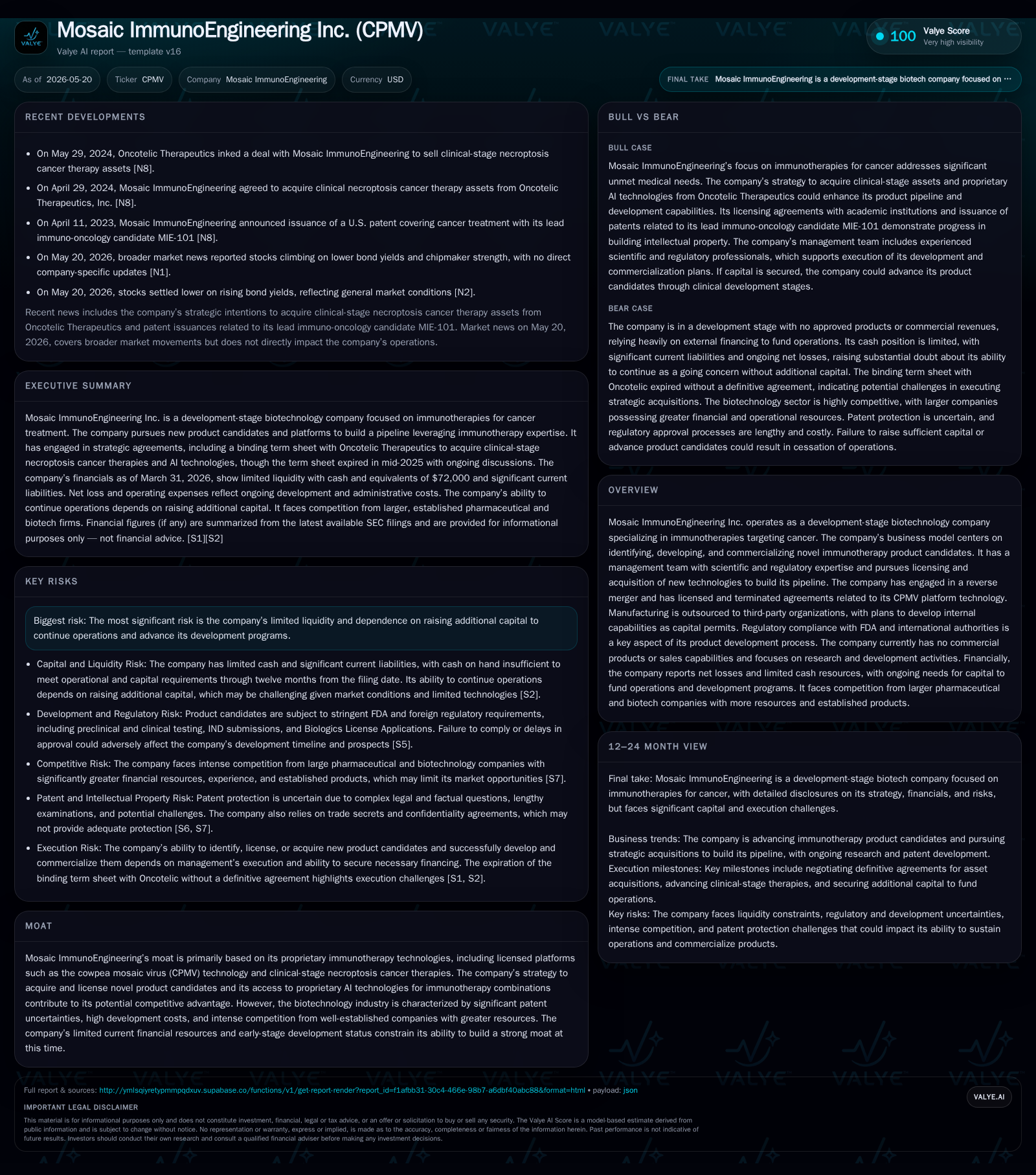
Mosaic ImmunoEngineering’s latest 10-Q reveals termination of its exclusive cowpea mosaic virus (CPMV) licensing, a foundational technology that had underpinned the company’s immunotherapy pipeline. This pivotal change necessitates a strategic repositioning focused on acquiring new clinical-stage assets and leveraging proprietary AI technologies to identify innovative immunotherapy combinations. While the company pursues opportunistic licensing deals, notably with Oncotelic Therapeutics for necroptosis vascular disruptive agents, it faces substantial capital constraints and regulatory hurdles characteristic of early-stage biotech. Its business model remains centered on outsourced manufacturing and research-driven pipeline development without commercial revenues. The path forward hinges on securing additional technologies and financing to sustain operations.
Latest Quarter Operating Update: The CPMV Platform Deal Fallout
In its most recent 10-Q filing dated May 20, 2026 [S2], Mosaic ImmunoEngineering disclosed the termination of its exclusive license agreement with Case Western Reserve University (CWRU) related to the cowpea mosaic virus (CPMV) platform technology. This platform was intended for cancer immunotherapy applications and formed a core element of Mosaic’s proprietary technology strategy since the license was secured in 2022. The expiration and termination represent a material setback that necessitates reevaluation of the company’s near-term pipeline and R&D focus.
Simultaneously, Mosaic has been engaged in ongoing discussions following an expired binding term sheet (effective April 26, 2024) with Oncotelic Therapeutics to acquire rights to clinical-stage necroptosis cancer therapies leveraging vascular disruptive agents (VDAs), along with non-exclusive access to proprietary artificial intelligence (AI) platforms for discovering immunotherapy combinations [S2][S1]. Although the binding term sheet expired mid-2025, these negotiations persist as part of Mosaic's pivot toward building a new technology portfolio.
This shift reflects an urgent need for new development assets given the loss of CPMV exclusivity [S2][S3]. The company is recalibrating its research priorities while navigating funding challenges that have historically limited operational scale
Business Model Overview: Development-Stage Pipeline and Outsourced Manufacturing
Mosaic operates primarily as a development-stage biotechnology entity focused on advancing cancer immunotherapies with no marketed products or sales infrastructure [S1]. Revenue generation is currently non-existent from product sales; rather, the business generates minimal advisory income per prior arrangements (e.g., $14K earned for advisory services connected to Oncotelic projects during early 2025) [S24].
Manufacturing is fully outsourced to contract manufacturing organizations (CMOs), reflecting standard biotech practice to reduce fixed capital deployment in early phases [S1][S25]. Plans exist to gradually build internal manufacturing capabilities contingent on capital availability—a common strategic posture allowing flexible scaling aligned with therapeutic candidate progression.
The company’s revenue mechanics hinge primarily on milestone-based agreements linked to licensing/acquisitions of innovative technologies. Given the absence of commercial products, operating expenses are dominated by R&D payrolls, consulting fees, regulatory consulting, and patent-related expenditures [S1][S17]. Future progress critically depends on successfully securing new candidates via licensing or acquisitions and steering them through preclinical and clinical development stages.
Immunotherapy Product Candidates and Technology Suite Quality
Historically centered around the CPMV platform—an immunomodulatory viral nanoparticle technology licensed from CWRU—Mosaic aimed to exploit novel mechanisms for tumor microenvironment modulation [S1]. The loss of CPMV rights curtails this asset class entirely.
Pivoting accordingly, Mosaic targets clinical-stage necroptosis therapies acquired from Oncotelic that involve vascular disruptive agents (VDAs). VDAs function by selectively damaging tumor vasculature to induce cancer cell death—a biologically distinct approach compared to traditional immune checkpoint blockade therapies. While still emerging in clinical validation phases, these therapies potentially offer differentiation within the oncology landscape [S2][S1].
Complementing biological assets is access to proprietary AI technology platforms designed to rationalize combination immunotherapies through computational analyses—an increasingly indispensable tool in oncology drug discovery allowing enhanced efficacy profiles by converging synergistic mechanisms [S2][S1]. However, these AI tools remain experimental without direct evidence yet supporting commercial viability or regulatory acceptance.
Overall, Mosaic's portfolio quality is anchored in innovation but constrained by early development stages lacking direct clinical readouts or proven market applicability. The forthcoming success depends heavily on effective integration and demonstration of these novel modalities' safety and efficacy.
Industry Competitive Dynamics and Peer Context in Cancer Immunotherapies
The biotechnology sector targeting cancer immunotherapies features intense competition from large pharmaceutical incumbents like Bristol-Myers Squibb (YERVOY, OPDIVO), Merck & Co. (KEYTRUDA), Genentech (TECENTRIQ), as well as emerging innovators deploying T cell engager platforms [S12]. High barriers include costly development pathways exceeding hundreds of millions USD per approved drug candidate coupled with complex patent landscapes exposing vulnerability to litigation or invalidation.
In this environment, emerging companies such as Mosaic typically differentiate via niche technology platforms or novel mechanisms like nanoparticle-mediated delivery or necroptosis induction. Licensing deals and mergers often serve as critical growth vectors given scarce internal capacities for expansive R&D pipelines or global commercialization infrastructure [S1][S6]. Regulatory hurdles loom large both domestically—with the FDA—and internationally where rules vary by jurisdiction presenting multi-layered approval pathways delaying revenue generation [S25].
Additionally, pricing power is moderated by payers’ scrutiny and biosimilar competition risk post-patent expiry. Customer bases are highly concentrated; eventual product adoption depends substantially on partnerships with major pharma or established distributors. In this context, Mosaic remains a small player striving for relevance through acquisition strategy amid resource constraints.
Growth Drivers: Pipeline Expansion Through Licensing and AI-Based Combination Therapy Discovery
Forward growth prospects hinge principally on Mosaic's capacity to consummate licensing or acquisition transactions akin to the ongoing Oncotelic negotiation trajectory. These deals could rapidly inject clinical-stage assets into Mosaic’s pipeline accelerating transition from proof-of-concept research toward human trials [S2][S1]. Definite milestone payments tied to share issuances underscore incentivization aligned between parties.
The AI combination therapy platform offers strategic upside by enabling exploration of multiple therapy pairings potentially optimizing clinical outcomes. Successful validation here may yield high barrier-to-entry technologies opening differentiated market segments against more generic immune checkpoint inhibitors.
Additional optional levers include future phased internal manufacturing build-out which might lower long-term cost structures once sufficient capital allows capacity investments—though this remains contingent upon corporate financial health.
Operational execution along these avenues must overcome limited resources but represents viable pathways toward maturing product candidates that address unmet medical needs in oncology therapeutics [S1].
Major Risks and Constraints: Financing, Regulatory Hurdles, and Pipeline Execution
Liquidity challenges present critically heightened risk; Mosaic held only about $72K in cash as of March 31, 2026 juxtaposed against over $6 million in current liabilities creating an effective zero current ratio scenario per latest balance sheet data [F1]. This financial stricture severely limits near-term operational flexibility.
Capital raising success is uncertain amidst challenging market conditions for early-stage biotechs lacking marketed products. Debt financing would likely entail onerous covenants while equity raises dilute existing ownership substantially [S2][S3]. Failure to secure timely funding could force cessation of operations altogether.
Regulatory hurdles compound risks: clinical trial initiation requires approvals from FDA and international agencies; delays or failures can derail valuation inflections [S25][S6]. Early-stage assets still require rigorous proof of safety/efficacy across multiple trial phases prone to attrition typical in oncology drug development
Loss of CPMV exclusivity not only removes a proprietary technology advantage but heightens dependency on replacement assets whose performance remains unproven at scale [S1][S2]. The complexity of integrating newly licensed platforms enhances execution risk given constrained management bandwidth.
Upcoming Catalysts and Milestones to Monitor
Market participants should closely observe whether Mosaic finalizes definitive license or acquisition agreements with Oncotelic or alternative licensors subsequently identified — such announcements would materially reshape pipeline content [S2][S1].
Clinical trial launches for acquired or internally developed candidates will serve as key scientific validation points impacting investor sentiment.
Shareholder vote outcomes particularly regarding approval for transaction terms involving stock issuance bear significance given Convertible Noteholder waivers required before closing corporate transactions per existing binding term sheet frameworks [S2]
Additional financing activity—whether equity placement or convertible debt incurrence—and covenant amendments warrant monitoring due to critical liquidity ramifications [S3][F1]
Finally, regulatory communications from FDA or foreign authorities related to candidate approvals or trial holds could catalyze reassessments of development timelines.
Financial Position and Liquidity Status
Mosaic's financial anatomy underscores acute operational stress: cash and equivalents barely extended beyond nominal levels at $72 thousand as of quarter-end March 31, 2026 while current liabilities surpassed $6 million indicating substantial short-term obligations unmatched by liquid assets resulting in an effectively zero current ratio [F1]. This denotes extreme liquidity risk threatening continued viability absent significant capital infusion.
Existing convertible notes add complexity regarding refinancing needs alongside restrictive terms potentially limiting operational flexibility if covenant breaches were triggered under stressed scenarios [S3].
Management acknowledges these challenges explicitly highlighting uncertainty about sustaining operations without successful financings referencing associated going concern considerations within filings [S2][S8]. Consequently, financial stewardship alongside effective fundraising execution will be determinative for survival through ensuing commercialization-focused milestones.
This analysis synthesizes information provided through SEC filings up to May 20, 2026. It incorporates sector-relevant perspectives without extrapolating unsupported details or offering investment advice. Biotechnology firms at similar developmental stages exhibit comparable risks related to funding volatility and regulatory uncertainty amidst a competitive landscape dominated by larger incumbents with established therapeutic franchises.
Disclaimer: This is research-only, informational analysis and not investment advice. It may include AI-generated interpretation and general industry context. Always verify important details using primary sources.

Comments