
Catalyst Pharmaceuticals Stretches Market Lead with Strategic Capital Moves
Catalyst Pharmaceuticals leverages its flagship FIRDAPSE® alongside robust liquidity and active patent defenses to consolidate a dominant position in rare neuromuscular therapies.
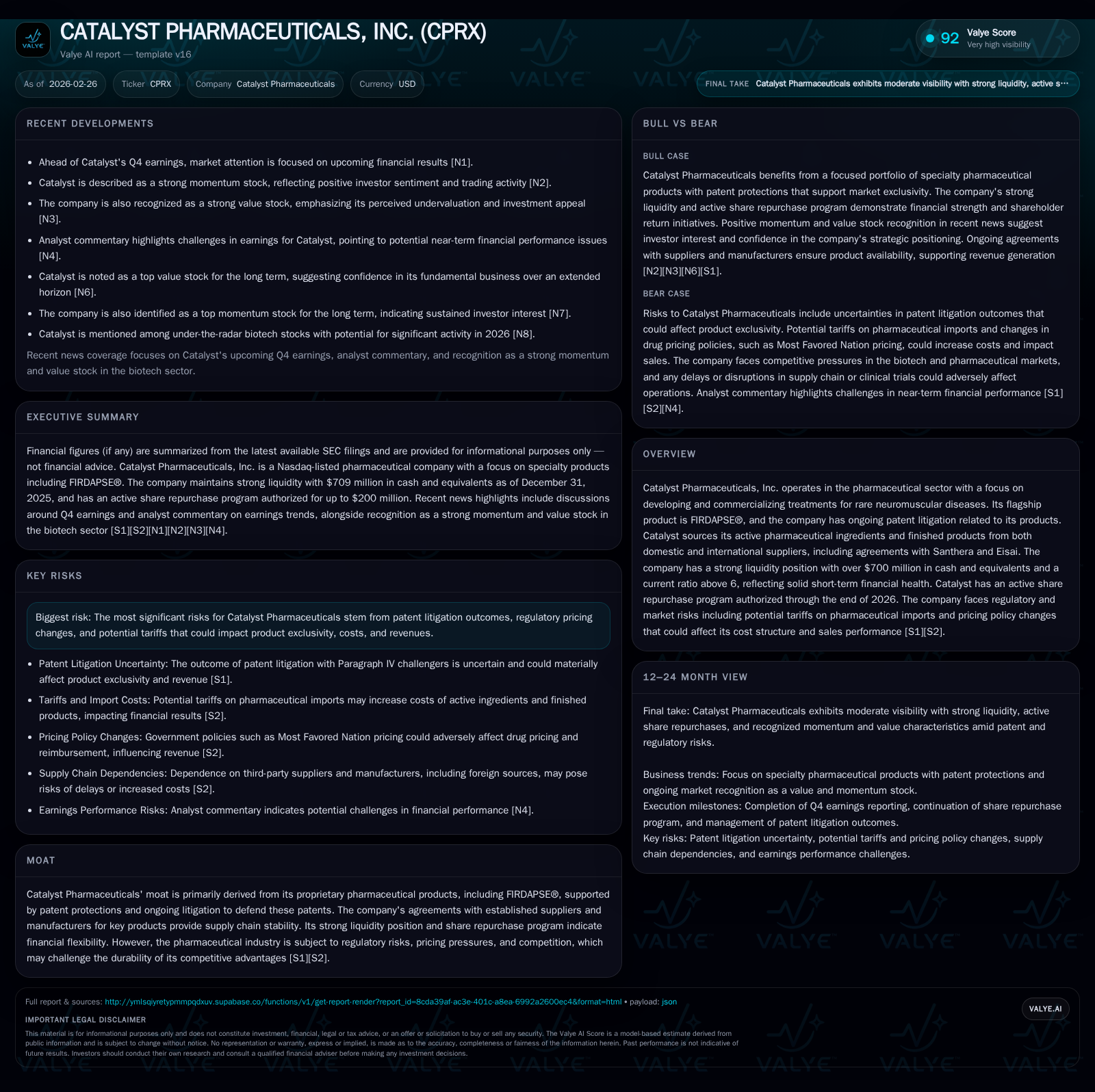
Catalyst Pharmaceuticals has transformed from negligible revenue in 2017 to reporting over $257 million in operating income by 2025, underpinned by commercial success of FIRDAPSE®. The company's moat is sustained through ongoing patent litigation, particularly involving Paragraph IV challenges, securing product exclusivity into the mid-2030s. Catalyst’s supply chain blends domestic and international API sources with exposure to potential tariffs and pricing reforms that could pressure margins. Financially, Catalyst demonstrates strong operating leverage and a fortress balance sheet with a current ratio above 6 and $709 million in cash equivalents, supporting an aggressive $200 million share repurchase program authorized through 2026. Upcoming milestones in litigation outcomes, manufacturing transitions, and regulatory developments demand close monitoring.
Breakthrough Growth Trajectory Fueled by FIRDAPSE® Commercialization
Catalyst Pharmaceuticals’ financial history reflects a remarkable trajectory from near-zero revenues in 2017 to extraordinary growth driven by its flagship product, FIRDAPSE®. Reported revenue stood at $119.1 million by fiscal year-end (FYE) 2020 after years of essentially no material sales. Operating income expanded dramatically to reach $257.8 million by the end of fiscal 2025 — a year-over-year increase of roughly 32.1% from $195.1 million in 2024 [F1]. Net income followed this robust pattern, reaching $214.3 million in 2025, representing a YoY gain of about 30.8%. These earnings gains reflect significant operating leverage as fixed costs were absorbed while sales volumes rose.
This surge was anchored firmly on the commercialization of FIRDAPSE®, an orphan drug targeting Lambert-Eaton myasthenic syndrome and other rare neuromuscular disorders. Its market penetration has been bolstered through targeted physician education programs and reimbursement strategies tailored to rare disease payers. This strategic focus has unlocked massive percentage gains; from zero revenue in FY17 to over $119 million in FY20 demonstrates growth exceeding 23,700% within three years — an uncommon scale even in biotech [F1][S1].
Historical performance (annual)
| FY | Net ($mm) | CFO ($mm) | OpInc ($mm) | Capex ($) | Net YoY |
|---|---|---|---|---|---|
| 2025 | 214 | 209 | 258 | 58000 | +30.8% |
| 2024 | 164 | 240 | 195 | 556000 | +129.5% |
| 2023 | 71 | 144 | 87 | 231000 | -14.0% |
| 2022 | 83 | 116 | 102 | 29000 |
Source: SEC companyfacts cache [F1].
Capital returns and efficiency (annual)
| FY | Buybacks ($mm) | FCF ($mm) | ROE% |
|---|---|---|---|
| 2025 | 25 | 209 | 22.5 |
| 2024 | 0 | 239 | 22.5 |
| 2023 | 7 | 143 | 18.4 |
| 2022 | 7 | 116 | 27.7 |
Source: SEC companyfacts cache [F1].
Note: Earlier years lack full comparable data for all metrics; the table uses available figures strictly from [F1].
Patent Litigation: Uncharted Waters Underpinning Product Exclusivity
The cornerstone protecting Catalyst’s market position is its robust patent portfolio around FIRDAPSE®. The company faces ongoing Paragraph IV certification challenges—an industry-standard legal mechanism whereby generic manufacturers attempt to invalidate or circumvent patents ahead of expiry—to fend off generic entrants [S4]. These disputes carry inherent uncertainty: successful challenges could truncate exclusivity prematurely.
Recent legal maneuvers culminated in settlement agreements with Lupin Ltd., prohibiting generic competition until at least February 25, 2035, conditional on FDA approval and barring unforeseen patent invalidation or regulatory events [S15]. Similar resolutions occurred with Teva Pharmaceuticals and Inventia Life Science Pty Ltd., reinforcing Catalyst’s defense firewall around key Orange Book-listed patents.
Nevertheless, litigation continues against Hetero Labs for all listed patents on FIRDAPSE®. The company’s SEC disclosures prudently caution that outcomes remain indeterminate and adverse rulings could materially impact revenue streams if generic entrants launch earlier than anticipated [S4][S15]. This dynamic necessitates sustained vigilance.
Supply Chain Dynamics Amid Potential Tariffs and Global Sourcing Challenges
Catalyst sources active pharmaceutical ingredients (APIs) and finished dosage forms both domestically and from global partners including Santhera for AGAMREE® and Eisai for FYCOMPA®, extending supply security but also exposing the company to geopolitical trade risks [S2][S5]. The U.S Department of Commerce initiated Section 232 investigations into pharmaceutical imports citing national security concerns, placing Catalyst’s cross-border sourcing arrangements under potential threat via tariffs.
Such tariffs could materially escalate raw material input costs or disrupt delivery schedules if alternative suppliers cannot be sourced rapidly without delay or additional expense [S2]. Retaliatory foreign tariffs might further strain international sales outside the U.S., introducing additional volatility into global revenue contributions.
From a sector perspective, pharmaceutical firms often mitigate such risks through diverse multi-jurisdictional supply bases or vertical integration strategies; Catalyst is actively evolving its manufacturing footprint but remains exposed during transition phases . This facet embeds operational risk alongside competitive uncertainty.
Operating Margins, Revenue Trends, and Financial Health Metrics
Financial rigor characterizes Catalyst’s recent performance profile: despite the heightened litigation and regulatory landscape, operating margins have expanded meaningfully due to scale efficiencies from commercial success.
Liquidity metrics underscore a conservative balance sheet posture: total current assets stood at approximately $894 million against current liabilities near $147 million as of December 31, 2025 — yielding a current ratio exceeding 6x, an unusually strong cushion underscoring prudent working capital management [F1][S9]. Cash and equivalents exceeded $709 million at year-end supporting operational continuity without reliance on external financing.
While operating cash flow showed a modest decline (-13% YoY), largely reflecting payout timing shifts or one-off factors documented in MD&A sections [S19], capital expenditures remain negligible relative to operating cash generation ($58K vs CFO $209M), cementing robust free cash flow ($208M). This metric fortifies the company’s capacity for self-funded growth initiatives or shareholder returns without leverage reliance.
Capital Deployment Strategy: Massive Repurchases vs Dividend Policy
Catalyst employs an assertive capital allocation stance marked by a substantial share repurchase program freshly authorized October 2025 for up to $200 million through end-2026—an order of magnitude increase relative to prior repurchase authority capped at $40 million [S7][S8]. As of December quarter-end October–December 2025, the company executed repurchases totaling approximately $25 million against this authorization.
This tactical redeployment contrasts with an explicit absence of dividend distributions; Catalyst has never paid common stock dividends nor announced plans to initiate any [S1][S7], reflecting a preference for buybacks as its primary capital return vehicle.
Calculated return on equity (ROE), derived from net income ($214M) divided by equity base ($954M) at fiscal-year-end approximates a healthy ~22.5%, signaling efficient capital utilization complemented by shrinking outstanding share count under buyback activity [F1].
Regulatory Pricing Pressures and Their Implications on Future Profitability
Catalyst faces regulatory headwinds typical across orphan drug producers amid evolving U.S. government pharmaceutical pricing policy frameworks—including proposed 'Most Favored Nation' (MFN) rules seeking parity between domestic Medicaid drug prices and those abroad—which could compress prices reimbursed under public programs [S2][S6]. Such changes hold particular risk for specialty drugs like FIRDAPSE®, where payer leverage exerts outsized influence.
Management discloses inability to precisely quantify impacts but flags regulatory dynamics as material uncertainties that can influence future margins severely should widespread pricing ceilings be mandated or reimbursement models altered significantly away from existing arrangements [S2][S6].
Monitoring Catalysts: Upcoming Clinical Trials, Legal Outcomes, and Market Signals
Investor focus should center on several key upcoming triggers shaping near- to medium-term outlook:
- Resolution timelines for ongoing Paragraph IV patent litigations especially involving Hetero Labs remain unconfirmed; any unfavorable judgments could challenge exclusive U.S marketing rights ahead of current settlements expiring in mid-2030s [N3][S4][S15].
- Clinical pipeline progress tied to manufacturing partnerships transitions may affect supply reliability or broaden therapeutic applications beyond current indications.
- Execution pace of the newly authorized $200 million share repurchase program will dynamically affect equity valuation metrics and capital structure trends.
- Recent analyst commentary highlights mixed expectations for Q4 earnings reflecting these uncertainties but notes strength as a momentum name within rare disease specialization sub-sector [N1][N5].
These elements collectively frame Catalyst’s strategic execution path amid a finely poised balance of innovation-led growth juxtaposed against legal-commercial vulnerabilities.
Disclaimer: This report is intended solely for informational purposes based on publicly available documents as cited herein. It does not constitute investment advice or recommendations. Readers should conduct their own due diligence regarding Catalyst Pharmaceuticals’ business prospects and risks before making any investment decisions.
Disclaimer: This is research-only, informational analysis and not investment advice. It may include AI-generated interpretation and general industry context. Always verify important details using primary sources.

Comments