
CRA International Accelerates Profitability with Rising Utilization and Aggressive Capital Returns
The consulting firm leverages improved consultant utilization and disciplined capital allocation to enhance its operating income and shareholder returns in fiscal 2025.
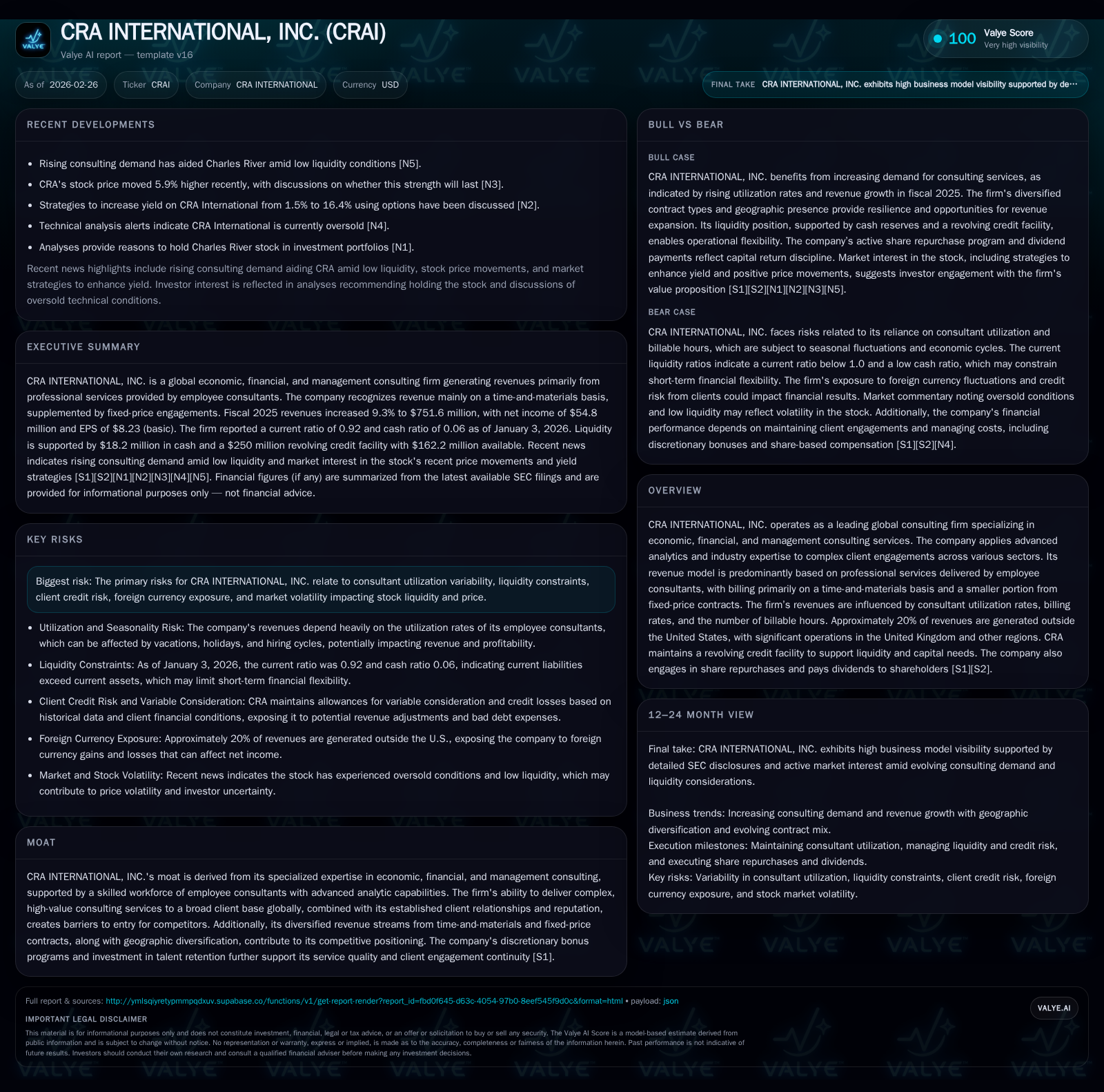
CRA International, Inc. (CRAI) has demonstrated solid operational growth in fiscal 2025, driven primarily by improved consultant utilization rates that elevated revenues and operating income by over 17% year-over-year. Despite a significant decline in operating cash flow compared to prior periods, the firm continued its commitment to returning capital through dividends and sizable share repurchase programs. The company maintains modest leverage under its revolving credit facility and ensures liquidity while investing selectively in technology capital expenditures. Future growth hinges on sustaining high utilization amid seasonal headwinds and expanding international contributions, balanced against typical risks such as foreign exchange volatility and client credit risks.
Company Overview
CRA International, Inc. operates as a premier global consulting firm providing economic, financial, and management advisory services. Its business model primarily relies on delivering professional services through employee consultants whose billable hours are compensated largely on a time-and-materials basis, complemented by a smaller segment derived from fixed-price engagements [S1]. Geographic diversification extends beyond the United States—where roughly 80% of revenues are generated—to key markets such as the United Kingdom and assorted international jurisdictions accounting for approximately one-fifth of total consulting fees [S1][S24].
Historical Performance and Past Growth Drivers
Fiscal year 2025 encapsulated continued expansion momentum for CRA, exemplified by operating income climbing sharply to $83.1 million from $70.8 million in the prior year, a notable improvement of approximately 17.5% [F1]. Net income mirrored this trend, recording $54.8 million versus $46.7 million in fiscal 2024 (+17.4%) [F1]. These gains trace primarily to increased consultant utilization—a critical operating metric measuring the ratio of billable hours worked relative to total available hours—which ascended to 77% in FY25 from 75% a year earlier [S1]. This increase unlocks more revenue-generating productivity per employee.
Operating cash flow exhibited a marked reversal, plunging nearly 55% year-over-year to $22.4 million from $49.7 million in FY24 [F1]. This contraction predominantly stems from changes in working capital components: larger accounts receivable balances coupled with upticks in incentive cash awards payable disrupted cash conversion cycles [S18]. Capital expenditures also retreated substantially to just under $3.9 million, down over three-quarters versus previous levels; these investments focus heavily on information technology infrastructure essential for modern consulting operations [F1][S18].
The consulting revenue mix underscores CRA's heavy dependence on billing rates and hours delivered by its employee consultants. Seasonal patterns exert pressure during summer quarters as junior staff transitions occur alongside vacation schedules reducing billability [S1]. Fixed-price contracts remain a smaller yet meaningful contributor to revenue and are recognized on proportional performance metrics aligned to project costs incurred [S1].
Historical performance (annual)
| FY | Net ($mm) | CFO ($mm) | OpInc ($mm) | Capex ($mm) | Net YoY |
|---|---|---|---|---|---|
| 2025 | 55 | 22 | 83 | 4 | +17.4% |
| 2024 | 47 | 50 | 71 | 17 | +21.2% |
| 2023 | 38 | 60 | 58 | 2 | -11.8% |
| 2022 | 44 | 25 | 59 | 4 |
Source: SEC companyfacts cache [F1].
Capital returns and efficiency (annual)
| FY | Div ($mm) | Buybacks ($mm) | FCF ($mm) |
|---|---|---|---|
| 2025 | 14 | 47 | 19 |
| 2024 | 12 | 33 | 33 |
| 2023 | 11 | 31 | 58 |
| 2022 | 10 | 28 | 21 |
Source: SEC companyfacts cache [F1].
Note: Fiscal year ends around calendar start of next year.
Future Growth Prospects
Looking ahead, CRA’s growth prospects center on sustaining or improving consultant utilization while navigating known seasonality and workforce training cycles that typically constrain second-half productivity [S1]. Incremental revenue could arise from expanding fixed-price engagements which offer greater visibility albeit at increased project execution risk [S1]. Additionally, geographical diversification—particularly increased penetration into European markets where local expertise commands premium billing—remains an area for expansion given existing groundwork in the UK and other territories [S24].
The company's moat hinges on its technical sophistication combining advanced analytics with domain-specific expertise that clients find difficult to replicate swiftly [S1]. As consulting demand rises globally—evidenced by broad industry peers reporting robust engagements—CRA’s niche positioning may capture more complex assignments commanding higher billing rates or longer-lasting contracts [N1][N2]. However, risks such as fluctuating consultant utilization rates due to labor market competition could hinder topline progression.
Currency fluctuations introduce potential volatility given approximately one-fifth of revenues derive from foreign sources denominated in Pounds Sterling and Euros; management employs active hedging strategies though residual exposure remains considerable [S29]. Furthermore, credit risks associated with clients' payment behaviors could weigh on net realizations absent effective collections management protocols [S29].
Forecasts / Milestones / Expectations
While public filings do not provide explicit forward guidance for revenue or earnings outcomes, supplemental disclosures note expectations for maintaining regular quarterly dividends funded via operations or available liquidity facilities [S12][S20][N3]. Planned continuation of share repurchases signals management confidence in intrinsic value though no program expiration is scheduled allowing discretionary pacing aligned with market conditions [S19][S27].
Key near-term milestones likely revolve around monitoring quarterly utilization metrics (specifically during seasonal lulls), execution success on fixed-price projects that can validate margin expansion potential, and effective FX management given current exchange rate uncertainties highlighted during recent reporting periods [N3][S29]. Analysts should observe operating cash flow evolution closely due to recent pronounced softness potentially impacting reinvestment capacity.
Returns & Capital Allocation
CRA demonstrates disciplined allocation of free cash flows toward shareholders as evidenced by substantial buybacks totaling approximately $47 million alongside dividend distributions near $13.8 million in fiscal year ending January 2026 [F1][S12]. These distributions have escalated steadily over several years consistent with rising earnings power.
Return on equity measured at roughly an impressive ~25.6% confirms efficient capital employment amid moderate net leverage supported by a revolving credit facility that was utilized moderately at about $34 million outstanding as of early January but leaving substantial borrowing headroom available totaling approximately $162 million in capacity after accounting for letters of credit usage [F1][S4][S18]. Financial covenants under the credit agreement maintain conservative limits including a maximum net leverage ratio of 3:1 alongside interest coverage constraints that have been comfortably observed through recent quarters [S4][S15][S23].
Capital expenditure discipline is evident given the reduction from elevated IT outlays seen previously coinciding with scalable remote work enablement investments typical within consulting firms leveraging cloud computing platforms within their analyst cohorts [F1][S18]. Compensation arrangements including forgivable loans form part of retention efforts for critical skilled consultants promoting continuity but represent accrued liabilities carefully expensed over service durations limiting earnings dilution impact short term [S17][S26].
Industry Context (Analysis)
CRA operates amid an intensifying professional services ecosystem characterized by digital transformation demands requiring increasingly sophisticated quantitative tools integrated into advisory outputs—a trend raising barriers for less specialized competitors but escalating talent acquisition challenges across the sector.
Time-based billing models remain prevalent but clients' appetite for fixed-fee arrangements grows as organizations seek cost predictability—a double-edged sword demanding flawless project scoping on firms like CRA or risking margin compression.
Global economic uncertainty prompts cautious corporate spending affecting consulting engagement pipelines unevenly across sectors; however specialized economic and financial analysis consultancies like CRA benefit from increased regulatory scrutiny demanding empirical rigor when assisting legal or governmental litigations.
Risks Summary
Key risks involve variability in consultant utilization which directly influences top-line stability; foreign currency volatility affecting earnings due to international exposure; client creditworthiness impacting accounts receivable collectability; liquidity constraints that could emerge if credit markets tighten unexpectedly despite current ample revolver capacity; and seasonal headwinds influencing quarterly revenue cadence along with competitive pressures for skilled talent retention [S29][S1].
Conclusion
CRA International’s recent fiscal results reflect robust profitability growth powered chiefly by improved consultant utilization driving higher operating income margins while maintaining shareholder-friendly capital returns through dividends and buybacks structurally underpinning attractive ROE levels near one quarter annually.
Challenges remain notably stemming from significant declines in operating cash flow linked principally to working capital swings requiring close attention going forward alongside ongoing management of currency risk exposures rooted abroad.
Finally, prospective investors should track quarterly operational metrics such as utilization trends post-seasonal troughs plus management commentary regarding fixed-fee contract mix shifts since these elements will strongly sway mid-term growth trajectories.
Disclaimer: This report is prepared solely for informational purposes reflecting data available as of February 26, 2026, without providing investment advice or recommendations regarding any securities discussed herein.
Disclaimer: This is research-only, informational analysis and not investment advice. It may include AI-generated interpretation and general industry context. Always verify important details using primary sources.

Comments