
Salesforce’s Agentforce 360 Bolsters AI-Driven Enterprise CRM Leadership
Salesforce's latest quarter highlights subscription growth fueled by AI-driven platform enhancements and strategic acquisitions, reinforcing its enterprise CRM dominance.
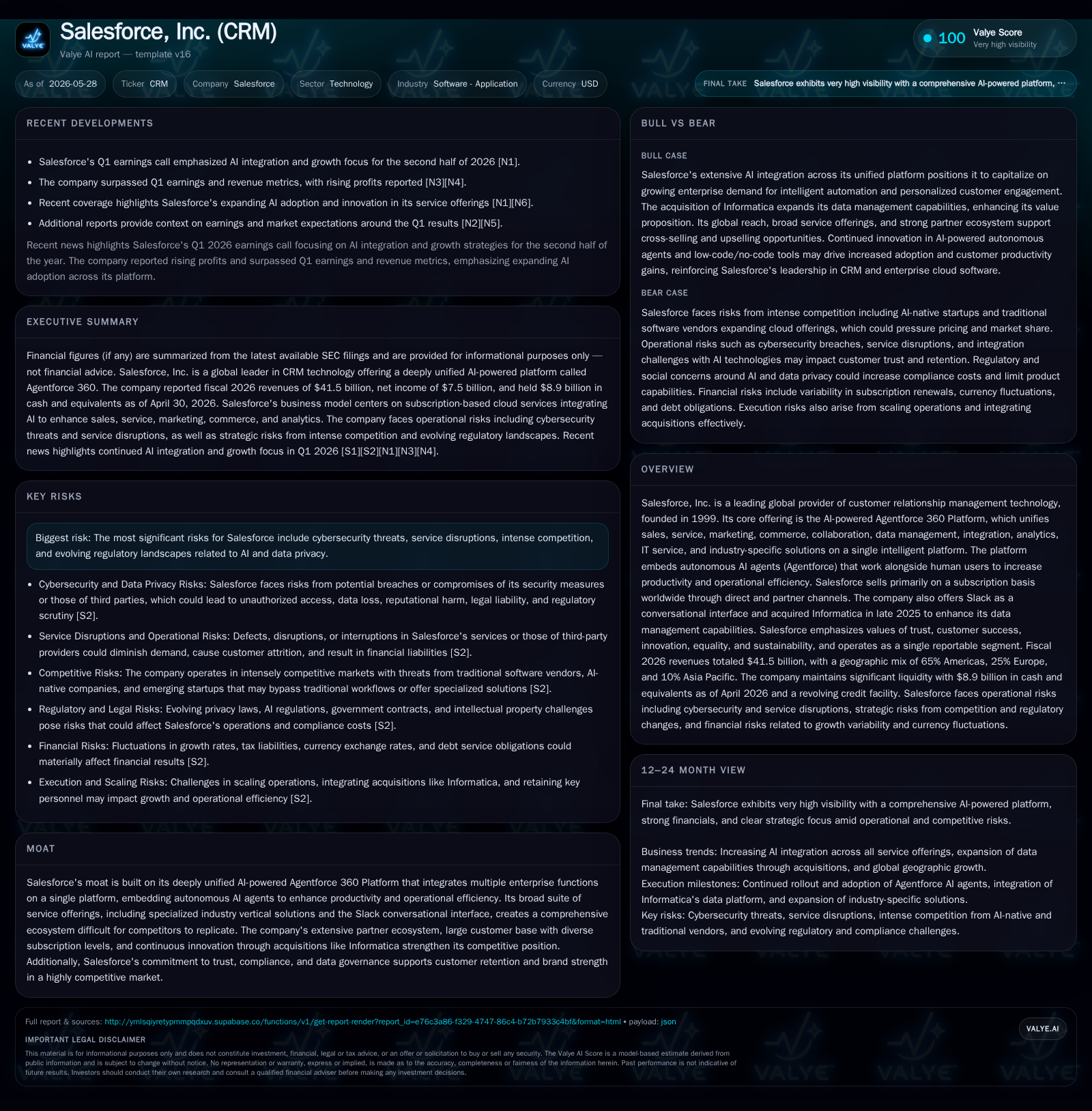
In Salesforce’s Q1 fiscal 2027 report, the company demonstrated robust subscription momentum anchored by its AI-powered Agentforce 360 Platform and bolstered data management capabilities following the Informatica acquisition. The integrated platform continues to unify core enterprise functions with intelligent autonomous agents that drive customer productivity and retention. Salesforce faces operational risks including cybersecurity and regulatory challenges but remains strongly positioned through its ecosystem breadth, innovative product suite, and resilient recurring revenue model. Monitoring AI adoption trends, customer expansion metrics, and integration progress of recent acquisitions will be key to assessing near-term growth trajectory.
Q1 Operating Update: Strength in AI & Subscription Momentum
Salesforce’s fiscal Q1 2027 quarterly filing [S2] reveals continued strength in subscription growth driven by adoption of its AI-embedded Agentforce 360 Platform. Revenue growth is underpinned by elevated demand for autonomous AI agents that enhance productivity across sales, service, and marketing functions. The recent acquisition of Informatica at the end of 2025 contributes new capabilities for data governance and management that complement the core platform [S2], [N1]. This combination provides scalable subscription revenue through a diversified customer base leveraging both direct sales efforts and an extensive partner channel.
These advancements translate into higher renewal rates and increased seat expansions as customers deepen their usage of integrated features. Management commentary during earnings calls [N1], [N3] highlights optimism around H2 growth driven by progressive rollouts of advanced AI functionalities within Agentforce. Despite macroeconomic uncertainties, Salesforce’s customer base continues to expand with growing usage intensity enabled by embedded autonomous agents learning alongside human users.
Agentforce 360 Platform: The Core of Salesforce’s Customer Engagement Transformation
Launched as the centerpiece of Salesforce’s offering suite [S1], the Agentforce 360 Platform acts as an all-encompassing cloud solution that converges CRM functions—sales automation, customer service workflows, marketing orchestration, e-commerce support—and collaboration tools such as Slack into one unified interface. This platform is distinguished by its embedded autonomous AI agents (“Agentforce”) that augment human work by performing routine tasks autonomously while learning from interactions.
Unlike competitors who offer siloed CRM modules or third-party AI add-ons, Salesforce integrates these services deeply on a single platform which harmonizes data across functions providing a complete and consistent view of customer interactions [S1]. The Slack conversational interface acts as a natural user touchpoint facilitating workflow automation and interdepartmental collaboration seamlessly.
Post the Informatica acquisition in late 2025—which was designed to enhance enterprise data management—Salesforce now offers sophisticated capabilities for data integration and quality governance directly accessible within Agentforce 360 [S2], [S3]. This merger strengthens operational efficiency for customers managing complex data ecosystems.
Business Model Nuances: Subscription Ecosystem, Channel Strategy, and Product Quality
Salesforce primarily generates revenue via subscription fees charged globally through a blend of direct sales teams targeting medium to large enterprises and a thriving network of partners who resell or build additive applications on the company’s platform [S1], [S2]. The recurring nature of multi-year contracts generates predictable annual recurring revenue (ARR), which is further buttressed by high renewal rates driven by significant switching costs owing to the platform’s extensive integrations and embedded autonomous agents.
Adoption benefits from flexible product configurations allowing quick deployments tailored to specific industries or business units. The AppExchange marketplace further democratizes access by enabling independent software vendors to contribute applications interoperable with Salesforce’s core services enhancing overall stickiness [S1]. Trust factors such as stringent security standards, compliance certifications, and legal adherence reinforce the reliability critical for customers’ mission-critical use cases.
Together these aspects create a virtuous cycle: strong customer success leads to upsells in additional modules or seat licenses and fosters ecosystem development which reinforces dependence on Salesforce technology across multiple IT domains.
Competitive Landscape: Unpacking Salesforce’s Moat and Industry Position
Salesforce stands atop the enterprise CRM market leveraging its unified Agentforce 360 Platform embedded with cutting-edge autonomous AI—a competitive advantage difficult for rivals to replicate without significant investment in integration depth and AI development expertise [S1], [N1]. The expansive partner ecosystem comprising ISVs and system integrators further raises barriers to entry by enriching application availability beyond native features.
While competition from other major tech firms persists—especially those focusing on standalone AI offerings or niche CRM products—Salesforce balances pricing pressures through continuous innovation including strategic acquisitions such as Informatica enhancing offering breadth [N1]. Its entrenched customer relationships foster switching costs not easily overcome due to the integrated workflows spanning multiple departments.
However, pricing power must be balanced against growing competitive intensity from newer SaaS entrants pushing aggressive terms or specialized solutions attractive in emerging vertical markets.
Growth Drivers: AI Integration, Ecosystem Expansion, and New Vertical Solutions
Several factors propel Salesforce’s growth outlook:
- Continued enhancement of Agentforce autonomous AI agents expanding process automation footprints driving greater seat utilization across existing clients.
- Strategic extension into industry verticals such as financial services, healthcare, manufacturing providing bespoke packaged solutions suited to domain-specific needs [S1].
- Amplified developer activity on AppExchange fueling innovation pipelines with new complementary apps increasing average revenue per account.
- Incremental revenues stemming from enhanced data management capabilities following Informatica integration allow penetration into sizeable enterprise segments with stringent governance requirements.
These growth vectors tie closely to KPIs including renewal rates post-AI rollout, seat expansion velocity within large enterprise customers, number of new vertical-centric bundled offerings adopted by marquee accounts, and pace of third-party application launches within the ecosystem.
Risks and Constraints: Cybersecurity, Competition, Regulation, and Execution
Salesforce faces critical challenges outlined in its recent filings:
- Cybersecurity breaches pose material risk impacting customer trust foundational to subscription renewals; third-party cloud provider vulnerabilities add complexity to risk mitigation [S2], [S4].
- Regulatory uncertainty surrounding evolving laws governing data privacy (GDPR-like mandates) and nascent AI-specific frameworks produce compliance burdens potentially inhibiting feature deployment or restricting cross-border data flows [S19], [S22].
- Intense competition may compress margins or elongate complex enterprise sales cycles requiring sustained upfront investments hurting near-term profitability [S2].
- Execution risks remain notably tied to effectively integrating acquired assets (e.g., Informatica), scaling operating infrastructure without service disruption or attrition increase, retaining key talent amid restructuring initiatives targeting operational efficiency gains [S2], [S10].
Effective navigation of these headwinds will materially influence Salesforce’s ability to sustain long-term leadership.
Investor Watchlist: Upcoming Milestones and Demand Signals to Monitor
Relevant indicators for stakeholders include:
- Progress on embedding next-generation AI capabilities within Agentforce workflows promised for H2 rollouts impacting top-line uplift projections [N1], [S2].
- Quantitative evidence on renewals and churn rates following incremental Informatica integration reflecting cross-sell success or retention challenges.
- Metrics capturing seat expansion rates particularly within newly penetrated verticals indicating product-market fit improvement.
- Execution speed on restructuring plans aiming at margin enhancement without compromising innovation investment levels.
- Adoption dynamics in international markets revealing scalable global demand elasticity supported by localized go-to-market strategies.
Continuous updates around these milestones will provide directional cues on trajectory sustainability amidst competitive pressures.
Brief Financial Review: Balancing Growth Ambitions against Leverage and Liquidity
As of April 30, 2026 [F1], Salesforce held $8.9 billion in cash and equivalents against approximately $39.5 billion in total debt, resulting in net debt near $30.6 billion.
Operating income reached approximately $8.3 billion annually with net income near $7.5 billion last fiscal year, highlighting continued profitability despite elevated R&D spending fueling innovation including AI augmentation initiatives. The company pursues margin improvements through ongoing restructuring programs focused on workforce optimization and capacity rationalization noted across recent disclosures [S10], [S15].
Strong operating cash flow generation underpins reinvestment capacity while maintaining significant capital return flexibility signaled by ongoing authorized stock repurchases, though leverage levels necessitate careful covenant monitoring going forward.
Disclaimer: This analysis is based exclusively on publicly available filings dated through May 28, 2026, company disclosures from SEC documents complemented by recent news sources without any non-public information or forecasts.
Disclaimer: This is research-only, informational analysis and not investment advice. It may include AI-generated interpretation and general industry context. Always verify important details using primary sources.

Comments