
CoreWeave’s Stratospheric Growth and the Tug of Capital Intensity
CoreWeave has scaled its AI-specialized cloud platform from hundreds of millions to billions in revenue by aggressively investing in power-hungry infrastructure amid rising operational and financial pressures.
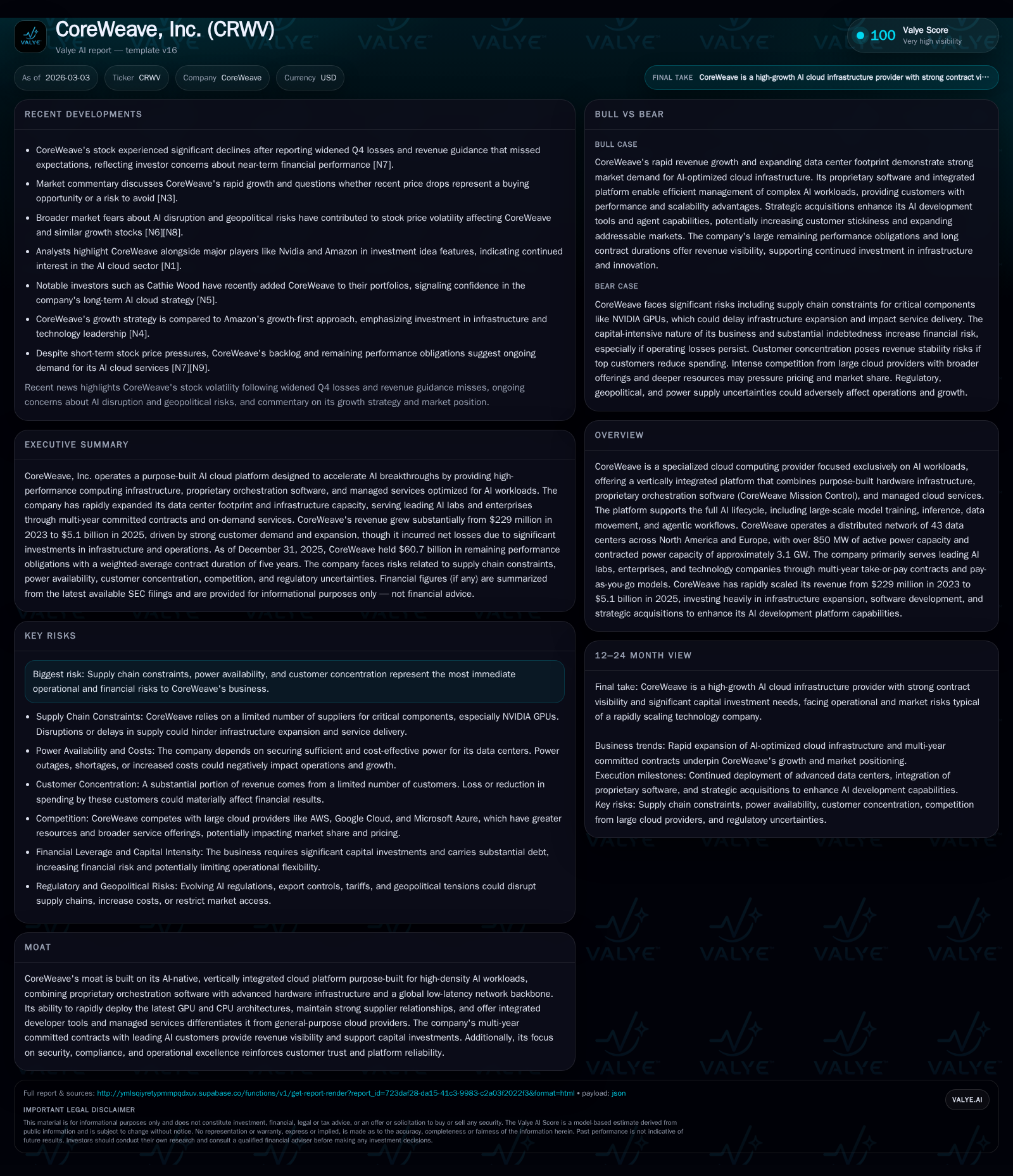
CoreWeave, an AI-native cloud provider focused on high-density workloads, surged from $229 million revenue in 2023 to $5.1 billion in 2025. Growth was fueled by multi-year take-or-pay contracts with leading AI labs and a massive expansion of data centers powering over 850 MW with 3.1 GW contracted capacity. Proprietary orchestration software and integrated services differentiate its offering. However, this rapid scale incurred operating losses and heavy capital expenditures, driven by hardware supply constraints and power availability risks. The firm's leverage and negative free cash flow reflect capital intensity, while recent guidance misses raise near-term execution questions despite long-term AI demand potential.
Accelerating Growth: Revenue, Contracts, and Customer Concentration
Historical performance (annual)
| FY |
|---|
| 2025 |
Source: SEC companyfacts cache [F1].
CoreWeave's financial trajectory over three years is remarkable. The company grew revenue from $229 million in fiscal 2023 to $5.1 billion in fiscal 2025 [F1], fueled primarily by long-term multi-year take-or-pay contracts with large AI enterprises and labs [S1][N1]. These contracts provide predictable revenue streams alongside pay-as-you-go models that add flexibility for customers operating at different stages of the AI lifecycle.
This contract mix aligns with CoreWeave’s specialized platform tailored for AI workloads requiring tight hardware-software integration. Nevertheless, customer concentration risk remains: a substantial portion of revenue derives from a relatively small set of sophisticated clients [S11]. While these relationships enable scale and customization aligned with AI pioneers’ demands, shifts in spending patterns among top customers could materially affect growth.
Following Q4 2025 earnings where revenue missed expectations, CoreWeave's stock declined sharply [N2]. Management cited a robust backlog suggesting ongoing contractual commitments that may sustain near-term revenue stability despite broader market concerns around discretionary AI spend cuts [N11].
Capital-Intensive Scaling: Infrastructure Expansion and Power Capacity
Supporting explosive growth required significant capital deployment into infrastructure expansion. As of December 31, 2023, CoreWeave operated 10 data centers powered by roughly 70 MW [S1]; this expanded to over 32 centers with about 360 MW by year-end 2024, then further to 43 data centers delivering more than 850 MW active power capacity along with contracted power nearing 3.1 GW for future expansions as of December 31, 2025 [S1].
Such scale is extraordinary given the high power density demands of GPU clusters supporting AI workloads—far exceeding general-purpose cloud data centers. Securing site-level power arrangements and exploring alternative energy sources remain critical competitive advantages but also pose bottleneck risks due to grid constraints or cost volatility [S22][S26].
Vertical integration combining hardware deployment strategy with proprietary orchestration software enables CoreWeave to maximize performance from constrained megawatt allocations—a key differentiator versus hyperscalers less optimized for ultra-high-throughput AI applications.
Proprietary Software and Integration: Mission Control™ Plus Developer Tools
CoreWeave's platform extends beyond hardware through its AI-native orchestration suite branded Mission Control™ [S1], managing resource provisioning across nodes, racks, and fleet levels over geographically distributed clusters while integrating observability tools tuned for distributed training workloads.
The use of Slurm on Kubernetes ("SUNK") supports HPC-style batch scheduling optimized for dynamic AI research demands [S2]. Storage innovations like Local Tier Acceleration (LOTA™) leverage GPU-local caching to mitigate bottlenecks feeding exascale datasets into training pipelines.
The acquisition of Weights & Biases integrates essential developer tools for experiment tracking, model governance, and workflow automation—shortening AI development cycles within the platform ecosystem [S2]. These combined capabilities facilitate rapid scaling of emerging GPU architectures critical for customer time-to-market.
Profitability Pressures: Losses Amid Heavy Investment
Fiscal year 2025 saw operating losses around -$46 million alongside a net loss exceeding -$1.16 billion as amortization related to acquisitions and interest expenses on variable-rate debt weighed heavily [F1][N2][S8].
Capital intensity is highlighted by deeply negative free cash flow approximating -$7.25 billion in 2025 reflecting investments into data center expansions and equipment refresh cycles amid hardware supply volatility [F1][N14].
This profile recalls early-stage large tech firms balancing top-line dominance prospects against margin challenges under capital-intensive growth models.
Operational Risks: Power Availability and Supply Chain Concentration
Risk disclosures emphasize two core operational constraints: securing reliable power at manageable costs; and timely procurement of advanced GPUs/CPUs from concentrated suppliers [S22][S23][S29].
Power procurement faces competition amid increasing electrification globally plus regulatory pushes toward non-emitting sources—potentially raising costs unpredictably or causing delays harmful to customer SLAs. Supplier dependencies focus heavily on Nvidia GPUs as critical compute engines; supply chain disruptions directly constrain capacity utilization or delay client deployments.
Dependence on third-party data center providers introduces counterparty risks including security breaches or downtime impacting compute task performance.
Guidance Misses and Market Outlook
The Q4 FY2025 earnings release showed slight revenue shortfalls versus consensus accompanied by wider losses, triggering an approximate 18% share price drop shortly after [N2][N7]. Execution challenges possibly linked to supply chain delays or cautious power contract ramp-ups were noted.
Nonetheless, backlog strength signals ongoing contractual commitments tied to generative AI model training still ramping globally [N11]. Upcoming quarters warrant monitoring for:
- Realization rates on contracted versus actual deployed power capacity,
- Timing of next-gen GPU/CPU equipment deployments,
- Shifts in customer concentration as new enterprise classes adopt private foundation models,
- Competitor moves including hyperscaler investments in specialty AI services. These indicators will help determine if short-term issues are cyclical or structural.
Capital Structure and Allocation: Debt Load Amid Growth Priorities
At fiscal year-end 2025, CoreWeave held approximately $3.13 billion in cash/cash equivalents against current liabilities exceeding $16.44 billion—yielding a current ratio near 0.46 indicative of liquidity pressure partly offset by revolving credit lines totaling up to $2.5 billion plus delayed-draw term loans collateralized by computing assets [F1][S4][S7][S8].
Debt includes $2 billion senior notes at a fixed coupon rate of 9.25%, contributing annual interest expense near $1 billion amid negative earnings restricting free cash flow generation capacity [F1][S6].
No dividends or share repurchases have been declared as management prioritizes reinvestment into infrastructure reflecting a 'growth-first' strategy reminiscent of early Amazon; return metrics like ROE remain deeply negative (approximate -35%) highlighting deferred profitability timelines pending scale maturation [F1][N14].
Investor confidence depends on credible paths toward margin expansion post-scale accumulation alongside prudent balance sheet management given restrictive covenants within credit agreements that may limit flexibility should operating results deteriorate further.
This analysis reflects information available up to early March 2026 derived from SEC filings including Forms10-K/10-Q/8-K alongside related market news reports without predictive assertions regarding future securities performance or investment decisions.
Disclaimer: This is research-only, informational analysis and not investment advice. It may include AI-generated interpretation and general industry context. Always verify important details using primary sources.

Comments