
Cloudastructure’s AI and Remote Guarding Fusion Reshapes Security Market Dynamics
Recent quarterly disclosures reveal Cloudastructure’s advancing AI-integrated remote guarding platform amid tightening privacy regulations and operational scaling challenges.
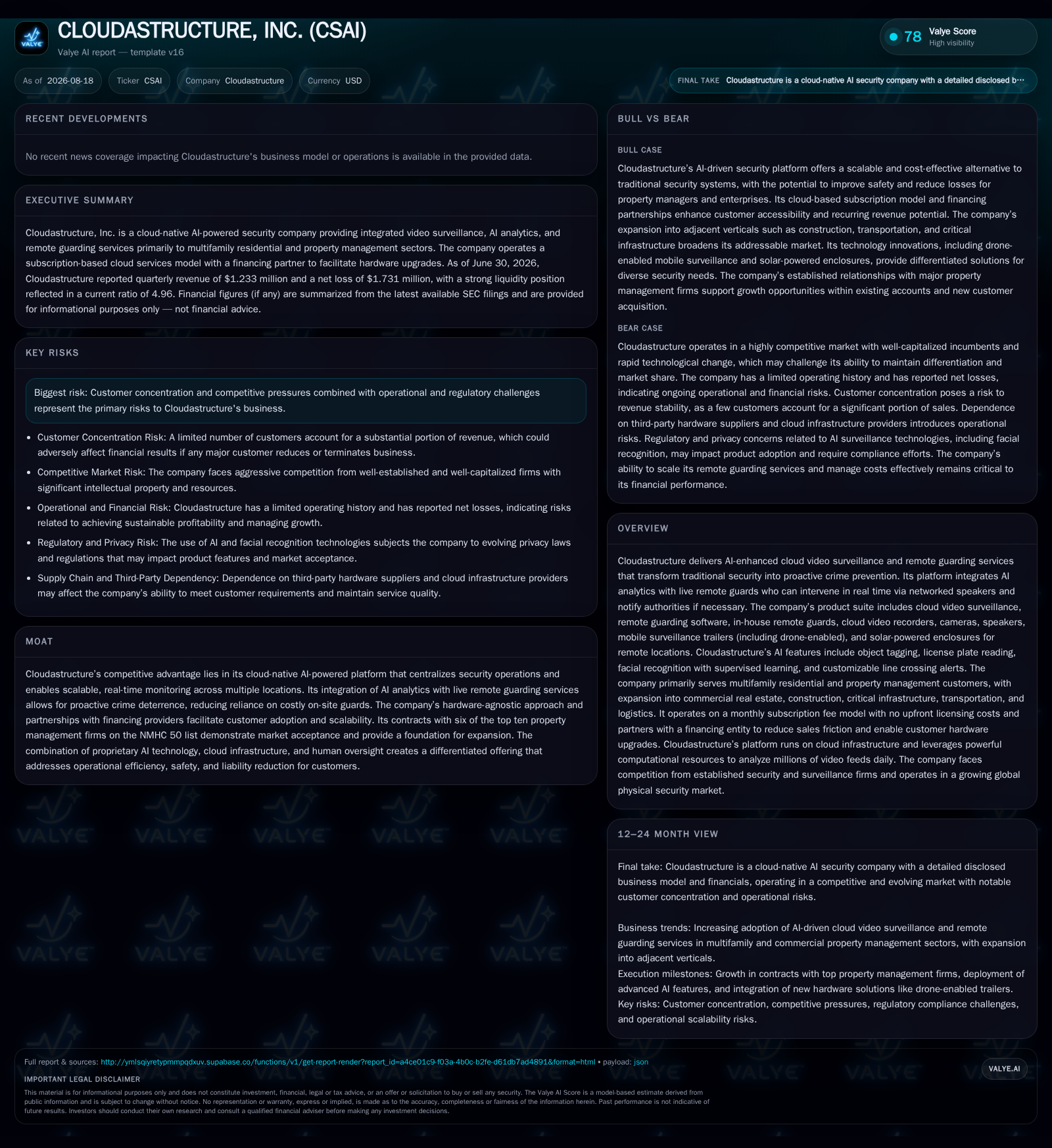
Cloudastructure, Inc. reported in its Q2 2026 filing increased scrutiny on data privacy regulations that could raise compliance costs and affect demand for its cloud-native AI-powered security platform. The company’s hybrid model combining AI analytics with live remote guarding remains a strategic differentiator in an evolving, competitive cloud-based security market dominated by leading property management clients. Scalability evidence through monthly recurring revenue growth and retention metrics contrasts with risks from customer concentration and regulatory compliance complexity. Upcoming contract renewals and regulatory developments serve as critical watchpoints for validating Cloudastructure’s growth trajectory.
Latest Quarterly Filings Highlight Regulation-Driven Cost Pressures and Operating Signals
Cloudastructure’s Q2 2026 10-Q filing underscores a rapidly evolving regulatory environment centered on data privacy that could materially impact the company’s cost structure and market demand. The company disclosed that new privacy laws—like California’s CPRA—and analogous regulations impose additional compliance obligations which may increase operating expenses and potentially dampen demand for its software solutions if prospective modifications are required. This regulatory tightening emerges as a key near-term headwind for Cloudastructure given its reliance on processing sensitive personal data such as biometric and facial recognition information [S2]. While the company reports no current material legal proceedings related to these risks, ongoing compliance investment is likely necessary to avoid penalties or reputational harm.
From an operational perspective, these incremental compliance costs could pressure gross margins or slow customer procurement cycles if pricing adjustments follow. Monitoring whether these incremental burdens compress margins or delay sales cycles will provide insight into Cloudastructure’s ability to sustain growth without sacrificing profitability.
Hybrid AI-Enhanced Remote Guarding as the Nexus of Cloudastructure’s Business Model
At the core of Cloudastructure's business model is a cloud-native platform that tightly integrates AI-powered video surveillance analytics with a live remote guarding service. Unlike traditional on-site security guards or hardware-centric vendors, Cloudastructure delivers subscription-based access to real-time monitoring augmented by trained remote guards who can intervene immediately via networked speakers or alert authorities. This hybrid approach addresses key client pain points around scalability of human monitoring while elevating threat detection precision through proprietary AI features such as object tagging, license plate reading, supervised facial recognition, and line crossing alerts [S1].
Revenue flows primarily from monthly recurring subscription fees combined with value-added guard services. The hardware-agnostic aspect allows customers—mainly multifamily residential property managers—to integrate existing cameras or deploy Cloudastructure-supplied units flexibly without vendor lock-in.
This platform transforms security operations by centralizing event triage efforts into a cloud orchestration system offering unified operational intelligence dashboards. As a result, the offering enhances operational efficiencies for clients by reducing reliance on costly on-site personnel while enabling scalable coverage across multiple properties.
Competitive Headwinds From Integrated Surveillance Players Shape Market Battles
Cloudastructure competes amid several well-established players spanning integrated video surveillance hardware/software vendors to traditional security service companies. Peers such as Avigilon (under Motorola Solutions) and Verkada provide integrated physical security solutions combining video cameras with local or hybrid cloud software platforms. Milestone Systems emphasizes software-centric video management but lacks remote guarding integration; whereas traditional firms like Tyco offer legacy security services but face challenges adapting to cloud-native hybrid models [S1].
While this competitive landscape pressures margins due to continuous technological innovation demands and pricing competition, Cloudastructure’s pure cloud-native and human-AI hybrid response model offers switching-cost advantages rooted in platform scalability and ease of deployment versus hardware-bound incumbents.
To maintain differentiation amid frequent product introductions by competitors who bolster AI analytics capabilities internally or through acquisitions requires sustained R&D investment—a drain on margins but essential for preserving relevance.
Scalability And Operational KPIs Signal Traction Amid Customer Concentration Risk
Effective management of this concentration risk hinges on successfully expanding the overall customer base beyond these few large contracts while maintaining strong retention driven by seamless integration of AI detection accuracy coupled with efficient remote guard utilization rates. Additionally, system uptime reliability and low latency are critical operational variables underpinning client satisfaction.
Growth Catalysts: Multifamily Penetration, Commercial Expansion & AI Adoption Trends
Cloudastructure's annual report frames growth potential driven by accelerating digitalization within multifamily residential—its core segment—and broadening footholds in commercial real estate spaces where proptech spending is expected to grow robustly. Regulatory mandates for enhanced monitoring coupled with rising tenant safety expectations encourage adoption of scalable cloud-native solutions especially those equipped with advanced AI analytics for proactive threat deterrence [S1].
Integration capability with IoT devices further supports expansion into infrastructure logistics sectors where real-time operational intelligence yields efficiency gains beyond pure security objectives.
Nonetheless, execution risks persist around scaling human resource-intensive remote guard operations effectively across diverse geographies as well as adapting solutions to vertical-specific requirements which could influence deployment velocity.
Key Risks in Data Privacy Compliance, Customer Dependency, and Technological Evolution
Principal risks revolve around the evolving regulatory landscape concerning data privacy governance that mandates continuous adaptation of product features and potentially escalates costs. Securing individually identifiable biometric data imposes responsibilities extending across direct operations and third-party vendors managing this sensitive information chain [S1]. Failures here threaten reputation damage plus possible fines.
Customer concentration risk materially constrains bargaining leverage impacting future contract negotiations; loss or downsizing by any top-tier client could significantly reduce revenue stability [S6]. Also inherent is intense competition necessitating unremitting technology advancement demanding elevated R&D spend to avoid obsolescence.
These dynamics create pressure points warranting careful risk management balancing innovation funding against prudent capital stewardship.
Watchpoints Ahead: Contract Renewals, Regulation Updates, And AI Innovation Milestones
Important near-term milestones include multi-year contract renewal outcomes among dominant property management customers whose buying decisions heavily influence revenue continuity [S2]. Regulatory developments impacting privacy law enforcement or introducing licensing requirements would further shape operating expense assumptions and potential product redesign needs
Product roadmap progress focused on enhancing AI detection accuracy—reducing false alarms—directly affects value proposition strength alongside operational intelligence feature maturation enabling better decision-making support.
Updates around partnerships facilitating financing for hardware adoption will also act as barometers for sales scalability.
Financial Profile Discussion: Recent Liquidity Position Supports Near-Term Strategy
Financially, Cloudastructure reported cash and cash equivalents totaling $3.81 million at June 30, 2026 against current liabilities approximating $1.14 million yielding a favorable current ratio near five times coverage—a robust liquidity profile indicative of an adequate runway to sustain operations in the near term while pursuing growth initiatives [F1], [S2].
However, cumulative net losses nearing $8.46 million underscore continued reliance on capital raises or improvement in operating efficiency to reach positive free cash flow sustainably [S2]
Ongoing capital expenditure requirements—while modest relative to software peers—will remain a factor given partial hardware sales/leasing components woven into solution deployments.
Investors should monitor improvements in subscription revenue growth trajectories coupled with scaling efficiencies in sales/marketing spend aligned to customer acquisition cost rationalization efforts going forward.
This analysis synthesizes publicly filed SEC disclosures through August 18, 2026 alongside sector-specific operational frameworks characteristic of cloud-based AI-enhanced physical security providers. It refrains from speculative valuation or investment research views adhering strictly to evidence-supported interpretation requirements prescribed by current policy directives.
Disclaimer: This is research-only, informational analysis and not investment advice. It may include AI-generated interpretation and general industry context. Always verify important details using primary sources.

Comments