
Cisco Systems Strengthens AI Networking Leadership After Burst Growth Quarter
Cisco’s Q3 2026 results highlight accelerating adoption of AI and cloud networking solutions, supporting an upgraded strategic outlook despite ongoing demand variability and supply chain challenges.
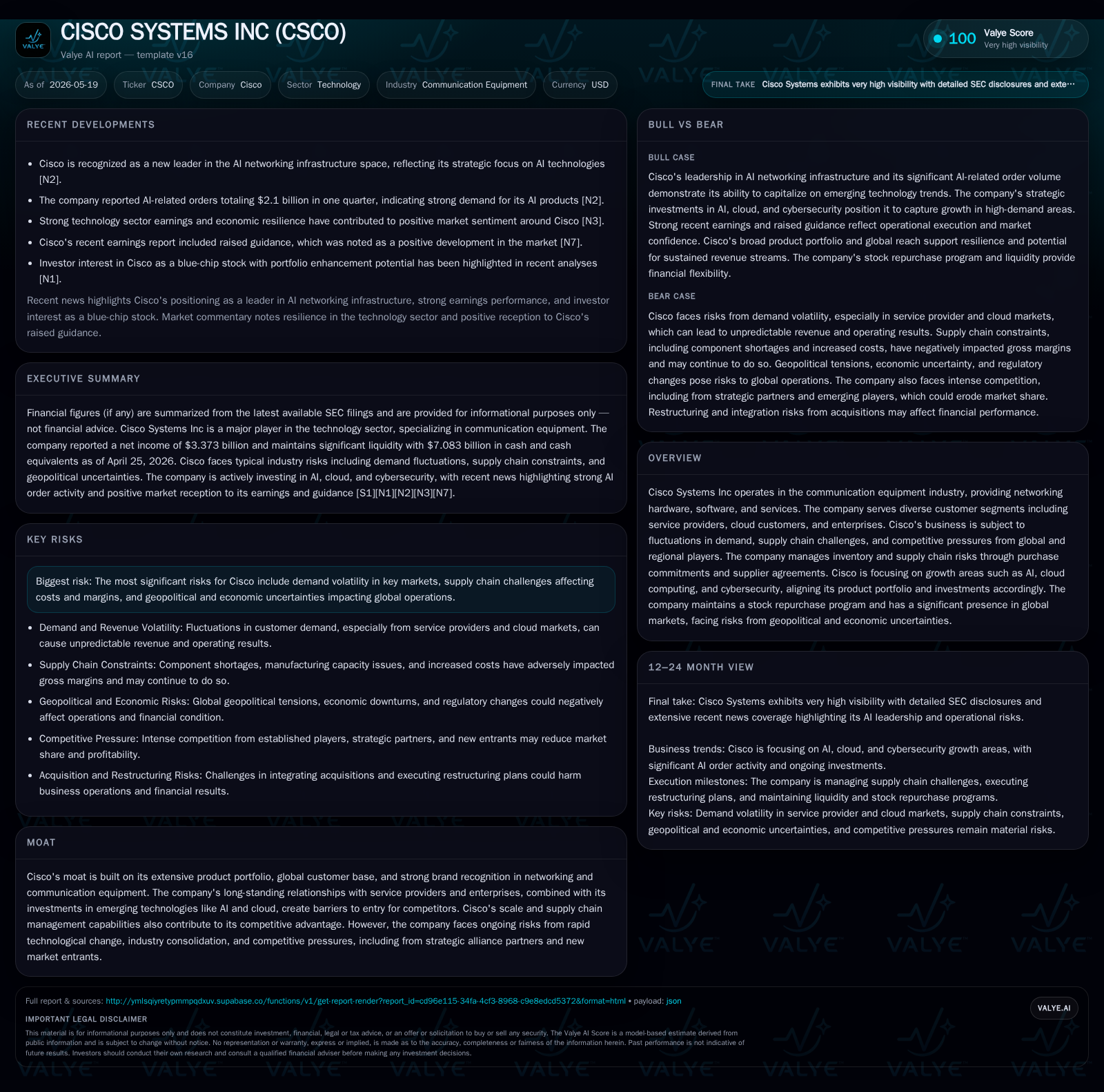
In its latest quarterly filing, Cisco Systems reported robust growth in AI-enabled networking products and cloud infrastructure solutions, underpinning raised guidance and reaffirmed focus on strategic investments in silicon, optics, and security. While demand from service providers and cloud customers remains volatile, the company’s diverse portfolio and industry-leading scale help navigate fluctuating sales cycles and supply chain pressures. Cisco’s sizeable restructuring plan aims to optimize resources towards high-growth areas, further strengthening its market moat against competitive and geopolitical headwinds.
Latest Quarterly Operating Update: What Changed in Q3 2026
Cisco's fiscal third quarter ended April 25, 2026, delivered a strong operational performance marked by increased sales momentum in AI-enhanced networking solutions and cloud infrastructure products [S2], [S3]. The company reported growth driven by higher adoption of AI capabilities embedded across its switching, routing, and cybersecurity platforms — a clear reflection of its strategic pivot towards next-generation technologies. This dynamic contributed to an improved revenue mix emphasizing software subscriptions and cloud-aligned offerings even as supply chain headwinds persisted. Cisco announced a material restructuring program costing up to $1 billion pre-tax with expected charges primarily recognized through fiscal 2027 [S13], refocusing investments toward silicon design, optics innovations, security enhancements, and artificial intelligence integration.
While overall demand remained somewhat uneven due to variability in spending patterns from large service providers and cloud customers—who exhibit cyclical capex influenced by global economic uncertainty—the company managed inventory prudently through supplier agreements and purchase commitments that mitigate risk amid volatile lead times [S2]. Pricing competition from Asian players including Chinese vendors continues but has been partly offset by Cisco's differentiated technology stack. Management’s commentary emphasized the importance of maintaining agility in sales cycles while expanding footprint in emerging markets despite geopolitical complexities affecting global operations [S2], [S4]. The raised forward outlook issued contemporaneously signals confidence in the sustainability of recent bookings growth within core high-growth segments [S3].
Cisco’s Business Model: Product Portfolio and Customer Value Proposition
Cisco operates across multiple product categories encompassing communication equipment hardware such as routers, switches, optical transport devices, complemented by an expanding suite of software solutions including network management tools, security platforms, collaboration applications, and cloud-native services [S1]. Revenue flows primarily from direct sales to service providers (carriers), large enterprises deploying private networks or hybrid clouds, and hyperscale cloud operators requiring scalable infrastructure. Pricing is a blend of upfront hardware sales—often customized for specific network architectures—and recurring software licenses structured via subscription models that enhance revenue visibility.
This mix enables Cisco to balance capital-intensive product cycles with recurring annuity-like income streams boosting margin resilience. Its ecosystem integration creates significant switching costs: once core network infrastructure is deployed using Cisco’s standards-compliant but proprietary components, customers face complexity and disruption costs that reinforce contract renewals [S1]. The company’s investment in AI networking—embedding machine learning for self-optimizing networks—leverages both hardware innovation (e.g., silicon ASICs) and advanced software orchestration. This dual approach not only differentiates offerings technologically but also aligns with evolving industry paradigms emphasizing software-defined networking and zero-trust cybersecurity frameworks [S1], [S2].
Industry Context: Competitive Dynamics and Market Position
Within the global communication equipment sector Cisco holds a leadership stance bolstered by scale unmatched by most rivals except a handful of multinational peers specializing in related domains (e.g., Juniper Networks for routing or Arista Networks focused on data center switching). The industry is characterized by rapid technological shifts including transitions toward cloud-centric architectures combined with highly competitive pricing pressures emanating from Asian manufacturers who leverage lower-cost structures [S1], [S2].
Customer consolidation among service providers creates larger but more concentrated deal opportunities while simultaneously raising negotiation leverage — posing margin pressure challenges. Cisco's broad geographic footprint spanning mature regions (North America/Europe) alongside emerging markets provides revenue diversification but also exposes the company to political risks such as trade restrictions or export controls affecting component sourcing [S15], [S25]. Its established brand recognition paired with comprehensive local support infrastructures strengthens client retention versus newer entrants lacking comparable deployment capabilities.
However, ongoing challenges include competitive encroachment by hyperscale cloud firms developing proprietary networking stacks internally—potentially limiting third-party vendor options—and the accelerating pace of alliances among competitors seeking integrated solutions packages. Maintaining technological leadership while balancing pricing strategies remains critical as product lifecycle velocity accelerates with innovations like AI automation reshaping demand drivers.
Strategic Growth Drivers: Cloud, AI Integration, and Emerging Technologies
Cisco’s primary growth vectors stem from its strategic alignment with AI-powered networking solutions that promise enhanced automation for complex environments increasingly dominated by hybrid cloud deployments. Investments into silicon chip design targeting performance efficiency combined with optical transceivers support bandwidth scaling at reduced power profiles—a critical factor given hyperscaler capex constraints [N5], [S2].
Expansion of subscription-based software services fuels predictability in revenues amid hardware cycle fluctuations. Enhanced cybersecurity offerings address heightened enterprise concerns around data protection amplified by regulatory mandates globally [S2], [N9]. Furthermore, ongoing R&D efforts focus on enabling seamless multi-cloud management capabilities providing vendors agility amidst shifting IT landscapes.
Measured success is observable via rising bookings rates for AI solution suites alongside stable renewal rates within technical support contracts forming an annuity backbone reinforcing cash flow stability [S2]. These favorable product mix changes contribute positively toward gross margin enhancement opportunities despite inflationary cost pressures documented elsewhere in the supply chain ecosystem [S20].
Risks and Constraints: Supply Chain, Demand Volatility, and Geopolitical Factors
Key near-term risks revolve around component availability—particularly semiconductors affected by industry-wide shortages—and elevated logistics expenses impacting cost structures [S2], [S20]. Demand uncertainty persists notably among service providers who historically demonstrate capital expenditure sensitivity tied to macroeconomic fluctuations or regulatory interventions impacting financing availability [S17].
Geopolitical tensions involving major trade regions expose Cisco to operational disruption risks including restricted access to manufacturing inputs or challenges selling into certain markets subject to heightened scrutiny or sanctions regimes [S4], [S22]. Intellectual property disputes present ongoing latent legal risks as rapid innovation cycles increase exposure to patent claims requiring costly defense or licensing arrangements potentially deleterious to earnings stability [S19].
Counterfeit product infiltration poses reputational hazards undermining brand integrity despite active enforcement efforts detailed in supply chain oversight programs [S4], [S14]. Additionally, the shift toward internalized hyperscale networking capabilities may erode portions of Cisco’s addressable market if not adequately countered through continued solution differentiation.
What to Watch Next: Guidance Outlook and Execution Milestones
Upcoming quarters will be telling regarding how effectively Cisco executes its restructuring plan delivering targeted cost savings without impairing R&D momentum vital for sustaining innovation-led growth strategies [S13]. Monitoring sequential trends in new bookings for AI-enhanced networking solutions along with contract renewals within subscription services will provide insight into market acceptance.
Inventory levels alongside vendor lead time normalization serve as important operational barometers signaling improvements or persistent constraints within the supply chain framework influencing margin trajectories [S2], [N6]. Tracking competitive responses—both price adjustments from regional players and product feature advances—will indicate whether Cisco retains architectural leadership or cedes ground amid evolving standards.
Investor focus remains on how corporate governance manages debt maturity profiles relative to cash flow generation ensuring balanced leverage stewardship amid capital allocation decisions supporting opportunistic acquisitions aligned with emerging technology domains or market adjacency expansions [S23]
Financial Health Snapshot: Balance Sheet Strength and Liquidity
As of April 25, 2026 end-of-quarter data reflect $7.1 billion in cash and equivalents against total debt nearing $23 billion yielding net debt approximately $15.9 billion [F1]. All forward-looking statements referenced are subject to inherent risks outlined explicitly within official corporate filings.
Disclaimer: This is research-only, informational analysis and not investment advice. It may include AI-generated interpretation and general industry context. Always verify important details using primary sources.

Comments