
Cisco Systems Inc (CSCO): Strategic Positioning Amid AI Growth and Supply Chain Risks
Cisco demonstrates solid product-driven growth fueled by AI infrastructure demand, balanced by persistent supply chain challenges and competitive pressures. Its global footprint and integrated technology portfolio underpin a durable competitive stance, while geopolitical and demand volatility temper near-term prospects.
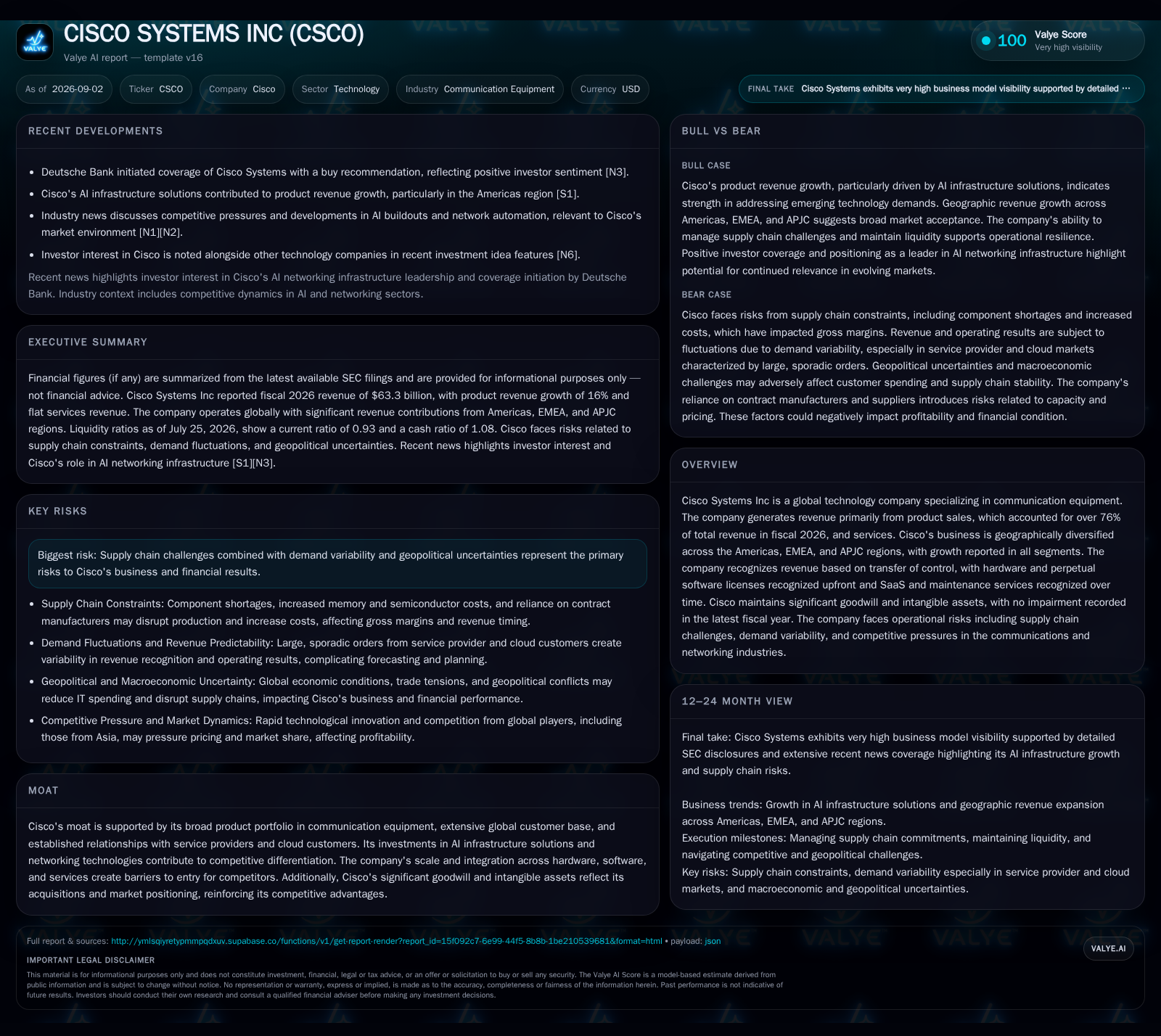
Cisco’s 2026 revenue growth of 12%, led by a 16% rise in product sales anchored by AI infrastructure solutions, reflects successful market penetration across key geographies. The business model hinges on hardware-centric sales augmented by software and services, with operating leverage potential moderated by supply chain cost pressures and demand variability. Competitive advantages stem from scale, portfolio breadth, and entrenched customer relationships, though risks from component shortages, macro uncertainties, and volatile service provider demand persist. The company’s trajectory depends on managing supply chain exposure, capitalizing on AI-driven network transformation, and navigating evolving competitive dynamics.
Cisco Systems Inc reported fiscal 2026 revenue of $63.3 billion, marking a 12% year-over-year increase driven chiefly by a 16% surge in product sales. The growth reflects the company’s strategic emphasis on AI networking infrastructure solutions, which have notably fueled expansion in the Americas and other regions. While services revenue remained flat, the geographic diversification across Americas, EMEA, and APJC regions suggests broad market acceptance. However, Cisco contends with ongoing supply chain challenges, including semiconductor shortages and rising input costs, which introduce margin and operational risks. Investor confidence, evidenced by Deutsche Bank’s recent buy recommendation, underscores optimism about Cisco’s positioning in the evolving networking landscape. The critical question is whether Cisco can sustain this momentum amid competitive pressures and demand volatility.
Latest Operating Snapshot
Cisco’s fiscal 2026 results indicate a 12% total revenue growth to $63.3 billion, driven by a 16% increase in product revenue, which now represents over 76% of total sales, while services revenue remained essentially flat [S1]. This split highlights Cisco’s core reliance on hardware and perpetual software licenses, recognized upfront, contrasting with its services and SaaS revenue recognized ratably over contract duration. The geographic distribution of revenue shows strength across Americas (59.7%), EMEA (26.2%), and APJC (14.1%), with product revenue growth of 17%, 15%, and 13% respectively, demonstrating broad-based demand across mature and emerging markets [S1].
Liquidity metrics as of July 2026 reflect a current ratio below 1 at 0.93 but a cash ratio of 1.08, underscoring sufficient cash coverage despite current liabilities slightly exceeding current assets [S1]. Supply chain challenges remain a material concern, with component shortages and increased costs for semiconductors and memory affecting gross margins and revenue timing. Cisco’s strategic procurement commitments to suppliers for components like Cisco Silicon One illustrate efforts to mitigate these risks but also increase exposure to input cost volatility [S1]. AI infrastructure solutions have materially contributed to product revenue growth, particularly in the Americas, positioning Cisco as a significant player in emerging AI-driven networking markets [S1][N3].
Business Model and Unit Economics
Cisco’s revenue model is heavily weighted towards product sales, which comprise approximately three-quarters of total revenue and are recognized upfront upon transfer of control, providing near-term visibility into revenue flows when orders are received [S1]. Services and software maintenance revenues, accounting for the remaining quarter, are recognized ratably over contract terms, contributing stable, recurring revenue streams but limiting rapid growth in that segment. The upfront recognition of hardware and perpetual licenses creates a revenue mix sensitive to order timing and demand volatility, particularly given the large, sporadic purchases typical in service provider and cloud markets.
The company’s unit economics are influenced by significant fixed costs associated with R&D, manufacturing commitments, and supply chain investments, including long-term purchase commitments to key suppliers. Operating leverage potential exists if product volumes scale sufficiently to absorb fixed costs; however, supply chain cost inflation and pricing pressures moderate margin expansion. Inventory management becomes critical in this context to avoid obsolescence or write-downs. Capital intensity is moderate, with reliance on contract manufacturers rather than owned fabs, but supplier dependency introduces risks to cost control and capacity. Product mix shifts toward higher-margin AI infrastructure solutions could enhance profitability if sustained.
Moat, Competition and Counterforces
Cisco’s competitive moat is underpinned by its extensive product portfolio spanning communication equipment, networking hardware, software, and services, coupled with deep, long-standing relationships with global service providers, cloud operators, and enterprise customers. Its scale enables integrated solutions that blend hardware and software, creating switching costs and differentiation difficult for new entrants to replicate. The company’s sizable goodwill and intangible assets reflect accumulated acquisitions and investments that bolster its technological breadth and market positioning.
However, the moat faces counterforces from intensifying competition, especially from Asian manufacturers and technology firms accelerating AI and network automation capabilities. Supply chain constraints and pricing pressures also erode margin defensibility. The cyclical and lumpy nature of orders from service providers and cloud customers introduces revenue unpredictability, challenging Cisco’s ability to leverage scale consistently. Rapid innovation cycles and the increasing importance of software-defined networking and cloud-native architectures require continuous investment to maintain relevance.
Bull Case
In the bullish scenario, Cisco leverages its AI infrastructure solutions to capture a growing share of the expanding AI networking market globally, benefiting from broad geographic demand across Americas, EMEA, and APJC. Successful execution of supply chain strategies ensures component availability at stable costs, enabling margin improvement. The company expands its software and subscription offerings, increasing recurring revenue and reducing reliance on volatile hardware sales. Positive investor sentiment, as reflected in Deutsche Bank’s buy recommendation, validates market confidence in Cisco’s growth trajectory and innovation leadership.
Confirmation of this scenario would come from sustained double-digit product revenue growth driven by AI-related products, improving gross margins through supply chain optimization, and accelerating services revenue growth. Conversely, failure to maintain component supply or to innovate rapidly enough in AI networking could falsify this outlook, as would continued margin erosion or loss of key customer contracts to competitors.
Base Case
The base case envisages moderate product revenue growth sustained by ongoing AI infrastructure adoption, balanced by flat to modestly growing services revenue. Supply chain disruptions persist but are managed with incremental cost increases passed selectively to customers, keeping gross margins relatively stable. Geographic diversification cushions regional demand fluctuations, though macroeconomic and geopolitical uncertainties introduce occasional volatility. Competitive pressures constrain pricing power but do not materially erode Cisco’s market share due to entrenched customer relationships and integrated portfolio offerings.
In this scenario, operating leverage emerges gradually as fixed costs are amortized over growing volumes, but margin gains are limited by ongoing input cost inflation and investment in new technologies. Recurring revenue grows slowly, maintaining revenue visibility without dramatic improvement. This outlook would be supported by consistent quarterly revenue growth near corporate guidance, stable margins, and steady investment in AI and network automation capabilities. Significant deviations, such as sharper margin declines or loss of key customers, would question this scenario.
Bear Case
The downside scenario involves persistent supply chain constraints with escalating semiconductor and memory prices, compounded by capacity shortages that delay product deliveries and reduce revenue recognition. Large, irregular orders from service providers and cloud customers decline due to macroeconomic weakness or competitive displacement, leading to pronounced revenue volatility and margin compression. Geopolitical tensions disrupt supply chains further and deter customer IT spending, especially in volatile regions. Increased competition from lower-cost or more agile players erodes Cisco’s market share and pricing power.
This scenario’s confirmation would be evident through declining product revenues, margin contraction beyond historical variability, inventory write-downs, and negative cash flow impacts. A failure to secure alternative suppliers or to adapt product offerings to emerging technology trends would exacerbate risks. Conversely, stable supply chain performance and resilient demand would falsify this negative outlook.
What Matters Next
Key performance indicators to monitor include quarterly product and services revenue growth rates, gross margin trends, and geographic revenue contributions to assess demand sustainability and cost pressures. Tracking the proportion of revenue derived from AI infrastructure solutions versus legacy products is critical to understanding Cisco’s strategic pivot effectiveness. Supply chain metrics such as inventory levels, lead times, and component cost trends provide insight into operational risk exposures.
Additional milestones involve progress in expanding subscription and software-based recurring revenue streams, continued-adoption indicators for maintenance contracts, and customer retention metrics to evaluate switching costs and loyalty. Monitoring competitor actions, particularly from Asian players and emerging AI networking vendors, will gauge competitive intensity. Lastly, macroeconomic indicators and geopolitical developments affecting IT spending cycles and supply chain stability remain vital external conditions influencing Cisco’s near-term prospects.
Disclaimer: This is research-only, informational analysis and not investment advice. It may include AI-generated interpretation and general industry context. Always verify important details using primary sources.

Comments