
CSW Industrials Strengthens Manufacturing Footprint with Strategic Acquisitions and Automation Investment
Recent quarterly disclosures reveal CSW Industrials’ proactive capital deployment into automation, safety, capacity expansion, and acquisitions underpinning its manufacturing growth strategy.
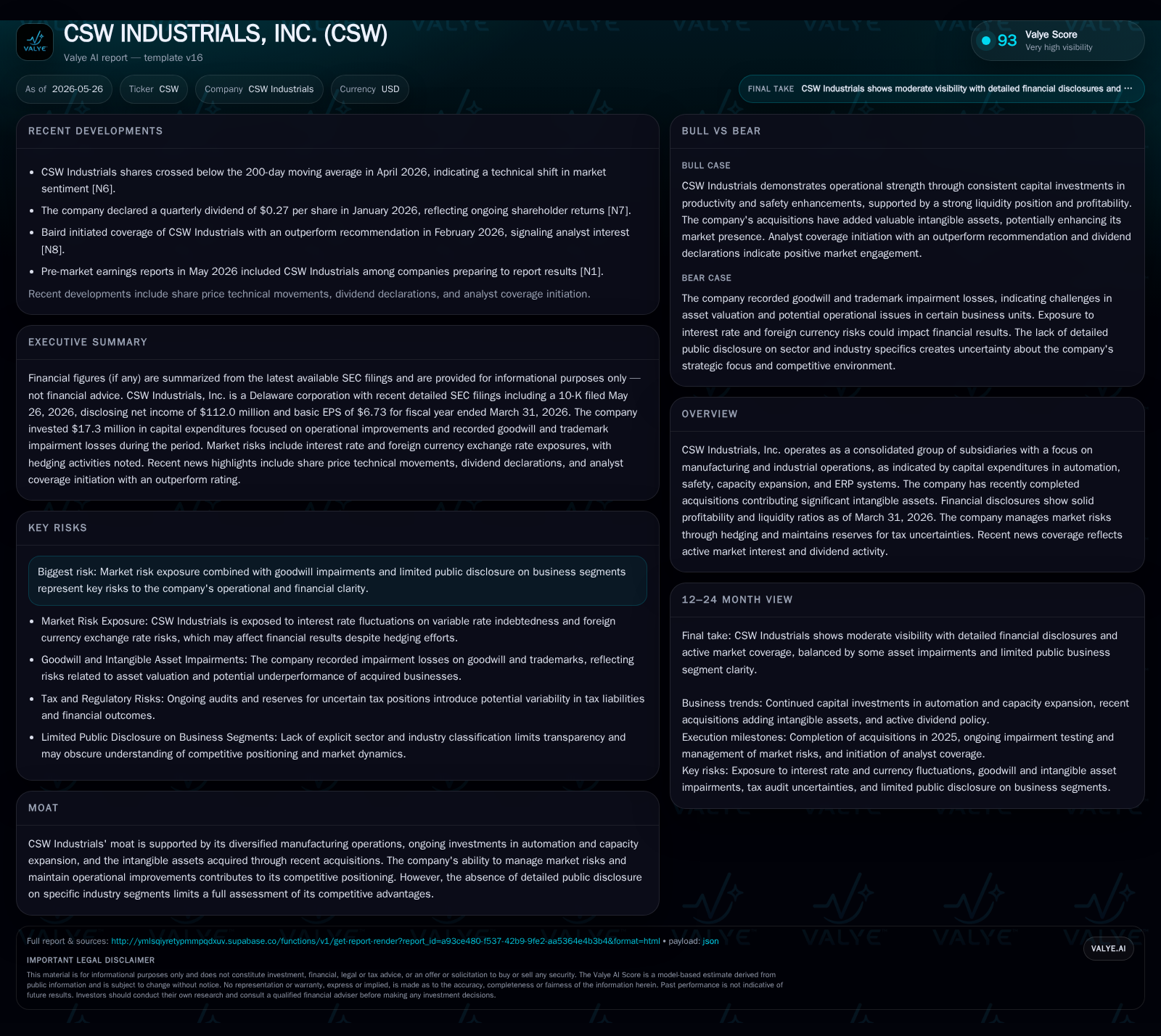
CSW Industrials’ latest quarterly filing shows intensified investment in automation and capacity, alongside strategic acquisitions that boost intangible assets and segment diversification. These moves reinforce operational efficiencies and competitive positioning across their diverse manufacturing subsidiaries. While market risk hedging and tax reserve management stabilize financials, goodwill impairment potential and limited disclosure detail of segments present clarity challenges. Focus on integration progress and capital expenditure execution will be critical milestones for assessing sustained growth.
Recent Quarterly Update: Insights from the Latest Filing
CSW Industrials’ most recent quarterly report filed on January 29, 2026 [S2] confirms continuation of its investment-driven growth strategy supported by capital expenditures totaling $17.3 million in fiscal year 2026 focused on automation enhancements, operational safety improvements, capacity expansions, enterprise resource planning (ERP) upgrades, and new product introductions [S1]. Complementing the Q3 update is the May 26, 2026 event filing [S3] detailing access to fresh operating cash flows underpinning the company’s ongoing acquisition activity.
Noteworthy developments include multiple acquisitions closed during the year culminating in a sizable increase in intangible assets and goodwill—the latter rising sharply due to deals like Hydrotex Holdings ($17 million purchase) that expand CSW’s general industrial lubricants offerings alongside other targeted bolt-ons [S15][S16]. This capital deployment is mirrored by amendments to the revolving credit facility (RCF) extending maturity to November 2030 with an accordion feature enabling flexible leverage adjustments [S4][S5]. Debt management remains disciplined with compliance maintained against covenants despite gross debt nearing $871.5 million as of March 31, 2026 [F1][S24].
Business Model and Quality of Product Offering
CSW Industrials operates through a consolidated model encompassing three reportable segments that reflect different manufacturing niches: Contractor Solutions (efficiency-enhancing HVAC/R and plumbing products), Specialized Reliability Solutions (industrial asset reliability and maintenance products), and Engineered Building Solutions (code-driven life safety products for commercial environments) [S9]. Revenue streams derive primarily from B2B sales to professional trades and industrial customers seeking differentiated products improving operational performance or compliance.
Product quality benefits from ongoing investments in automation which aim to improve throughput while maintaining stringent safety standards. ERP system upgrades signal an effort to reduce back-office friction, enhance supply chain responsiveness, and heighten switching costs through integrated customer service solutions—all critical levers in manufacturing where reliability and lead-time matter deeply. These factors underpin customer retention given professional trades’ preference for dependable suppliers who minimize downtime risk.
Competitive Positioning and Industry Structure
CSW's competitive moat stems from its diversified manufacturing footprint spanning multiple end-markets within industrial controls, building safety, HVAC/R sectors. The acquisition-led growth strategy has bolstered its intangible asset base—providing patent protections, brand equity, and specialized know-how crucial for maintaining differentiated offerings amid commoditization pressures seen in peer groups lacking similar scale or integration capability [S1].
Operationally, CSW demonstrates nimbleness through continuous process improvements supported by technology investments. Market risk mitigation via interest rate hedging safeguards financing costs—a notable advantage given recent volatility in benchmark rates [S17]. However, opaque reporting at the segment level constrains full visibility into granular competitive dynamics or customer concentration risks.
Capital Expenditures and Acquisitions as Growth Engines
Capital expenditures accelerated materially during FY2026 with $17.3 million directed towards multifaceted objectives: automation upgrades intended to raise manufacturing efficiency; enhanced workplace safety features; capacity additions responding to increased demand; ERP system implementations designed for synchronous operations; and new product launches fueled by innovation pipelines [S25]. This capex cadence aligns tightly with CSW’s strategic intent to modernize its manufacturing base.
Acquisition activity has been robust—Hydrotex Holdings acquisition for $17 million expanded its lubricant portfolio adding high-performance formulations that complement existing industrial solutions [S15][S16]. Likewise, the Dusk Acquisition Corporation transaction enlarged its motors manufacturing segment while contributing goodwill that encapsulates expected synergies yet carries inherent impairment risk requiring careful monitoring
The orchestrated use of debt facilities including a senior secured term loan A (TLA) of $592.5 million bears testament to leveraging low-cost capital markets to fund these transactions responsibly while preserving liquidity cushions via an extended RCF line with high undrawn capacity [S4][S5]. The mix optimizes capital structure flexibility without overextending credit profiles.
Risk Factors and Operating Constraints
Key risks identified revolve around CSW's exposure to fluctuating market conditions including raw material input costs, interest rate volatility (managed partly through swaps), and currency effects given global supplier footprints [S17]. Critical accounting estimates present potential downside from goodwill impairments linked to acquisition valuations particularly if anticipated synergies underperform post-integration leading to asset write-downs [S1].
The company's limited granularity on segment financials restricts external assessment precision—potentially dampening investor confidence while complicating peer benchmarking efforts. Purchase obligations projected at $80.4 million impose short-term liquidity demands despite a strong current ratio of approximately 2.6 underscoring operating flexibility [S25][F1]
Key Milestones and What to Monitor Next
Upcoming milestones include Q4 fiscal year earnings release which should provide incremental visibility into the early financial contribution of recently acquired entities including PF WaterWorks and Aspen Manufacturing as they complete integration phases marked by revenue recognition normalization [S12][N6]. Management guidance on further capex plans will also shed light on ongoing modernization priorities beyond FY2026 outlays.
Market reaction measured through stock technical levels crossing critical moving averages offers indirect sentiment insight linked to execution confidence across core operations.
Capital allocation priorities balancing share repurchase programs valued up to $250 million against opportunistic M&A spending will be another focal area for investors tracking cash flow utilization efficiency alongside dividend policy trajectories set forth by Board resolutions [S6][N6]
Concise Financial Overview
As of March 31, 2026, CSW Industrials reported total debt outstanding approximating $871.5 million against cash reserves near $33.8 million resulting in net debt of roughly $838 million consistent with stated leverage targets calibrated through sizable RCF availability ($419.7 million borrowing capacity after utilization) supported by staggered maturities—notably term loan maturing November 2030—providing refinancing risk mitigation [F1][S4][S7]
Profitability remained solid with operating income reported at approximately $168.5 million underscoring effective margin management despite inflationary pressures encountered across manufacturing sectors [F1][S25]
In summary, CSW’s disciplined approach combining automated production capabilities expansion alongside highly selective acquisition integrations fosters a resilient platform positioned for measured growth amidst macroeconomic uncertainties while balancing financial prudence against strategic agility.
This analysis reflects information available up to May 26, 2026 from SEC filings including the latest quarterly (10-Q), annual (10-K), and recent events (8-K). It aims to provide factual context without offering investment advice or price targets.
Disclaimer: This is research-only, informational analysis and not investment advice. It may include AI-generated interpretation and general industry context. Always verify important details using primary sources.

Comments