
Centuri Holdings' Transition to Independence Shapes Growth Amid Industry Consolidation
After spinning off from Southwest Gas Holdings in 2024, Centuri Holdings navigates growth opportunities and financial challenges in the North American utility infrastructure sector.
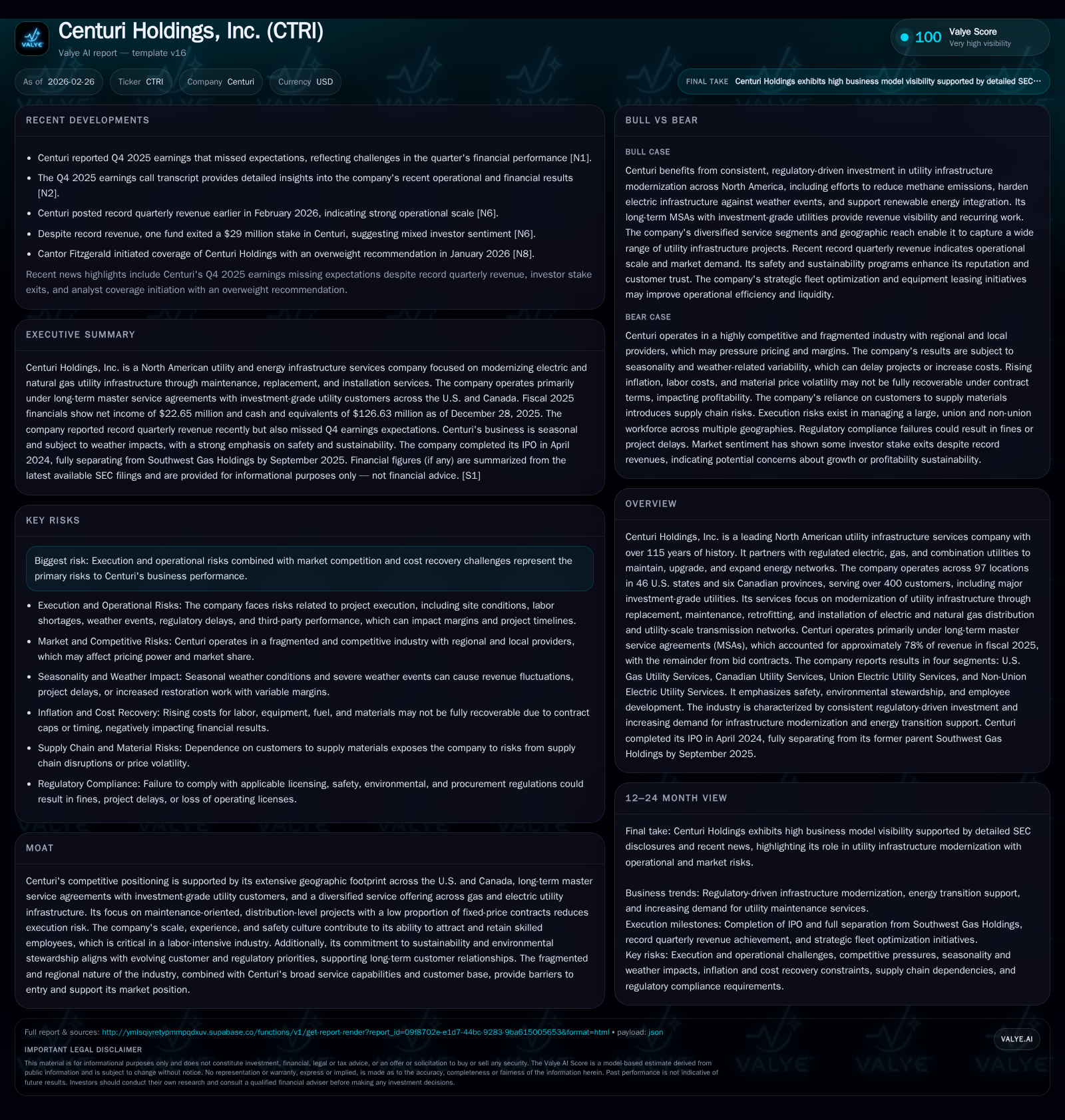
Centuri Holdings, a prominent utility infrastructure services provider with over a century of history, completed its separation from Southwest Gas Holdings and launched as an independent public company in mid-2024. The company serves mainly regulated electric and gas utilities across the U.S. and Canada via long-term master service agreements (MSAs), driving a solid revenue base focused on maintenance and modernization of distribution networks. Despite record revenue results, recent quarterly earnings missed analyst expectations, highlighting operational cost pressures and cash flow volatility. Centuri maintains a robust geographic footprint and diversified portfolio but faces challenges from elevated leverage and softer free cash flow performance amid fleet optimization efforts and evolving contract mix.
Historical Performance
Centuri Holdings emerged as an independent publicly traded company following its spin-off from Southwest Gas Holdings in April 2024 [S1]. The separation involved issuing over 71 million shares transferred from Southwest Gas Holdings and subsequent secondary offerings reducing Southwest's ownership from approximately 81% at IPO close to below majority stakes by mid-2025 [S1].
Despite its relatively recent standalone status, Centuri boasts over 115 years of operating history across utility infrastructure services throughout North America [S1]. Its strategy focuses on partnering primarily with regulated electric, gas, and combination utilities under master service agreements (MSAs) that provide revenue visibility.
Financially, fiscal year 2025 showed growth against the prior year with operating income increasing about 7% to $92.8 million while net income recovered to $22.4 million from a net loss of $6.7 million in fiscal 2024 [F1]. This improvement reflects operational scale benefits and management’s emphasis on safety and quality execution [S16].
However, operating cash flow halved year-over-year to $78.1 million due partly to working capital shifts and the lack of one-time favorable impacts such as the initial receivables securitization cash inflow realized in late 2024 [F1][S20]. Capital spending declined by a modest 13% to $86.3 million as Centuri implemented fleet optimization initiatives including sale-leaseback transactions which generated liquidity but increased lease obligations [S15].
Historical performance (annual)
| FY | Net ($mm) | CFO ($mm) | OpInc ($mm) | Capex ($mm) | Net YoY |
|---|---|---|---|---|---|
| 2025 | 22 | 78 | 93 | 86 | +433.1% |
| 2024 | -7 | 158 | 87 | 99 |
Source: SEC companyfacts cache [F1].
Capital returns and efficiency (annual)
| FY | FCF ($mm) | ROE% |
|---|---|---|
| 2025 | -8 | 2.6 |
| 2024 | 59 | -1.2 |
Source: SEC companyfacts cache [F1].
Note: Revenue figures by year were not disclosed explicitly; YoY growth rates are based on company narrative.
Future Growth Prospects
Centuri’s growth outlook is tied closely to regulatory-driven utility infrastructure investments aimed at modernizing aging electric and gas networks across North America [S16]. The company benefits from its broad geographic footprint—operating in nearly all U.S states (46) alongside six Canadian provinces—and its position as a long-term partner via MSAs with over 400 customers including top-tier investment-grade utilities such as American Electric Power, Enbridge, Exelon, and Southern Company [S24].
Master service agreements accounted for approximately 78% of total revenues during fiscal year 2025, providing substantial visibility into demand given the recurring maintenance-oriented workload profile focused on distribution-level utility infrastructure rather than large-scale projects [S16][S21].
The company also expanded its service scope following the acquisition of Connect Atlantic Utility Services within the Canadian segment—broadening exposure into renewable energy construction projects alongside traditional utility services [S21][S22]. This aligns with broader industry trends where decarbonization efforts spur investments in grid modernization and distributed resources integration.
Emerging areas like AI-driven power demand increases and resilience enhancements necessitated by weather-related disruptions are expected to sustain steady demand for Centuri’s core services [S16]. That said, continued competition among regional contractors, potential challenges around contract pricing especially under inflationary cost environments, as well as execution risks remain factors that could temper growth or compress margins .
Forecasts / Milestones / Expectations
While explicit management guidance for fiscal year 2026 was not provided in the latest filings or earnings calls [N2], several key variables will be important to monitor:
- The company’s ability to convert higher revenue run rates into improved operating cash flow given past volatility associated with working capital timing.
- Contract renewals or expansions within existing MSAs particularly with top customers representing around two-thirds of revenue.
- Success integrating renewable energy-related workstreams within Canadian operations.
- Management’s delivery on fleet optimization benefits amidst ongoing equipment lease strategy changes.
- Debt profile evolution including leverage ratio trends as upcoming covenants tighten before September 2026.
Investors should watch quarterly updates for margins trajectory, capital expenditure levels vis-à-vis operating cash flows, and any new significant contract awards or strategic acquisitions.
Returns / Capital Allocation
Centuri reported an approximate return on equity (ROE) of around 2.6% for fiscal year ending December 28, 2025 derived from net income of $22.4 million against equity totaling approximately $873 million at year-end [F1]. This relatively modest ROE reflects an early stage as an independent public company along with ongoing investments in fleet capacity.
Free cash flow was negative by approximately $8.2 million (operating cash flow minus capital expenditures) for the same period, illustrating some near-term strain on cash generation despite profitable operations [F1].
Liquidity remained solid with cash balances up more than double to $126.6 million at the end of fiscal 2025 compared with prior year end and ample availability under revolving credit lines totaling roughly $450 million maximum capacity after mid-2025 refinancing actions [F1][S6][S11]. The recent refinancing extended debt maturities out to mid-2030 for revolver and mid-2032 for term loans while lowering interest margins somewhat [S6][S10].
The company undertook strategic sale-leaseback transactions during late fiscal 2025 that yielded proceeds near $38 million improving liquidity but increased right-of-use lease assets by more than $70 million due to longer-term equipment leasing arrangements replacing prior short-term rentals [S15]. These moves help optimize balance sheet usage though their impact on free cash flow metrics should be observed going forward.
Dividend payments are restricted by credit agreement limitations pegged at available income adjusted for certain parameters; details on dividends or buybacks were not highlighted prominently in disclosures suggesting capital allocation currently prioritizes reinvestment and debt management [S15][S19].
Industry Context Analysis
The North American utility infrastructure services sector remains regionally fragmented despite recent consolidation waves among larger players striving for scale advantages [S12]. Providers like Centuri distinguish through breadth spanning union/non-union labor markets across multiple jurisdictions with comprehensive offerings covering gas distribution modernization, electric grid resiliency upgrades, storm response capabilities, and emerging renewable energy integrations.
Secular trends include accelerating replacement cycles driven both by regulatory mandates reducing leakage methane emissions and upgrading aging underground cable networks vulnerable to extreme weather events—a rising concern imperiling grid reliability [S16]. Increasing electrification demand energized by AI computing infrastructure expansions also implies sustained medium-term need for expansion capex.
Centuri’s notably low proportion of fixed-price contracts (around one-fifth of revenue) curtails margin volatility—a common pitfall among peers exposed heavily to lump-sum project bids [S21]. This risk mitigation aligns well with customer preference for dependable maintenance vendors capable of tactical responsiveness rather than episodic turnkey project delivery.
Risks Overview
Operational execution risks inherent in field-intensive utility construction services combined with competitive bidding pressures represent persistent challenges . Escalating labor costs or shortages could impact delivery timelines or margins given reliance on skilled workforce across unionized/non-unionized regions.
Cost recovery mechanisms embedded within regulatory frameworks influence pricing dynamics potentially constraining rate base expansion translating into automated growth ceilings.
Legal contingencies including withheld receivables disputes have been noted though no significant reserves accrued thus far; monitoring such exposures is prudent [S23]. Furthermore, debt covenant commitments escalate scrutiny ahead due dates although compliance remains intact currently [S17][S19].
Conclusion
Since its spin-off less than two years ago, Centuri Holdings has established itself firmly within the utility infrastructure sector bolstered by extensive experience legacy and diversified service lines underpinned by long-term contractual relationships with creditworthy utilities across North America. Its business model emphasizing low-risk contract profiles alongside geographic breadth supports stable revenue streams despite cyclical pressures.
Near-term challenges include refining free cash flow generation amid balance sheet optimizations like sale-leasebacks coupled with navigating tightening debt covenant ratios over the next several quarters. The company's role expanding into renewable grid integration positions it well for ongoing energy transition tailwinds but competition remains vigorous.
Key performance indicators such as margin sustainability, working capital management efficiency, contract renewal success rates especially among top customers, plus progress incorporating emerging technologies will shape future momentum outcomes.
This report is prepared solely for informational purposes based on publicly available data as of February 26, 2026. It does not constitute investment advice or recommendations regarding any securities mentioned herein.
Disclaimer: This is research-only, informational analysis and not investment advice. It may include AI-generated interpretation and general industry context. Always verify important details using primary sources.

Comments