
Corteva's Strategic Spin-Off: Navigating Regulatory Hurdles and Unlocking Separate Value in Seeds and Crop Protection
Corteva's planned separation of its seed and crop protection businesses represents a pivotal evolution amid regulatory complexity and strong fiscal resilience.
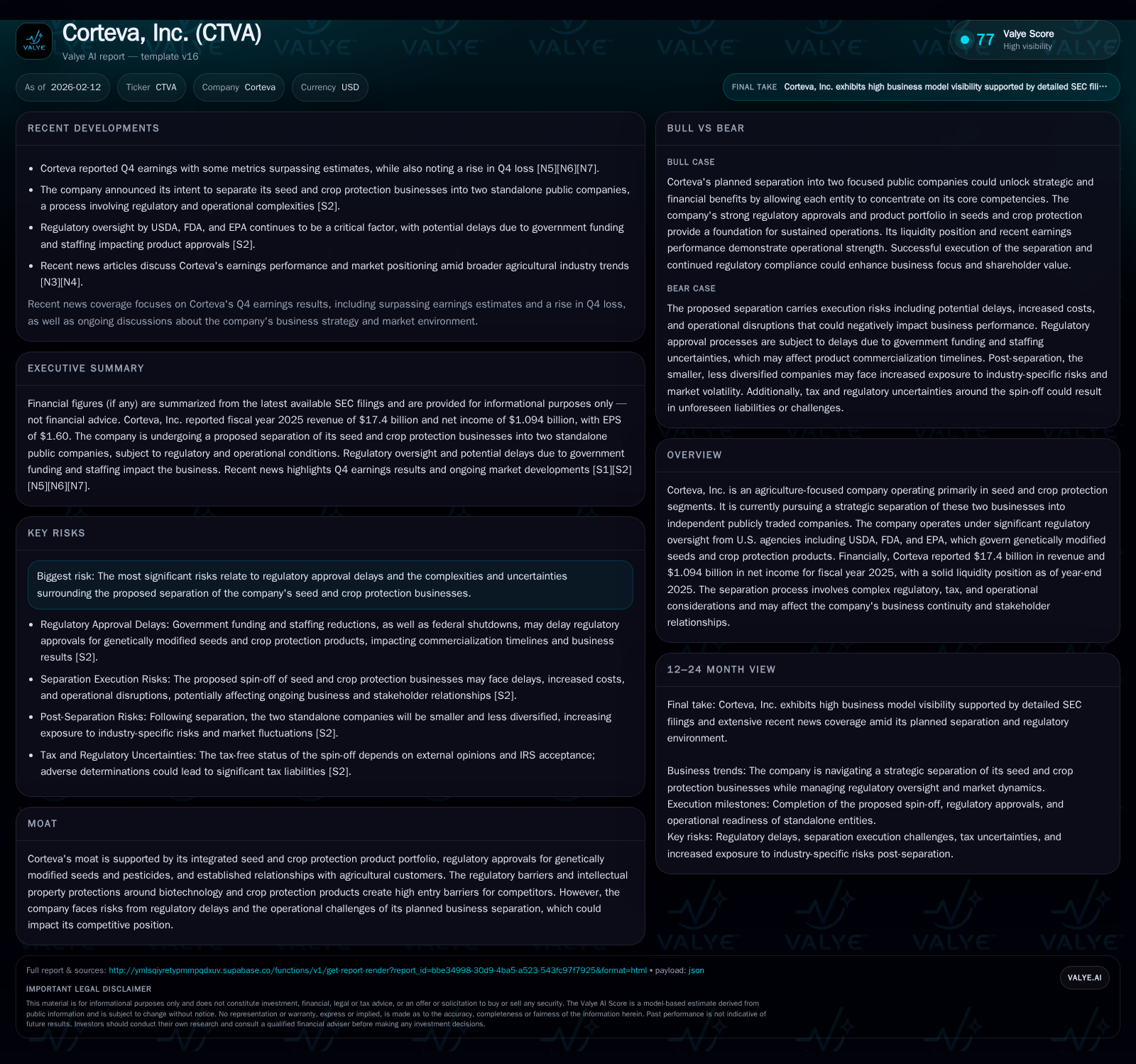
Corteva, Inc. stands at the cusp of a transformative split that will yield two independent publicly traded companies, one focused on seeds and the other on crop protection. This strategic move aims to unlock intrinsic value but is fraught with regulatory challenges involving USDA, FDA, and EPA oversight. Financially robust with $17.4 billion revenue in 2025 and solid liquidity, Corteva must carefully manage operational and market risks during the transition to maintain competitive strength. The company’s entrenched intellectual property and customer relationships provide a formidable moat even as uncertainties around separation timing persist.
The Dual Pillars of Corteva: Seeds and Crop Protection Unpacked
Corteva’s identity today is built squarely on two pillars that not only drive its business but also define its future path: its seed segment and its crop protection segment. The seeds business focuses on genetically modified varieties designed to enhance yield, pest resistance, and climate resilience. Complementing this is the crop protection unit that develops chemical herbicides, insecticides, and fungicides aimed at safeguarding crops throughout the production cycle. While tightly interwoven in their agricultural purpose—with seeds often engineered to work synergistically with specific crop protection products—these divisions have evolved different operating models over time.
As of fiscal year-end 2025, Corteva reported $17.4 billion in total revenue [F1], illustrating both scale advantages from integration and significant market penetration across global geographies [S1]. Each segment brings unique scientific expertise; seeds leverage advanced biotechnology traits regulated by multiple U.S. agencies, while crop protection depends heavily on chemical innovation subject to rigorous environmental assessments. Understanding this duality provides necessary context for why separating these businesses is both logical and complex—their underlying technologies differ as do their regulatory pathways.
Strategic Separation: Motives, Mechanics, and Market Implications
Announced on October 1, 2025 [S2], Corteva’s intention to spin off its seed business into an independent publicly traded company while retaining crop protection under the original name marks a strategic pivot aimed at allowing each entity sharper operational focus. The decision follows growing recognition that seeds’ capital intensity and innovation cycles differ materially from crop protection’s regulatory dependencies.
The planned transaction is structured as a tax-free spin-off for U.S. federal income tax purposes contingent upon satisfying traditional closing conditions including successful SEC registration filings, receipt of favorable tax opinions, board approvals, readiness assessments for independent operation, and finalized capital structures [S2]. Market implications could be far-reaching: unlocking hidden value by allowing investors to directly invest in distinct agricultural sub-industries; providing management teams greater strategic autonomy; yet also exposing each firm to narrower economic cycles inherent in their specialized markets.
Nonetheless, this path contains uncertainty—the actual timing remains fluid pending regulatory clearances and internal preparedness [S2]. Delays or changes could erode anticipated benefits or disrupt stakeholder confidence.
Regulatory Crosswinds: Navigating USDA, FDA, and EPA Complexities
Regulatory oversight sits at the heart of Corteva’s business model complexity. Genetically modified seed products undergo multi-agency review under the Coordinated Framework for Biotechnology Regulation: USDA screens for plant safety; FDA assesses food/feed safety; EPA regulates pesticidal traits embedded in biotech seeds [S2]. Crop protection products face even more exacting scrutiny from the EPA which evaluates environmental safety before registration permitting marketing.
Recent budgetary headwinds—including funding cuts at EPA, USDA, FDA—and federal government shutdown episodes have strained these agencies’ capacity to deliver timely reviews [S2]. Such systemic pressures translate directly into prolonged product approval timelines risking go-to-market delays that can materially impact Corteva’s competitive positioning given patent-sensitive technology lifecycles.
Shifts in enforcement priorities or resource allocation at these regulators further complicate forecasting approval windows. For instance, any sudden increase in evidentiary requirements or changes in residue tolerance levels can stall product re-registrations essential for sustained market access.
Financial Snapshot: Strength and Risks in Corteva’s Latest Performance
Corteva closed fiscal year 2025 with robust metrics underscoring operational resilience ahead of corporate restructuring. Revenues totaled $17.4 billion alongside net income of $1.094 billion affirming profitable capacity despite industry headwinds [F1]. Liquidity remained strong with $4.52 billion in cash equivalents supporting working capital needs amid ongoing investments [F1]. A current ratio near 1.43 signals moderate short-term financial flexibility.
Quarterly earnings announced early February 2026 reflected a beat against consensus estimates driven by volume gains but tempered by rising net loss commentary linked potentially to separation-related expenses or cost pressures [N2][N3][N12]. Investors scrutinize whether margin dilution will precede clearer benefits post-spin-off — a dynamic typical during complex transitions.
Ultimately, Corteva’s financial footing provides it with necessary runway to execute separation plans without compromising core business operations if managed prudently.
Operational Challenges Ahead: Managing Transition Without Losing Momentum
While strategically sound on paper, spinning off integrated segments into standalone entities demands meticulous operational orchestration. Corteva must establish separate governance frameworks, finance functions including debt allocations consistent with credit ratings expectations, human resources infrastructures aligned with independent corporate cultures as well as IT systems migration—all without disrupting daily business flows [S2].
Operational readiness assessments remain ongoing prerequisites prior to completion authorization by the Board [S2]. Any delays in these areas risk deferring separation timelines.
Meanwhile maintaining steady supply chain relationships with agricultural customers who rely on combined seed-crop solutions poses additional complexity—discontinuities may ripple downstream adversely affecting brand loyalty or contract renewals.
Moat Analysis: Intellectual Property and Customer Relationships as Strategic Bulwarks
Corteva’s competitive moat springs fundamentally from deep intellectual property portfolios covering biotechnology traits within seeds coupled with registered formulations protecting proprietary pesticides [F1][S1]. These IP protections afford exclusivity preventing easy entry by competitors given long patent durations tied to novel genetics or chemical compound discoveries.
Moreover regulatory approvals serve as non-replicable barriers—establishing compliance certifies efficacy and safety critical for farmer adoption calibrated over years of field trials.
Longstanding contracts encompassing broad agricultural customer bases foster stable revenue streams while enhancing switching costs creating further lock-in effects.
Still post-spin independent companies will need continuous innovation investment plus relationship management refinement to preserve these moats amid evolving competitive pressures.
Risk Factors in Focus: Regulatory Delays and Separation Uncertainties
Primary risk exposures center upon uncontrollable elements within approval processes whereby federal agency slowdowns may extend commercialization schedules jeopardizing product pipeline vitality [S2]. Additionally unexpected shifts in compliance rules add unpredictability over planning horizons.
Within separation execution itself lies potential for deferrals arising from unsatisfactory fulfillment of closing conditions including SEC registrations or obtaining requisite tax opinions rendering transactional timelines volatile [S2]. Such setbacks dampen stakeholder confidence impacting stock valuations indirectly.
Other risks encompass adverse macroeconomic developments worsening agricultural demand patterns intersecting with elevated input costs thus pressuring profit margins during transitional phases.
Stakeholder Perspectives: What Investors and Partners Should Watch
Investors evaluate Q4 earnings within context of indicated operational expenses tied to spin formation reflecting cautious optimism offset by apprehension over prolonged separation completion timing [N2][N6][S2]. Volatility around share price is expected as clarity emerges gradually.
Agricultural customers monitor continuity assurances particularly around integrated service offerings linking seed genetics with matching crop protection chemistry facilitating reliable yield outcomes essential for farm economics.
Regulators continue vigilant oversight enforcing environmental safety standards while employees navigate shifting organizational identities requiring transparent communications from leadership fostering morale retention throughout upheaval.
Outlook on Post-Spin Business Models: Growth, Autonomy, and Competitive Edge
Once spun off successfully into individual entities each company will likely tailor strategies aligned strictly with their core competencies allowing sharper investments addressing respective market needs more nimbly [S1][F1].
Seeds-focused firm may intensify biotech R&D efforts targeting traits enhancing climate adaptability facilitating premium pricing power whereas separated crop protection company can concentrate on innovating safer chemistries meeting tightening environmental regulations accelerating product rotations.
Independent capital structures ideally allow optimized balance sheets enabling focused growth expenditure without cross-subsidy considerations inherent prior consolidation structure.
However execution timing remains crucial since premature fragmentation without full operational preparedness could compromise scale benefits diminishing competitive edge built over decades.
This analysis synthesizes publicly available filings from SEC documents dated February 12, 2026 ([S1]) and November 5, 2025 ([S2]), along with recent news articles ([N2], [N3], [N6], [N12]) and financial data ([F1]). It does not constitute investment advice but aims to present an integrated perspective on Corteva’s ongoing strategic transformation.
Disclaimer: This is research-only, informational analysis and not investment advice. It may include AI-generated interpretation and general industry context. Always verify important details using primary sources.

Comments