
Commvault Systems Boosts Recurring Revenue Through SaaS Growth Despite Cybersecurity Market Challenges
Q1 2027 results reflect expanding cloud subscription sales and sustained investment in infrastructure amid competitive and regulatory pressures.
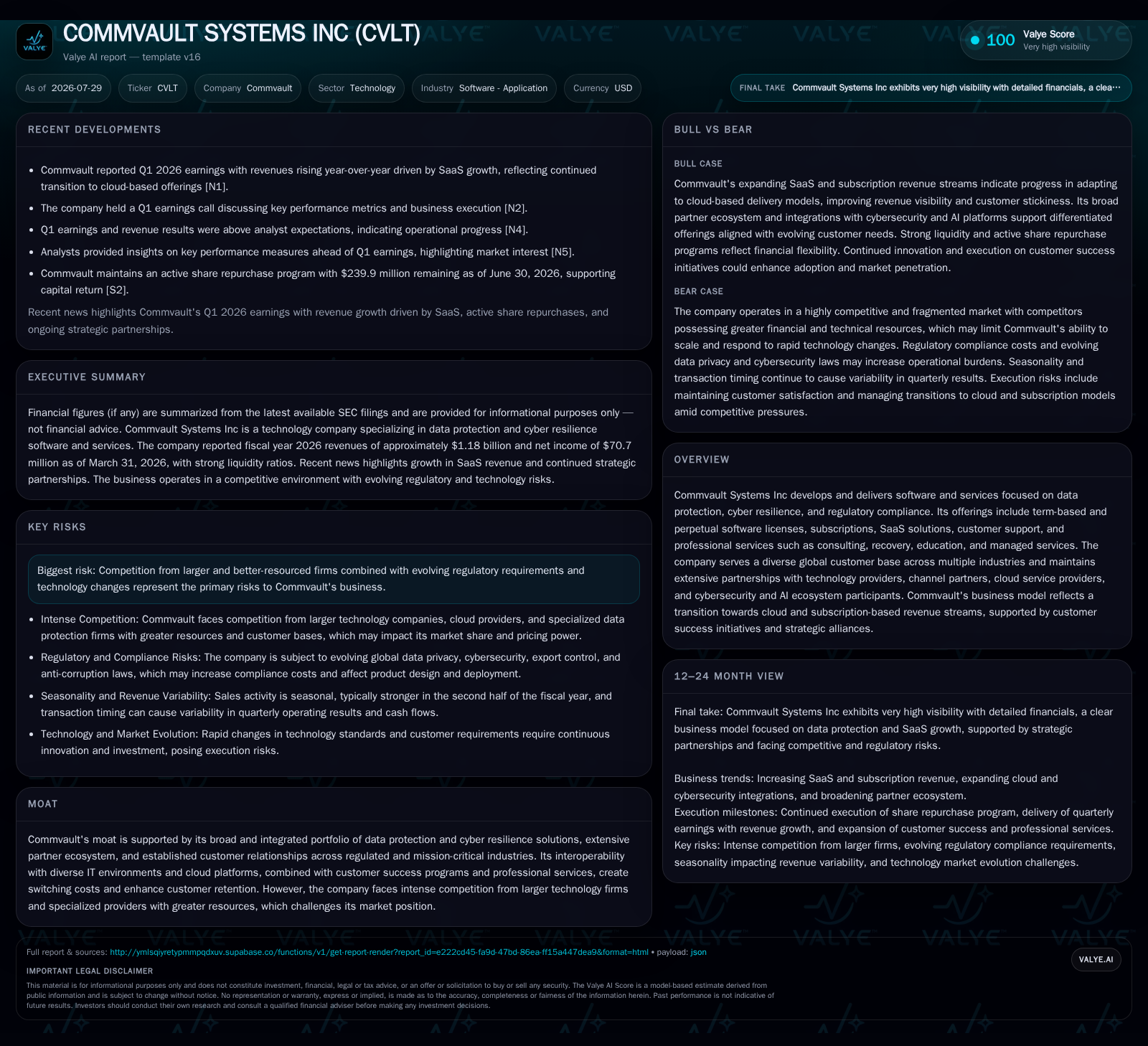
Commvault Systems Inc, in its latest fiscal quarter ended June 30, 2026, demonstrated revenue growth driven by its expanding Software-as-a-Service (SaaS) offerings as it continues transitioning away from traditional perpetual licenses [S2][N1]. The company's broad portfolio of data protection and cyber resilience solutions positions it well in a market prioritizing cloud platforms and regulatory compliance, though it faces intense competition from larger players with longer cloud experience [S1][S20]. Strategic investments in infrastructure and professional services support customer success and retention, crucial for sustaining annual recurring revenue (ARR) growth. Risks related to competitive pricing pressures, evolving regulations, and technology shifts remain prominent factors shaping its outlook [S1][S11].
Recent Operating Update
In the first quarter of fiscal 2027, ended June 30, 2026, Commvault Systems Inc reported year-over-year revenue growth driven primarily by expansion in its Software-as-a-Service (SaaS) subscription offerings [S2][N1]. This growth reflects the company’s ongoing strategic transition from traditional perpetual license sales toward cloud-native subscription models via its Commvault Cloud platform. The quarter also featured continued investments in cloud infrastructure and security operations to support scalable SaaS delivery, which are critical to sustaining gross margins amid increasing hosting costs [S2][N2]. Additionally, the company repurchased approximately $10.1 million of common stock under its share repurchase program, with $239.9 million remaining available as of June 30, 2026, underscoring a strong liquidity position [S2].
Business Model Discussion
Commvault operates as a software vendor specializing in enterprise data protection, cyber resilience, and regulatory compliance solutions. Its monetization model includes recurring subscription revenue from SaaS offerings, term-based licenses, and a declining share of perpetual licenses, complemented by customer support and professional services such as consulting, managed services, and recovery assistance [S1]. The shift toward SaaS aligns with industry trends favoring predictable annual recurring revenue (ARR) streams, which are supported by high gross retention rates and customer success initiatives that drive upsell and cross-sell within regulated sectors including banking, healthcare, government, and energy utilities [S1][S13].
Revenue generation depends on expanding ARR through new customer acquisition and seat expansion within existing accounts, particularly in environments requiring stringent data governance and cyber recovery capabilities [S1][S13]. Commvault’s platform integrates AI-driven data discovery and classification to manage complex hybrid and multi-cloud environments, enhancing interoperability and reducing vendor lock-in risks. This integration fosters customer stickiness and elevates switching costs, critical factors in subscription economics
Professional services play a dual role by facilitating initial deployment and fueling ongoing customer success programs, which are vital for reducing churn and increasing net retention rates [S1][N2]. However, the company’s cost structure is impacted by substantial infrastructure investments necessary to maintain SaaS delivery, including cloud hosting, security operations, and availability commitments. These factors influence cloud gross margins and operating income, making scale efficiencies essential for margin expansion
Industry Structure and Competitive Position
The data protection software market is undergoing a pronounced shift from license-heavy sales toward SaaS and cloud-based delivery models, driven by growing cyber resilience demands amid rising ransomware threats and regulatory pressures [S20][S13]. Commvault competes within a landscape that includes large enterprise software vendors offering integrated suites, specialized backup and disaster recovery providers, cybersecurity firms expanding into resilience workflows, and channel partners that facilitate global distribution
While Commvault benefits from a broad product portfolio and a robust partner ecosystem—including technology integrators, cloud providers, and cybersecurity firms—its competitors often possess longer-standing cloud-native architectures and larger R&D budgets, which can accelerate innovation and exert pricing pressure [S20]. This competitive dynamic necessitates rapid adoption of emerging standards and continuous enhancement of interoperability features to maintain market relevance.
Customer acquisition costs (CAC) remain elevated due to lengthy enterprise sales cycles and complexities in government procurement, where budget volatility and regulatory compliance requirements add layers of uncertainty [S19][S25]. Consequently, retention metrics such as net and gross retention rates serve as key indicators of competitive strength, reflecting the company’s ability to expand within installed bases and mitigate churn risks.
Growth Drivers
Key growth catalysts for Commvault include accelerating enterprise adoption of hybrid and multi-cloud architectures, which demand flexible, scalable data protection and cyber resilience solutions capable of harmonizing on-premises and cloud resources. Regulatory compliance mandates worldwide intensify demand for integrated data governance and privacy functionalities embedded within core protection platforms [S19].
The exponential growth in data volumes further drives the need for scalable backup, recovery, and cyber recovery capabilities. Commvault addresses these demands through AI-assisted automation embedded in its SaaS offerings, enhancing operational efficiency and reducing manual intervention [S1][N2].
Customer success initiatives focusing on onboarding efficiency, support responsiveness, and lifecycle engagement are pivotal for ARR expansion, enabling upsell opportunities and improving subscription durability—a critical KPI benchmarked by peers in the SaaS data protection space [S13]. Strategic alliances with cloud providers, cybersecurity ecosystems, and technology partners amplify go-to-market velocity and deepen penetration within mid-to-large enterprises requiring robust interoperability standards [S13].
Emerging technologies such as AI augment product differentiation by enabling advanced data classification, threat detection, and incident response automation, which are expected to underpin next-generation resilience suites and further enhance competitive positioning.
Risks and Watchpoints
Several risk factors warrant close monitoring. Intense competition from larger firms with entrenched cloud-native SaaS models may pressure pricing and slow customer migration, potentially impacting subscription revenue ramp-up timing [S20]. Regulatory changes increase product complexity and development costs, potentially elongating sales cycles, especially within public-sector clients where budget uncertainty is prevalent [S19][S25].
The company’s restructuring efforts initiated in fiscal 2026 aim to optimize costs and realign strategy but carry execution risks that could affect operational agility and talent retention, both critical for sustaining innovation velocity [S15][S25]. Customer satisfaction risks related to implementation challenges or support quality could erode retention metrics and dampen ARR growth [N3].
Technological shifts favoring fully cloud-native architectures may necessitate accelerated infrastructure investments beyond current plans, risking margin compression if scale efficiencies are not realized as expected [N2]. Additionally, reliance on third-party cloud infrastructure providers introduces operational risks related to service availability and cost variability.
Economic downturns or reductions in enterprise IT budgets could depress demand, particularly for higher-tier offerings sold under multi-year contracts, underscoring the need for cautious pipeline and contract management [N5].
What to Watch Next
Near-term milestones include quarterly disclosures of ARR and net retention rates, which will provide insights into subscription momentum and the effectiveness of cross- and upsell strategies within existing customer bases post-Q1 FY2027 [S2]. Monitoring cloud gross margin trends alongside operating income trajectories will reveal progress in scaling SaaS delivery relative to infrastructure investments.
The impact of restructuring initiatives will become clearer through trends in operating expenses and employee turnover, which influence innovation pace and customer success capabilities. Contract wins in regulated sectors, particularly those involving FedRAMP compliance, will serve as validation points for the company’s positioning in complex compliance environments [N2].
Competitive developments such as new integrations or bundled offerings from peers should be tracked to anticipate potential market share shifts. Management commentary on CAC payback periods and sales cycle length will shed light on go-to-market efficiency, a key driver of sustainable growth [N4]
Strategic partnership expansions, especially those leveraging AI-augmented resilience technologies, could signal acceleration phases warranting close attention.
Financial Profile Discussion
Margins are influenced by infrastructure and hosting costs inherent in SaaS delivery, making cloud gross margin progression and operating margin trends important metrics to assess the scalability of the evolving business model relative to legacy licensing declines [N3]
This analysis synthesizes publicly available filings up to July 29, 2026, including quarterly (10-Q), annual (10-K), and event (8-K) disclosures. It emphasizes operational and financial metrics directly supported by company-reported data, contextualized within industry dynamics relevant for buy-side evaluation. Forward-looking interpretations are grounded solely on disclosed information without speculative extrapolation.
Disclaimer: This is research-only, informational analysis and not investment advice. It may include AI-generated interpretation and general industry context. Always verify important details using primary sources.

Comments