
Data I/O Corp Expands Scope with Transformational Acquisition and AI Deployment
Latest quarterly results underscore strategic shifts as Data I/O pursues broader data provisioning markets aided by AI and acquisition.
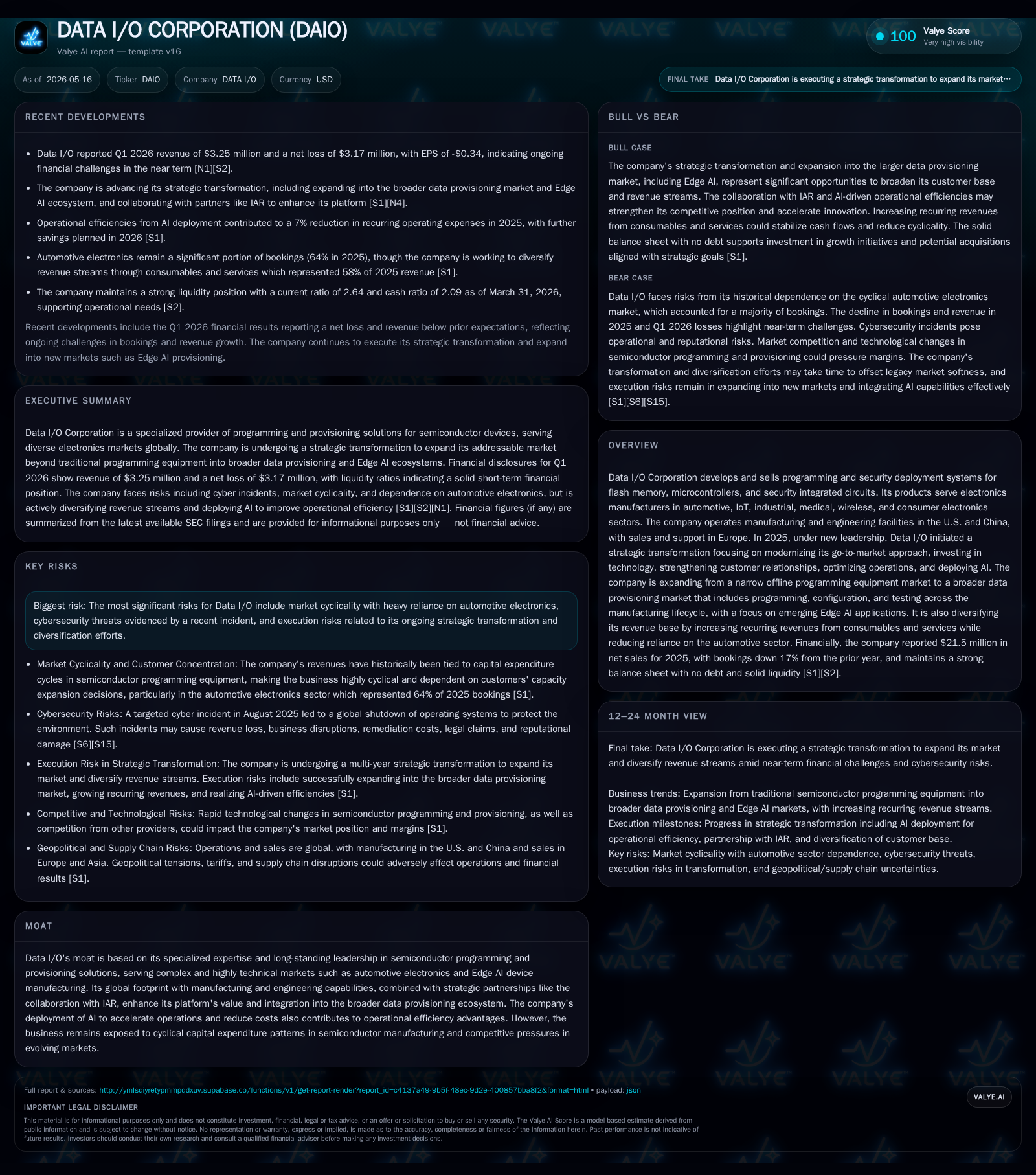
Data I/O Corporation reported a Q1 2026 revenue shortfall and operating loss, reflecting ongoing pressures from its historically cyclical programming equipment markets. Concurrently, the company announced a transformational acquisition and significant direct investment to accelerate its pivot towards integrated data provisioning solutions for Edge AI and manufacturing lifecycle services. This strategic repositioning seeks to leverage deep semiconductor programming expertise, global engineering capabilities, and AI-enabled operational efficiencies to diversify revenue away from capital-intensive hardware sales toward recurring services. Execution risks remain substantial given cyclical end-markets, recent cybersecurity incidents, and the complexity of integrating new business lines.
Latest Quarterly Operating Update: Earnings Miss and Strategic Transactions
In its Q1 2026 10-Q filed May 15, Data I/O Corporation reported revenues below market expectations alongside an operating loss reflective of continuing pressure from cyclical end markets such as automotive electronics [S2]. The quarterly loss underscores lingering headwinds despite the company's prior efforts toward transformation. However, coinciding with these results were announcements via contemporaneous 8-K filings of a transformational acquisition aimed at broadening the company's addressable market beyond narrow flash memory programming hardware [S3][S4][S5]. Additionally, a significant direct investment commitment was disclosed to support this expansive strategic shift [S4][S5]. These simultaneous events mark a pivotal inflection point where near-term financial softness coexists with longer-term growth ambitions anchored in data provisioning for emerging Edge AI applications.
Management's public commentary emphasizes that while the legacy business remains exposed to semiconductor capital expenditure cycles, these strategic moves intend to diversify revenue streams by incorporating programming, configuration, testing services across manufacturing lifecycles—including ramping digital go-to-market channels and embedding AI internally for operational efficiencies [S1]. As such, the latest quarter acts as both a reminder of cyclical realities and a harbinger of transformative intent.
Business Model: From Specialized Programming Hardware to Data Provisioning Ecosystem
Data I/O's historical revenue generation has centered on the design, manufacture, and sale of programming and security deployment systems for flash memories, microcontrollers, and security ICs. Its product suite caters primarily to high-precision electronics manufacturers involved in automotive systems, IoT devices, industrial equipment, medical electronics, wireless communications, and consumer electronics [S1]. These customers require highly specialized programming solutions customized for complex manufacturing specifications often requiring local engineering support.
The company currently operates manufacturing and engineering facilities located strategically in Redmond (U.S.) and Shanghai (China), complemented by sales/support presence in Europe (Munich), underscoring a geographically diverse footprint aligned with global customer bases [S1]. Partnerships such as the collaboration with IAR firm up platform-level integration within software ecosystems that extend beyond hardware provisioning into firmware development environments.
Previously dependent largely on capital equipment sales—making revenues lumpy and tied closely to semiconductor production investments—Data I/O is evolving toward an integrated data provisioning platform encompassing value-added offerings like programmable configurations, testing as a service during manufacturing cycles, and longer-term software-related consumables supporting Edge AI deployments. This transition aims to smooth revenue volatility by layering recurring contracts atop foundational hardware platforms [S1].
Competitive Positioning in Semiconductor Programming and Emerging Edge AI Markets
Within its niche semiconductor programming market segment, Data I/O maintains moderate competitive moats grounded in technical know-how accumulated over decades. Its domain specialization addressing critical assembly-stage programming needs for automotive-grade electronics confers differentiated barriers given stringent quality requirements of these clients.
The evolving landscape introduces additional competitive pressures from emerging entrants focused on integrated data provisioning or software-managed configuration markets. The interplay between U.S. and China operations also requires balancing supply chain continuity against geopolitical risks.
Operationally, internal adoption of AI-enabled automation offers potential cost leadership advantages by accelerating workflows related to order processing, system diagnostics, and customer support [S1]. However, inherent cyclicality in semiconductor demand imposes oscillations on addressable volumes that could constrain growth absent successful portfolio diversification.
Growth Drivers: New Market Expansion, AI Integration, and Operational Modernization
The most tangible growth catalyst stems from the May 2026 acquisition disclosed through multiple recent event filings [S4][S5]. Although details remain limited publicly at this writing, management frames it as transformational—enabling access to adjacent opportunities within data provisioning that extend beyond traditional offline programming equipment. This is expected to complement internal modernization initiatives previously launched under new leadership starting late 2024 focused on reconfiguring go-to-market channels digitally while leveraging AI technology to improve productivity metrics significantly ahead of conventional methods [S1].
Increasing uptake of Edge AI devices creates structural demand for more sophisticated provisioning throughout the manufacturing lifecycle including secure key injection—a domain where Data I/O's security deployment systems are already critical components.
Additional growth leverages include ramping software services matching hardware rentals/demos/testing setups which dilute reliance on single large capital orders; improved retention via multi-year contracts; penetration into rapidly growing Asian markets; operational cost reductions via AI-enhanced supply chain planning; plus cross-selling newly acquired solutions onto existing client relationships.
Risks and Execution Challenges: Cyclicality, Cybersecurity, and Transformation Execution
Despite progressions toward diversification measures several prominent risks persist:
- Market Cyclicality: The business remains tethered heavily to automotive electronics capital expenditure cycles. Prolonged downturns could delay booking recoveries substantially.
- Cybersecurity Threats: A targeted ransomware attack in August 2025 forced shutdowns of global operating systems temporarily disrupting shipments and incurring remediation costs approximating $388K in Q3 2025 [S2][S23][S27]. Though contained currently with restored operations as per latest reports [S27], continued security vigilance is mandatory.
- Transformation Execution Risk: Integrating acquired assets while simultaneously shifting core business models demands substantial managerial focus; failure could dilute operational effectiveness or fragment customer experience during transition phases.
- Supply Chain / Regulatory Uncertainties: Geopolitical tensions impacting US-China supply chains or evolving compliance regimes targeting semiconductor technologies raise risk profiles around sourcing continuity or cost escalations.
Key Monitors: Revenue Trajectory, Integration Milestones, and AI Adoption Progress
Critical near-term indicators underpinning assessment of execution progress include:
- Quarterly revenue versus internal guidance/street expectations post-acquisition integration onset summarized in upcoming earnings releases [N1][S2][S4][S5].
- Demonstrable milestones achieved toward synergistic combination of acquired technologies within core platform aligned with management commentary.
- Quantifiable impacts from internal AI deployments accelerating order cycle times or reducing operating expenses accessible via operating metrics disclosures or investor communications.
- Stability or improvement in bookings velocity across key regions including Asia – especially given prior fourth quarter momentum noted by management for new customer engagement pipelines heading into 2026 [S22].
Monitoring these KPIs will illuminate whether strategic aspirations manifest tangibly amid macroeconomic uncertainties.
Financial Overview: Liquidity Position and Capital Structure Amid Transition
Latest financial snapshot
| Metric | Value | Period |
|---|---|---|
| Current assets | $15mm | |
| 2026-03-31 | ||
| Current liabilities | $6mm | |
| 2026-03-31 | ||
| Current ratio | 2.64x | |
| 2026-03-31 |
Source: SEC companyfacts cache [F1].
Data I/O’s balance sheet entering 2026 reflects a current ratio of approximately 2.64 as of March 31, 2026, indicating sufficient near-term liquidity cushioning working capital amidst ongoing transformation investments [F1].
This analysis evaluates Data I/O Corporation’s public disclosures through May 16, 2026 based on SEC filings (10-Qs/10-Ks/8-Ks) supported by companyfacts catalogued fundamentals as well as credible industry context without extrapolative forecasting or investment guidance.
Disclaimer: This is research-only, informational analysis and not investment advice. It may include AI-generated interpretation and general industry context. Always verify important details using primary sources.

Comments