
Invesco DB Commodity Index Tracking Fund Confronts Volatile Futures and Position Limits
DBC offers diversified commodity futures exposure but faces structural and market-driven constraints affecting returns and liquidity.
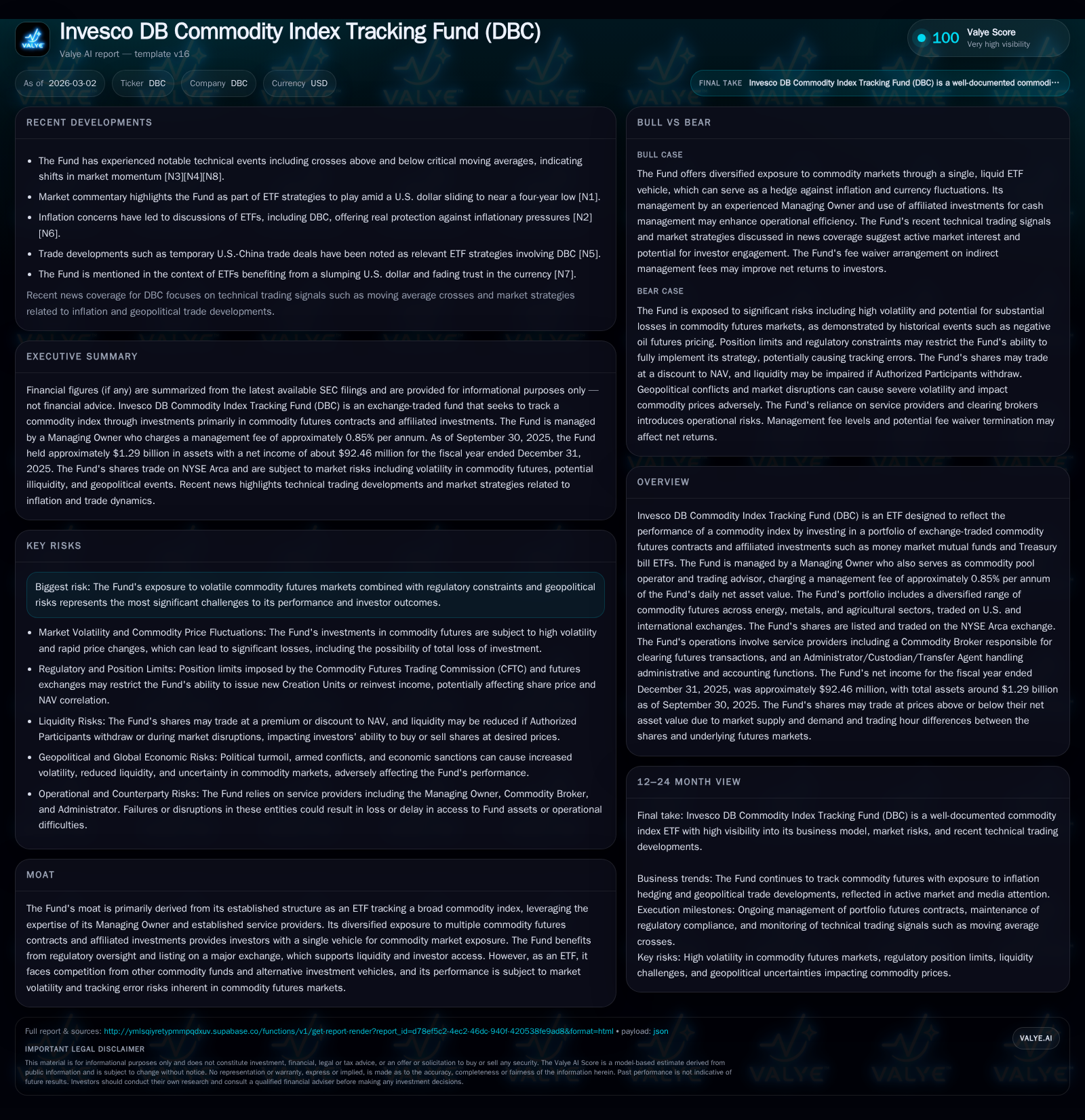
The Invesco DB Commodity Index Tracking Fund (DBC) provides investors a broad exposure to commodity futures markets across energy, metals, and agriculture. Historically marked by dramatic swings in operating income and net income, the Fund's results heavily depend on volatile commodity prices and futures market dynamics. Operating income declined by over 40% year-over-year in 2025, though net income showed a strong rebound owing to lower losses and gains on investments [F1]. The Fund’s growth prospects hinge on commodity price trends, regulatory position limits that could constrain scaling, and the Managing Owner’s ability to minimize tracking error. Capital allocation prioritizes buybacks and dividends but cash flows remain volatile, reflecting the underlying asset class risks [S1][F1].
Company Overview
Invesco DB Commodity Index Tracking Fund (DBC) is an ETF engineered to mirror the performance of a diversified commodity index through holdings primarily comprised of exchange-traded commodity futures contracts. Managed by Invesco Capital Management LLC since 2015, it also invests in affiliated money market mutual funds and Treasury bill ETFs for enhanced yield. Its portfolio spans major commodity sectors including energy (crude oil, natural gas), agriculture (corn, soybeans), and metals (gold, silver), traded on prominent exchanges such as NYMEX, CBOT, LME, providing investors comprehensive exposure within a single vehicle. The shares trade on NYSE Arca, benefiting from regulatory oversight that underpins liquidity and investor confidence.
Historical Financial Performance
Historical figures reveal DBC’s fundamental characteristic: pronounced earnings volatility driven by commodity price swings and futures market dynamics. Operating income declined substantially from $69 million in FY2024 to roughly $41 million in FY2025 (F1), representing a -40.2% year-over-year decrease. This drop reflects challenging market conditions during the fiscal year impacting the value of futures contracts held.
Contrastingly, net income rebounded sharply from a modest $22 million in FY2024 to approximately $92 million in FY2025 — an impressive 313% rise reversing prior years’ losses such as the substantial negative result of -$151 million recorded in FY2023 (F1). This volatility illustrates DBC’s sensitivity not just to market price movements but also the realized versus unrealized gains or losses inherent in futures trading.
Operating cash flow followed operating income trends but with greater swings; CFO shrank from $431 million in FY2024 down to near $142 million in FY2025 (F1), highlighting challenges converting accounting profits into steady cash generation.
Historical performance (annual)
| FY | Net ($mm) | CFO ($mm) | OpInc ($mm) | Net YoY |
|---|---|---|---|---|
| 2025 | 92 | 142 | 41 | +313.1% |
| 2024 | 22 | 432 | 69 | +114.8% |
| 2023 | -152 | 809 | 90 | -127.5% |
| 2022 | 552 | 536 | 19 |
Source: SEC companyfacts cache [F1].
Capital returns and efficiency (annual)
| FY | Div ($mm) | Buybacks ($bn) | ROE% |
|---|---|---|---|
| 2025 | 41 | 0.4 | 7.6 |
| 2024 | 68 | 0.6 | 1.7 |
| 2023 | 84 | 1.1 | -9.0 |
| 2022 | 16 | 2.9 | 20.9 |
Source: SEC companyfacts cache [F1].
Table notes: OpInc = Operating Income; NetInc = Net Income; CFO = Cash Flow from Operations.
The sizeable buybacks accompanying dividend payouts illustrate a significant allocation of available capital back to investors even amid high return volatility.
Growth Drivers and Limitations
Growth prospects for DBC stem primarily from its diversified access to commodities markets — an asset class increasingly viewed as an inflation hedge or portfolio diversifier. Positive momentum in commodities prices or structural inflation dynamics could drive higher inflows into commodity ETFs like DBC.
However several factors may cap growth:
- Regulatory Position Limits: The Fund is subject to constraints set by the CFTC and exchange rules limiting maximum positions. These restrictions may impair its ability to issue new Creation Units or reinvest income effectively if limits are reached (S1). This can cause discrepancies between share market price and NAV potentially discouraging large scale inflows.
- Tracking Error Risks: Futures contracts necessitate ongoing rolling which can introduce slippage against the Index benchmark. Tracking error risk may limit attraction for institutional buyers seeking precise index replication.
- Fees & Expenses: The annual management fee of approximately 0.85% weighs on net returns; outperformance requires returns from futures trading plus Treasury/Money Market/T-Bill incomes exceed this hurdle (S1).
- Market Volatility & Geopolitical Risks: As witnessed during the historic negative pricing event for WTI crude oil (May 2020), abrupt shocks can devastate returns. Current elevated geopolitical tensions globally add layers of uncertainty impacting underlying commodity markets (S17,N1).
- Competitive Landscape: The Fund operates among numerous competing commodity ETFs offering different index methodologies or fee structures.
Capital Allocation and Returns
DBC's capital allocation reveals active share repurchases alongside dividend distributions despite earnings variability:
- Dividends paid dropped from about $68M in FY2024 to roughly $40M in FY2025 (F1), indicating cautious distribution aligned with lower incomes.
- Share buybacks remained significant at around $364M in FY2025 but fell notably compared to prior years’ multi-hundred-million-dollar repurchase programs (F1).
Cash flow from operations contracted markedly year-over-year (-67%) while equity levels showed moderate declines suggesting some balance sheet contraction or shareholder redemptions (F1). Approximate return on equity based on net income over equity is around ~7.6% as of FY2025 — fairly modest for an ETF reliant on volatile futures markets.
The Fund does not appear committed to stable dividends; distributions are discretionarily managed by the Managing Owner with no declared fixed payout schedule (S23).
Operational Structure & Risk Factors
Managed by Invesco Capital Management LLC who also acts as Commodity Pool Operator and Trading Advisor charging management fees out of daily NAV (S1), the Fund operates under strict regulatory oversight involving multiple specialized service providers:
- A Commodity Broker handles clearing and execution of futures transactions.
- An Administrator/Custodian/Transfer Agent maintains operational back-office services including NAV calculations and shareholder recordkeeping.
These relationships are critical given that disruption or insolvency of brokers or custodians could delay or result in loss of access to assets ([S6],[S12]).
Risk factors highlighted extensively include:
- Extreme price fluctuations including historic anomalies like negative oil prices causing deep investor losses.
- Possibility that fund shares trade at premium or discount due to creation/redemption cycle inefficiencies under position limits.
- Potential conflicts of interest between Managing Owner affiliates and shareholders could adversely affect outcomes despite oversight efforts.
- Effects from worldwide instability such as wars or sanctions impacting commodity supplies leading to market dislocations ([S17]).
Forward-Looking Considerations (Analysis)
While explicit future guidance is generally absent given its ETF structure ([N#],[S#]), watching these milestones will be key:
- Ability of DBC to expand assets under management without breaching futures position limits — any regulatory changes here would impact growth trajectory significantly.
- Management effectiveness in reducing tracking error especially amidst heightened volatility periods.
- Responses to evolving global economic conditions influencing commodities – e.g., inflationary trends supporting demand vs cooling factors dampening prices.
- Maintenance of liquidity with core service providers crucial for operational continuity.
- Investor sentiment regarding commodities allocations versus alternative inflation hedges such as real estate or TIPS may moderate flows into DBC.
Conclusion
The Invesco DB Commodity Index Tracking Fund remains a well-established instrument offering diversified exposure across multiple physical commodity sectors via futures contracts. Its financial history underscores the inherent volatility embedded within commodities markets — evident through sharply fluctuating operating metrics and uncertain cash flow patterns [F1]. Structural constraints like position limits coupled with regulatory scrutiny shape its growth ceiling while capital allocation favors returning resources to shareholders through buybacks and dividends when conditions permit. Prospective investors should monitor macroeconomic signals driving commodity prices alongside operational risks related to liquidity providers and regulatory change impacts [S17][N1]. Its role as an ETF provides ease of access but comes with complexity reflective of the underlying asset class traded.
Disclaimer: This is research-only, informational analysis and not investment advice. It may include AI-generated interpretation and general industry context. Always verify important details using primary sources.

Comments