
Asset Integration and Financial Stewardship Define Diversified Energy’s 2025 Performance
Diversified Energy’s U.S. transition and strategic acquisitions fuel growth while disciplined capital management supports cash flow resilience.
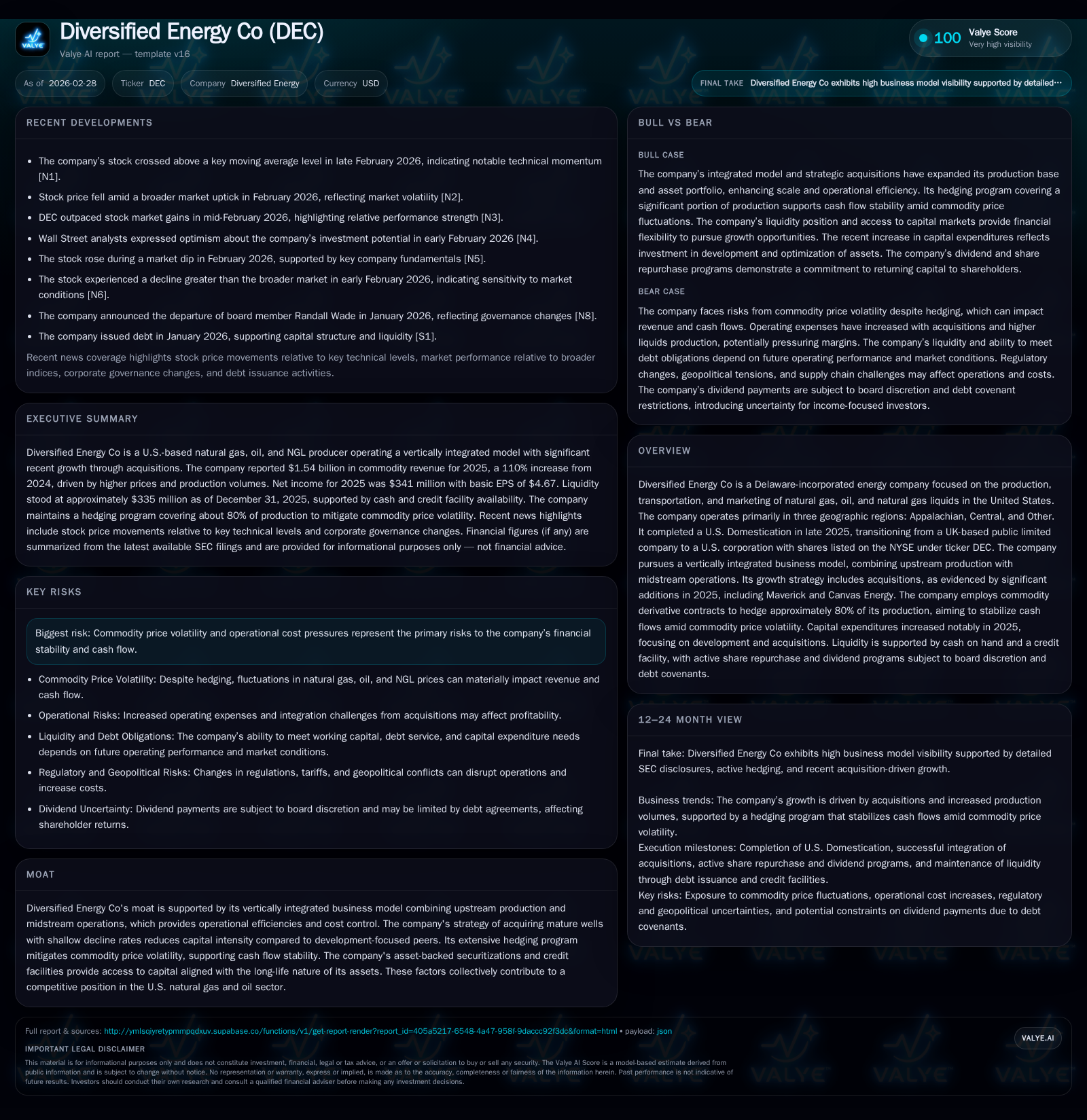
Diversified Energy Company (DEC) completed its U.S. Domestication in late 2025, marking a pivotal structural shift accompanied by major acquisitions, notably Maverick and Canvas Energy. This expanded its vertically integrated footprint across upstream and midstream assets, enabling operational efficiencies and mitigating capital intensity through a focus on mature wells with shallow decline rates. The firm’s rigorous hedging program, covering approximately 80% of production, shields cash flows from commodity price swings amid sector volatility. With substantial investment in capital expenditures primarily linked to acquired development projects, DEC maintained compliance with debt covenants and pursued shareholder returns via dividends and share repurchases. Looking forward, continued operational expansion balanced with disciplined leverage management underpins the company’s sustainable growth aspirations.
Historical Growth Trajectory and Shifting Drivers Through 2025
Diversified Energy Company (DEC) executed a transformative year in 2025 marked by elevated revenue and profitability alongside material increases in capital expenditures reflecting its acquisitive growth strategy. Total revenue advanced to $666.5 million [F1]. Operating income surpassed $250 million while net income reached $195.5 million, underpinning a strong approximate return on equity of 19.9% based on reported net income against shareholders' equity [F1].
Capital expenditures surged more than threefold year-over-year to $185 million [S10], mainly attributable to the Maverick acquisition which added undeveloped acreage requiring development spend through non-operated development agreements [S10]. Such agreements allow DEC to participate financially without incurring full operatorship costs.
Cash flow from operations (CFO) robustly expanded to support these investments at approximately $465 million [F1], enabling free cash flow generation near $280 million after capex [F1]. This inflow surge is partly due to increased production volumes resulting from both organic operations and accretive acquisitions.
Historical performance (annual)
| FY |
|---|
| 2025 |
Source: SEC companyfacts cache [F1].
Note: CFO for FY2024 used as baseline; revenue data for FY2024 not explicitly provided.
Vertical Integration and Asset Strategy: Operational Efficiencies Explored
DEC's vertically integrated business model melds upstream production with midstream infrastructure ownership, achieving operational synergies manifested in cost control amelioration and capital intensity reduction [N2],[S1]. This integration allows seamless transport of hydrocarbons and fee generation from gathering systems—translating into margin stabilization.
Unlike development-heavy peers investing heavily upfront in drilling new wells, DEC targets mature assets characterized by shallow decline curves. This strategic pivot reduces both capital expenditure volatility and execution risks tied to exploratory activities [S10]. The company supplements legacy operating capabilities with non-operated partnership agreements acquired alongside Maverick properties allowing exposure to new development upside while limiting direct capital outlay.
Commodity Hedging Program: Buffering Price Volatility
Amid chronic commodity price fluxes inherent in natural gas and oil markets, DEC employs a disciplined derivative hedging program covering around 80% of its anticipated production volumes annually [N2],[S1]. Common instruments include fixed-price swaps and collars designed to cap downside risk while preserving partial upside exposure.
This hedge book is integral for underpinning predictable cash flows which support capital budgeting decisions and debt servicing reliability despite prevailing market turbulence typical for independent energy producers [S25]. This proactive risk management contrasts favorably against unhedged peers vulnerable to sharp commodity corrections.
Capital Structure, Liquidity, and Debt Covenants Overview
As of December 31, 2025, DEC maintained total outstanding debt approximating $3 billion structured predominantly through asset-backed securitizations (ABS) alongside Nordic bond issuance [S19]. These long-dated notes are non-recourse revolving vehicles collateralized by producing reserves aligning financing terms with asset life cycles—a nuanced structuring approach common among upstream-focused firms aiming for tailored interest costs and amortization schedules [S4],[S20].
The company benefits from an amended credit facility borrowing base redetermined semi-annually capped at $825 million by early 2026 following reductions post-acquisition adjustments [S4],[S15],[S19]. Credit covenants require maintenance of leverage below stringent thresholds—restricting dividend payments or share buybacks when EBITDAX leverage surpasses defined bands [S4]. At year-end, DEC remained covenant-compliant with leverage metrics conducive for discretionary distributions.
Liquidity resources stood at approximately $335 million comprising cash on hand ($30 million) plus undrawn lines ($305 million), providing buffer capacity for acquisitions or working capital needs [S5],[F1].
Capital Allocation Priorities: Dividends, Share Repurchases, and Capex
DEC’s approach to shareholder returns reflects calibrated financial stewardship tempered by acquisition-driven growth investments. The board declared steady quarterly dividends of $0.29 per share throughout 2025 while actively repurchasing stock—retiring over 5.6 million shares at an average price near $13.65 totaling roughly $78 million—a marked acceleration relative to prior years [S6],[S7],[S8].
Repurchase authorization rose substantially under the newly approved programs extending through early 2027 demonstrating confidence in free cash flow sufficiency post-investment commitments [S7],[S8].
Meanwhile, capital expenditures funneled predominantly toward upstream well participation funded via non-operated agreements along with midstream pipeline expansions maintain a balance between sustaining production levels and prudent cost control [S10],[S24].
Strategic Acquisitions Impacting Future Growth Prospects
The acquisition spree during 2025 centered on two key transactions: Maverick Natural Resources and Canvas Energy Inc.—both expanding DEC’s geographic footprint across Appalachian basins contributing sizable proved reserves mostly consisting of mature assets with low decline characteristics [N6],[N11],[S1].
These purchases introduced attractive growth via non-operated development agreements creating low-capital risk exposure while offering incremental production uplifts—a model recognized for its efficiency versus sole operator-led drilling campaigns common within the sector.
Stock consideration partially funded these deals exemplifies balance between equity issuance mitigating leverage accumulation while maintaining alignment with shareholders [S23],[S24].
Financial Metrics at a Glance: Profitability and Cash Flow Generation
DEC delivered strong profitability metrics supported by operating efficiencies combined with commodity hedging stability. Reported net income of approximately $195 million coupled with operating income above $250 million showcase the earnings power despite volatile input prices [F1]. Approximate return on equity of just under 20% underscores effective use of shareholders’ invested capital amid steady top-line expansion.
Free cash flow generation stood robust at around $280 million reflecting operating cash inflows well exceeding capex requirements—a vital signal for sustaining dividend obligations and financing growth initiatives organically without excessive dilution or incremental leverage [F1]. Margins reflect healthy spreads anchored by the vertical integration strategy that optimizes logistics expenses typically eroding peer profitability.
Market Indicators and What to Monitor Going Forward
Moving ahead, stakeholders should monitor natural gas/oil price trends influencing hedge rollovers; debt leverage ratios relative to covenant limits dictating potential flexibilities in discretionary payouts; progress on authorized share repurchase programs; as well as execution on newly acquired undeveloped acreage through partnership agreements [N2],[N3]. Technical price chart breakouts paired with hedge coverage ratios will provide signals regarding timing for further capital deployment or risk mitigation adjustments.
Regulatory and Operational Risks Affecting Performance
The company faces inherent risks chiefly from commodity price volatility impacting revenue streams alongside operational hazards including plugging obligations on aging wells requiring escalating expenditures within environmental compliance frameworks documented in filings [S1],[S21],[S27]. Pipeline integrity maintenance programs also present continuous cost burdens necessitating careful monitoring.
Heightened regulatory scrutiny around greenhouse gas emissions continues evolving potentially affecting long-term operational licensing or cost structures. Instabilities in credit markets could restrict financing access despite current liquidity strength if macroeconomic shocks prevail.
Management emphasizes proactive risk governance embedding contingency planning informed by trend analyses ensuring rapid response capability while safeguarding corporate resilience.
Outlook Summary: Sustainability of Growth Amid Sector Challenges
DEC’s integrated model combined with disciplined capital allocation plans positions it favorably for sustainable returns notwithstanding inflationary pressures or regulatory headwinds [N12],[N5],[S1],[S6]. Maintaining approximately four-fifths hedged production secures predictable cash flow fundamentals vital when pursuing growth opportunities financed through internally generated funds augmented selectively by structured ABS debt or measured equity issuance.
Disciplined leverage management remains central ensuring covenant compliance preserving access to low-cost borrowing facilities conducive for accretive acquisitions or operational enhancement investments.
Overall, the firm balances asset integration advantages with financial stewardship principles driving near-term profitability improvements aligned with longer-term growth ambitions amid a complex industry backdrop.
This analysis reflects information available as of February 28, 2026 without offering investment advice or forecasts beyond documented company disclosures.
Disclaimer: This is research-only, informational analysis and not investment advice. It may include AI-generated interpretation and general industry context. Always verify important details using primary sources.

Comments