
Immatics N.V. Advances PRAME-Targeted Immunotherapies While Managing Rising R&D Investments and Competitive Pressures
The clinical-stage biotech leverages proprietary TCR technology in a broad oncology pipeline amid intensifying competition and evolving regulatory demands.
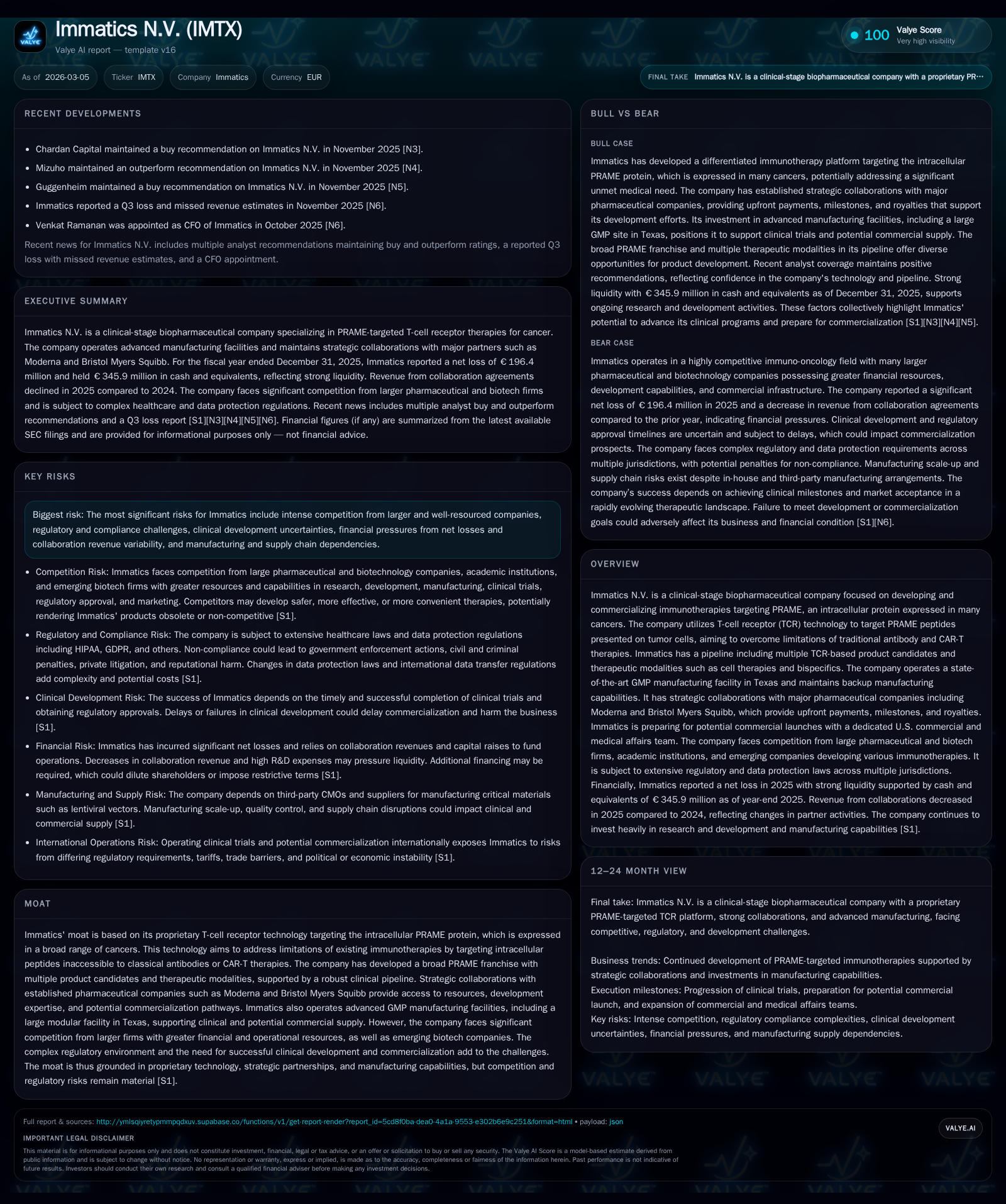
Immatics N.V. focuses on developing immunotherapies targeting the intracellular cancer antigen PRAME, employing cutting-edge T-cell receptor technology to circumvent limitations of conventional therapies. The company's recent years have been marked by substantial growth in clinical-stage programs and strategic collaborations, supported by significant equity capital raises and a robust cash position as of year-end 2025. Despite posting a sizeable net loss in 2025, largely due to escalating R&D expenditures amid ongoing clinical activities, Immatics is preparing for potential commercial launches, backed by state-of-the-art manufacturing facilities and alliances with partners such as Moderna and Bristol Myers Squibb. The biopharma faces key risks from competitive advances, regulatory complexities, financing variability from collaboration revenues, and manufacturing dependencies; monitoring milestone achievements and regulatory progress will be critical indicators of future performance.
Company Overview and Historical Growth
Immatics N.V., a clinical-stage biopharmaceutical company headquartered in Germany with operations including a GMP manufacturing facility in Texas, specializes in immunotherapies aimed at PRAME—an intracellular protein presented via HLA on tumor cells expressed across a broad range of cancers. Utilizing proprietary T-cell receptor (TCR) technology allows precise targeting of PRAME peptides inaccessible to traditional antibody or CAR-T approaches [S1].
Since inception, the company has concentrated on assembling a broad PRAME franchise encompassing multiple clinical product candidates across several therapeutic modalities: primarily autologous TCR-engineered cell therapies such as anzu-cel (IMA203), next-generation versions like IMA203CD8 (GEN2), off-the-shelf bispecific molecules (IMA402), and combination treatments leveraging immune checkpoint inhibitors or Moderna's mRNA-based cell therapy enhancer (mRNA-4203) [S1].
Historically, Immatics has not recorded product sales revenue but relies on partnership-derived income including upfront payments, milestone payments linked to development progress, and reimbursement of R&D costs under collaborations with pharmaceutical heavyweights such as Moderna and Bristol Myers Squibb [S1]. This model enabled financing for expanding clinical programs while building internal capabilities.
The employee base has grown moderately supporting pipeline advancement with 656 full-time equivalents at end-2025 compared to 627 in the prior year [S1]. Equity financing rounds cumulatively raised approximately €1.6 billion through the end of 2025 funding research activities and infrastructure expansion [S1][S23].
Financial Performance Summary
Historical performance (annual)
| FY | Net ($mm) | Net YoY |
|---|---|---|
| 2025 | -196 | -1390.9% |
| 2024 | 15 | +115.7% |
| 2023 | -97 | -358.6% |
| 2022 | 38 |
Source: SEC companyfacts cache [F1].
Capital returns and efficiency (annual)
| FY | ROE% |
|---|---|
| 2025 | -40.6 |
| 2024 | 2.6 |
| 2023 | -43.1 |
| 2022 | 17.6 |
Source: SEC companyfacts cache [F1].
Source: Company filings [F1]
In FY2025 Immatics reported a significant net loss of €196 million versus net income of €15 million in FY2024—a roughly fourteenfold decline indicative of intensified spending on clinical development and infrastructure scaling ahead of potential market launches [F1]. This contrasts with prior years where results fluctuated between moderate losses and gains.
Equity capital stands robustly at €484 million despite this loss due to recent successful equity offerings totaling over €400 million net proceeds in late 2024 and December 2025 alone [S23]. Year-end cash plus equivalents of €346 million assure sufficient operating runway beyond twelve months per management assertions [S1][S23]. The exceptionally strong current ratio (~11.7x) underscores highly liquid working capital relative to short-term liabilities.
Drivers Behind Financial Trends
The widening losses notably stem from expanding direct external R&D spend driving advanced clinical trials of lead cell therapy candidates particularly anzu-cel focused on SUPRAME indication and uveal melanoma [S17]. External R&D expenses nearly doubled from €25.9 million in 2024 to €49.5 million in 2025 for cell therapies alone; bispecific programs also saw increased outlays due to IMA401 repositioning as proprietary post-collaboration termination with BMS in late 2024 [S17].
Indirect costs relating to intellectual property protections (€8.2 million), facility operation/depreciation (€11.5 million), and broader indirect research support rose alongside program intensification contributing substantially to total operating expenses exceeding €180 million in FY25 [S17].
The absence of commercial product sales continues as none have achieved regulatory approval or launch yet; collaboration revenues fluctuate depending on milestone timings and cost reimbursement patterns inherent in partnership agreements [S1][S23].
Future Growth Prospects
Looking forward Immatics seeks regulatory approvals for its lead candidates within the PRAME franchise as hallmark catalysts toward commercialization [N2][S1]. Planned pivotal study readouts for anzu-cel (IMA203) across multiple oncology indications will be critical inflection points determining registration success timelines.
The pipeline's breadth—cell therapies alongside bispecific antibodies with unique mechanisms combining targeted cytotoxicity with immune modulation—offers diversified avenues potentially addressing various solid tumor types refractory to existing immunotherapies [S1]. Partnerships with industry leaders Moderna bring complementary mRNA-enhanced treatment strategies further differentiating the portfolio.
Operational preparedness includes fortified GMP manufacturing capacity via its Texas modular facility ensuring supply continuity from late-stage clinical material into early commercial needs—a vital barrier against common biotech scale-up bottlenecks—augmented by backup manufacturing arrangements [S1].
Nonetheless growth remains contingent upon navigating inherent clinical development risks including enrollment challenges, efficacy/safety outcomes meeting regulatory thresholds, as well as competitive dynamics intensified by sizeable pharma immunotherapy pipelines pursuing overlapping targets or modalities [S21]. Regulatory complexities across jurisdictions pose additional hurdles given evolving standards impacting approval pace post-submission.
Key Milestones & Guidance to Monitor
While explicit near-term guidance is limited in public disclosures [N2][N1], investors should closely track:
- Upcoming pivotal study data releases for anzu-cel regarding efficacy/safety kinetics,
- Regulatory decision points particularly BLA submissions/approvals status,
- Milestone recognitions tied to partnered collaborations impacting reported revenue flows,
- Commercial infrastructure developments signaling readiness for launch,
- Manufacturing scale-up validation study completions. These milestones collectively will clarify pathway certainty toward revenue generation transitioning from dependency on collaborations toward sustainable product sales.
Capital Deployment & Returns Considerations
Immatics’ capital allocation currently prioritizes investment back into research efforts supporting rapid pipeline advancement amid significant burn rates consistent with typical late-stage biotech models pre-launch stage [F1][S17]. Cash flows remain negative driven by these operational investments; nonetheless the strong liquidity base tempers near-term liquidity risks [F1][S23].
No dividends or share repurchases occur given focus on preserving funds for innovation driven growth [F1]. Return metrics are impacted accordingly—FY25 reflects an approximate ROE of negative 40.6% driven by substantial losses relative to size of equity capital [F1].
Strategic collaborations provide non-dilutive financing streams balancing some development costs while conferring technical expertise and potential commercialization channels but introduce revenue variability tied to performance milestones subject to timing uncertainties [S1].
Industry Positioning & Risks
Immatics possesses a distinctive technology moat focused on TCR-engineered immunotherapies enabling access to intracellular antigens like PRAME unavailable to classic antibody or CAR-T approaches—this technical niche differentiates its asset base amidst crowded oncology immuno-oncology space.
However challenges persist including formidable competition from large well-capitalized pharma companies developing next-generation CAR-Ts, checkpoint inhibitors, vaccines or additional bispecific constructs targeting similar cancer indications often with broader label possibilities or more established commercial footprints [S21].
Regulatory scrutiny remains high given complexities around novel biologics requiring extensive safety monitoring post-market including REMS programs, labeling restrictions plus companion diagnostics co-development obligations within EU/US markets increasing timelines/costs risk profile dramatically [S13][S16].
Further risks arise from data protection statutes spanning GDPR/HIPAA increasing compliance burdens when handling patient data critical for trial conduct; cybersecurity breaches could compromise sensitive IP or delay progress significantly threatening program integrity or regulatory standing [S18].
Manufacturing scale reliability is crucial; reliance on third-party service providers introduces vulnerabilities around supply chain disruptions that could imperil trial continuity or commercial readiness if not rigorously managed [S15][S20].
Finally exposure to product liability during both late-phase development & eventual marketing phases necessitates ongoing comprehensive insurance coverage yet risks remain materially impactful potentially restraining commercialization strategies if adverse events arise [S10][S14].
Conclusion & Monitoring Focus Areas
Immatics occupies an innovative niche leveraging TCR technology targeting intracellular PRAME antigen across a multifaceted therapeutic platform poised near critical inflection points transitioning toward commercialization. Its financial footing is strong thanks to significant equity capital raises notwithstanding steep current losses reflecting heavy R&D investment ramp-ups.
Success depends principally on delivering positive clinical milestone data timely coupled with efficient navigation through complex regulatory landscapes amid intense competition from established large pharmas pushing novel immuno-oncology agents.
Key checkpoints to observe include progress updates related to:
- Anzu-cel pivotal trials,
- Approval pathway advancements especially BLA-related communications,
- Collaborator milestone achievements impacting revenue recognition,
- Manufacturing scale-up confirmations supporting prospective launches. Monitoring these will be essential for assessing whether Immatics can capitalize on its technological advantages within oncology’s fiercely contested marketplace.
This report is based solely on publicly available information up to March 5, 2026 including SEC filings [F1], company disclosures [], and relevant industry context without offering investment advice.
Disclaimer: This is research-only, informational analysis and not investment advice. It may include AI-generated interpretation and general industry context. Always verify important details using primary sources.

Comments