
Deckers Outdoor: Marrying Premium Heritage with Strategic Agility for Sustainable Growth
Deckers combines iconic brands, diversified channels, and risk-conscious operations to navigate evolving market dynamics.
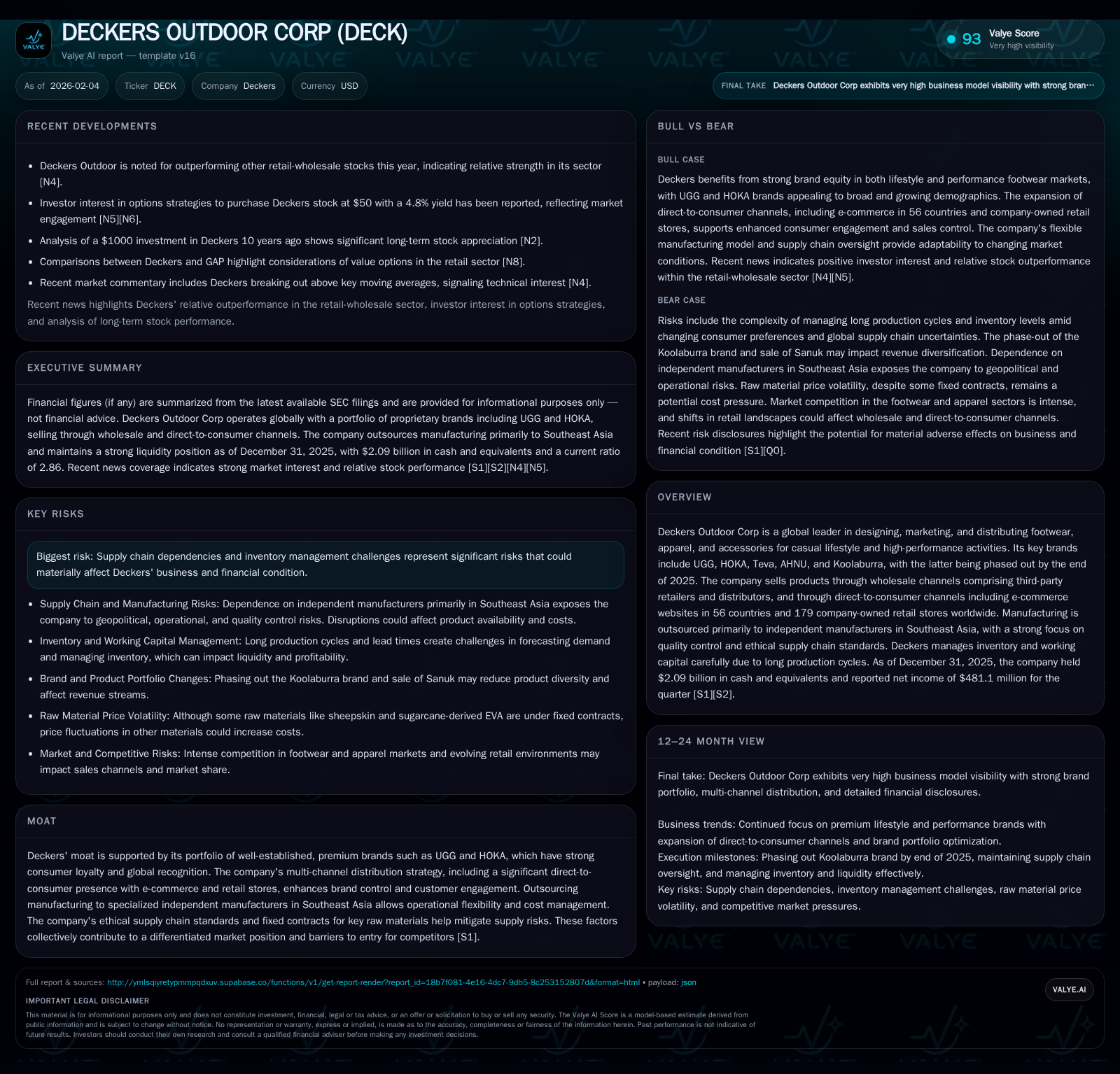
Deckers Outdoor Corp stands out as a global leader in premium footwear and apparel by leveraging its well-established brands like UGG and HOKA, a balanced multi-channel distribution network, and disciplined operational practices. With outsourced manufacturing centered in Southeast Asia and an emphasis on ethical standards, Deckers manages supply chain complexities amid shifting consumer trends. The phase-out of Koolaburra underscores strategic prioritization towards high-growth assets. Financially robust with over $2 billion in cash and strong liquidity, the company shows resilience despite inherent industry risks and competitive pressures.
From Iconic Heritage to Forward-Looking Growth: Deckers’ Brand Evolution
Few companies master the delicate art of balancing deep-rooted brand heritage with an eye toward future growth better than Deckers Outdoor Corp. Established names like UGG evoke instant recognition worldwide—rooted in casual luxury footwear that transcends seasons—while newer entrants such as HOKA have disrupted the athletic performance footwear segment within years. UGG's transformation from a niche sheepskin boot provider into a full lifestyle brand offering year-round footwear, apparel, and accessories illustrates Deckers’ strategic nimbleness in evolving alongside consumer tastes [S1]. Likewise, HOKA appeals across a spectrum from ultra-runners to everyday fitness enthusiasts through its distinctive cushioning technology merged with contemporary design ethos.
Together, these flagship brands form the cornerstone of Deckers’ competitive moat; their broad demographic appeal is bolstered by ongoing innovation aimed at fashion-forward authenticity without compromising comfort or performance. This combination drives strong consumer loyalty that supports sustained revenue streams despite volatile retail environments.
Mapping Deckers’ Multi-Channel Distribution Edge
Deckers’ distribution strategy embodies diversification calibrated for maximal brand control and resilience. Beyond traditional wholesale relationships with reputable third-party retailers and international distributors, direct-to-consumer (DTC) channels have been aggressively expanded. Operating 179 company-owned stores worldwide alongside ecommerce platforms servicing 56 countries globally ensures not only access to end consumers but also valuable data capture to inform market responsiveness [S1].
This multi-pronged approach enriches customer engagement through tailored shopping experiences while preserving margin integrity often eroded in wholesale-only models. Notably, expanding international retail footprints complements strengthened digital ecosystems — a crucial strategic hedge in an era where omnichannel retailing dictates competitive advantage.
Manufacturing Outside the Box: Southeast Asia’s Role in Operational Flexibility
Deckers’ manufacturing model rests on strategic outsourcing predominantly to independent suppliers in Southeast Asia—an established hub for quality footwear production at scale [S1]. This outsourced structure affords the company important benefits including cost optimization without sacrificing oversight concerning quality assurance. The reliance on third-party contractors necessitates stringent quality controls and adherence to ethical labor standards—a hallmark of Deckers’ supply chain philosophy.
Moreover, fixed contracts with raw material suppliers act as a buffer against price volatility common in commodity markets, safeguarding input cost predictability. This intertwined framework enables Deckers to remain flexible operationally while mitigating some forms of supply disruption risk inherent in global trade networks.
Navigating Supply Chain Complexities and Inventory Risks
Balancing inventory levels is particularly challenging for Deckers due to extended lead times intrinsic to outsourced footwear production combined with fluctuating consumer demand signals [S1][S2]. The company explicitly acknowledges the difficulty in accurately forecasting demand amidst fast-evolving fashion preferences and seasonal variances. Overstocking risks tie up working capital unnecessarily; understocking erodes sales opportunity and damages retailer relationships.
Additionally, supply chain dependencies expose Deckers to disruptions—whether geopolitical events affecting Southeast Asian manufacturing hubs or logistics bottlenecks—that could materially impact financial outcomes. These vulnerabilities underscore why proactive inventory management and diversified supplier relationships remain crucial pillars mitigating downside risk.
Financial Strength and Capital Strategy: A Clear Cushion Against Volatility
As of December 31, 2025, Deckers held $2.09 billion in cash and equivalents supported by current assets totaling $3.28 billion against current liabilities of approximately $1.15 billion [F1]. This translates to a robust current ratio near 2.86 — indicative of strong short-term liquidity enabling the company to weather economic downturns or invest steadily without capital constraints.
Such financial solidity underpins ongoing strategic initiatives including brand development, selective store expansions, digital investments, as well as buffering against raw material cost swings or unforeseen supply chain shocks.[F1]
What the Numbers Tell Us: Recent Financial Performance Deep Dive
Deckers closed fiscal 2025 with net income of $481 million reflecting solid operational leverage from its high-margin premium product offerings [F1]. While detailed quarterly disclosures reveal continued momentum particularly within UGG’s expanded product lines and HOKA’s accelerated international penetration [S2], challenges remain visible in legacy or non-core segments such as Koolaburra facing wind-down phases.
Margins benefit from the balanced channel strategy that offsets some wholesale pressures by capturing higher DTC earnings. Overall financial metrics signal a resilient business model capable of sustaining profitability despite macroeconomic headwinds affecting discretionary consumer spending.
Market Sentiment and Stock Dynamics: Beyond the Moving Averages
Deckers has garnered notable attention amid recent technical trading activity where it broke decisively above its 20-, 50-, and 200-day moving averages — markers often scrutinized by market participants signaling potential momentum shifts [N9][N10][N11]. Concurrent options market interest around purchase commitments at $50 strike prices reveals nuanced investor strategies aiming for income generation linked to expected price stability or moderate appreciation [N5][N6].
Analyst coverage appears cautiously optimistic but tempered by competitive pressures typical within retail-wholesale sectors [N13]. These signals reflect balancing acts between recognized brand strength versus prevailing concerns around consumer trends volatility.
Competitive Moat Under Pressure? Assessing Brand Loyalty in a Changing Market
Deckers operates in a fast-changing consumer landscape where preference shifts can quickly undermine entrenched brand advantages [S1]. Social media acceleration means reputational risks magnify rapidly; any missteps related to product quality perceptions or controversial marketing can disproportionately affect desirability.
Moreover, price sensitivity among premium consumers continues evolving amidst broader inflationary pressures impacting discretionary spending habits. Maintaining relevance involves continuous innovation while honoring core brand DNA — a challenging equilibrium given divergent demographic tastes globally.
Phasing Out Koolaburra: What It Signals About Strategic Priorities
Initiated during Q3 fiscal 2025, phasing out Koolaburra represents Deckers’ deliberate resource reallocation toward more significant organic opportunities within its flagship labels [S1]. Closing Koolaburra’s standalone ecommerce presence by March 31, 2025 and winding down wholesale operations by year-end marks an explicit pruning of non-core brand distractions.
This strategic pruning potentially frees bandwidth both financially and managerial for expanding proven winners like UGG’s lifestyle extensions or HOKA’s performance-athlete traction — thereby sharpening overall corporate focus amid competitive retail milieus.
Future Outlook: Challenges, Opportunities, and Risks Ahead
Looking ahead, Deckers must continue navigating twin currents: evolving global consumer behaviors alongside persistent supply chain uncertainties [S1][S2][N7][N8][N12]. The company’s authentic branding coupled with diverse channel execution positions it well against competitors who may lack equivalent scale or multi-channel sophistication.
However, contingent risks include fluctuating raw material costs despite fixed contracts, potential geopolitical disruptions impacting manufacturing hubs in Southeast Asia, and rapid shifts in social attitudes or technology adoption reshaping purchasing patterns. Sustained investment in product innovation aligned with transparent ethical practices likely remains vital for maintaining customer trust.
Careful inventory governance will be indispensable given long lead times paired with demand unpredictability — failures here could impair profitability or market standing irreversibly. Nonetheless, ample liquidity reserves provide meaningful financial cushions enabling prompt response capabilities when required.
Deckers Outdoor Corp exemplifies how legacy brand equity married with modern operational discipline can carve out resilient pathways amid increasingly complex industry landscapes.
This analysis is based solely on publicly available information including SEC filings [S1][S2] and relevant news reports [N#], along with observed industry trends. It does not constitute investment advice or recommendations regarding purchases or sales of any securities.
Disclaimer: This is research-only, informational analysis and not investment advice. It may include AI-generated interpretation and general industry context. Always verify important details using primary sources.

Comments