
Digi Power X Accelerates HPC and AI Data Center Growth Driven by Cerebras Partnership
The company’s latest quarterly filing highlights a critical multi-year AI infrastructure contract with Cerebras Systems, marking a strategic step in HPC data center expansion.
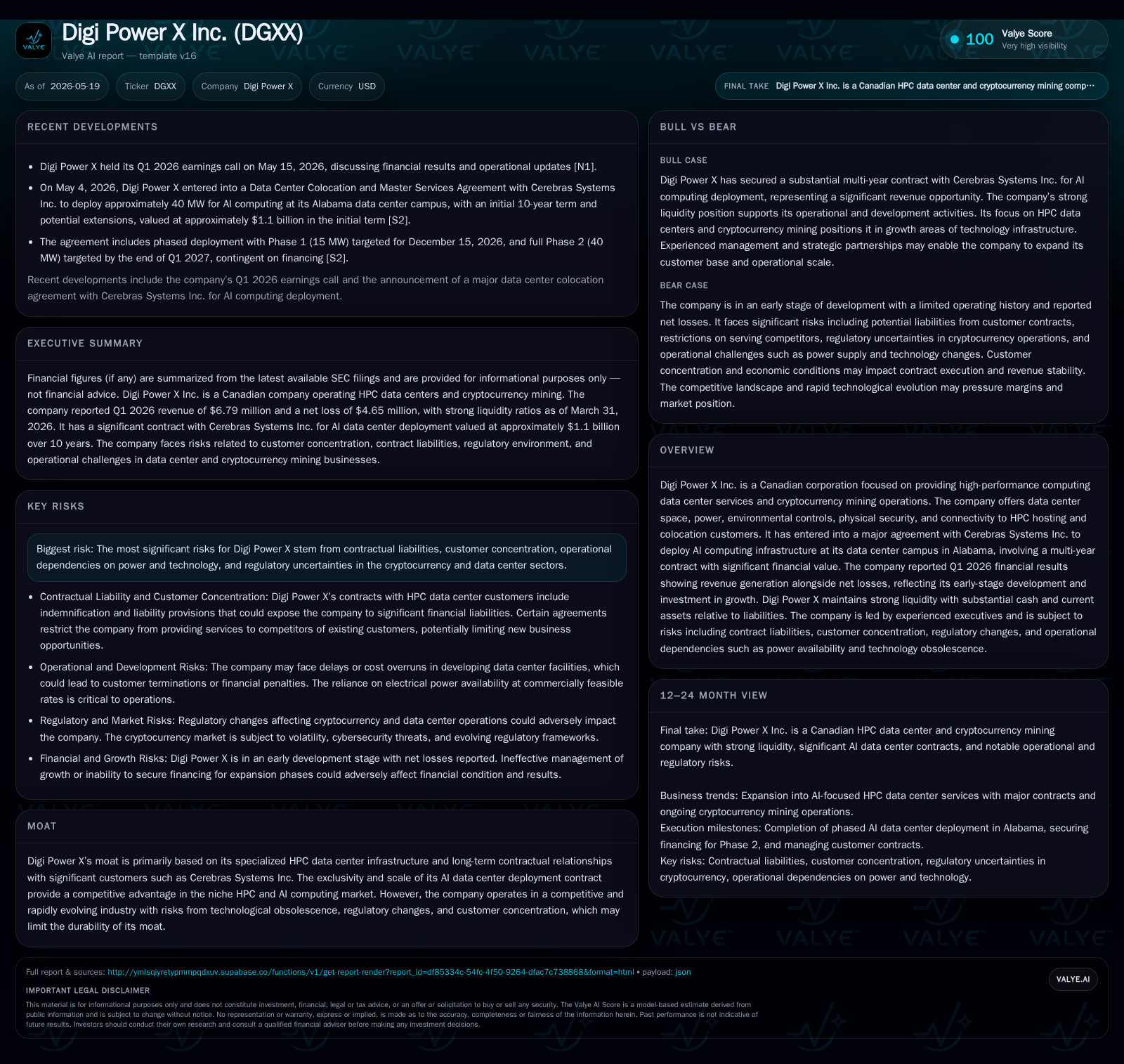
Digi Power X Inc.’s May 2026 quarterly report reveals significant operational progress, notably executing a substantial multi-year agreement with Cerebras Systems to deploy AI-focused high-performance computing (HPC) infrastructure at its Alabama data center. This milestone anchors the company's transition toward specialized, contract-backed HPC services, generating early revenue while absorbing net losses during growth investments. Strong liquidity with a current ratio above 12x supports ongoing expansion and operational execution. Risks center on contract liabilities, customer concentration, and regulatory uncertainties in crypto and HPC sectors.
Latest Operating Update: Quarterly Progress and Contractual Milestones
Digi Power X's 10-Q filing dated May 15, 2026 [S2] along with contemporaneous 8-K disclosures [S3] represent the clearest recent operating update anchoring the company's trajectory. The centerpiece is the formal execution of a multi-year Data Center Colocation and Master Services Agreement with Cerebras Systems Inc., targeting deployment of AI-specific high-performance computing infrastructure at Digi Power X's Alabama campus. This contract—filed as Exhibit 10.1 [S23]—reflects both exclusivity in service provision and a commitment to phased capacity delivery aligned with AI workload needs.
This agreement is crucial because it materially enhances near-term revenue visibility for Digi Power X through long-duration contractual cash flows tied to colocation space, power provisioning, environmental controls, physical security, and connectivity services tailored for Cerebras’s AI compute hardware. Early Q1 2026 financials show revenue generation that aligns with this contractual backbone; reported revenues approach $34 million annualized [F1], indicating substantive business scale despite the company’s continued investment-phase net losses nearing $28 million [F1]. Financial disclosures emphasize that these losses accompany expansion investments rather than operational runoff.
Simultaneously, Digi Power X maintains strong liquidity metrics. As of March 31, 2026, cash and cash equivalents stand at approximately $57.8 million against modest current liabilities near $5.8 million [F1], yielding a current ratio of roughly 12.6 — a robust buffer that enables flexible capital allocation to capacity buildout and operational scaling.
Business Model Breakdown: Revenue Streams and Service Offerings in HPC and Crypto Mining
Digi Power X generates revenue primarily from hosting HPC client workloads via its data center facilities that integrate specialized colocation services: space leasing tailored to compute density requirements; reliable power provisioning often exceeding several megawatts per installation; sophisticated environmental controls (cooling systems adapted to high heat loads); physical security protocols compliant with enterprise standards; and high-bandwidth connectivity supporting low-latency AI computing operations [S1],.
This modular service package meets stringent Service Level Agreements (SLAs) expected by HPC clients whose workloads cannot tolerate downtime or thermal fluctuations. The long-term nature of these contracts—particularly with Cerebras—implies recurring revenue streams driven by contracted capacity commitments rather than spot or transient utilization alone.
Complementing data center services is Digi Power X’s cryptocurrency mining business segment. While not the primary growth vector, the mining operations provide diversification of cash flow sources but also introduce regulatory exposure given shifting policies around crypto mining globally [S1]. Economies of scale are achieved through centralized infrastructure investments enabling optimized power usage effectiveness (PUE) ratios across both HPC colocation and mining operations.
Customer profiles skew towards large-scale technology firms deploying cutting-edge AI workloads requiring bespoke compute environments rather than traditional commodity cloud or colocation providers.
Industry Context: Competitive Dynamics and Positioning within AI Data Center Infrastructure
Within the broader HPC and AI data center ecosystem, Digi Power X occupies a specialized niche characterized by advanced facility specifications designed to support highly parallelized AI workloads with substantial power density demands. Its partnership with Cerebras—a leader in wafer-scale AI chip manufacturing—confers technological differentiation compared to general-purpose colocation providers or hyperscale cloud operators primarily focused on more commoditized offerings, [S1].
Critical competitive advantages arise from exclusive or semi-exclusive long-term contracts securing predictable demand amid an industry marked by capital-intensive capacity buildouts requiring careful balancing between facility scale and operational risk.
Capacity constraints are non-trivial: availability of reliable power sources at scale combined with local regulatory compliance sets hard limits on new site development speed. Moreover, switching costs for clients entrenched in specific hardware stacks managed by Digi Power X's customized environment are elevated due to physical migration complexities.
Risks include rapid technological evolution demanding continual reinvestment to avoid obsolescence in cooling infrastructure or connectivity standards, alongside cryptocurrency regulations which increasingly scrutinize energy consumption profiles of mining operations interconnected within such facilities.
Growth Catalysts: Expansion Drivers and Contract Leverage from Strategic Partnerships
Digi Power X’s growth roadmap is closely linked to escalating demand for AI compute services powering models that require specialized infrastructure distinct from legacy HPC offerings. The multi-year Cerebras contract acts as a foundation upon which incremental deployments can scale both geographic footprint at the Alabama campus and service sophistication delivered through tiers of colocation [S23].
Capital access is another linchpin: recent upsizing of at-the-market equity offerings (ATM) capped at $175 million total authorized shares issuance reflects proactive funding strategies for meeting expansion capital expenditures [S4], [N5]. These funds accelerate build phases enabling Digi Power X to swiftly incorporate additional megawatts of power capacity suited for GPU/AI server racks anticipated to grow at rates outpacing typical cloud expansions.
Potential exists for future customer diversification as the sector's underlying demand expands beyond early adopters like Cerebras into adjacent markets requiring bare metal GPU rentals or hybrid HPC/cloud integrations—as evidenced by agreements such as that signed with SubQ AI [S22]. This indicates emerging product-market fit spreading among startups and mid-tier enterprises requiring flexible access to advanced AI computation without full ownership overheads.
Risk Factors: Contract Liabilities, Customer Concentration, and Regulatory Challenges
Key risks emphasized in the May 2026 10-Q exhibit substantial contractual liability exposures embedded within HPC client agreements [S2]. Indemnification clauses paired with stringent SLAs raise potential costs if any breaches occur—potentially material legal damages coupled with defense expenses could weigh heavily on financial outcomes.
Customer concentration risk is acute given sizable reliance on Cerebras for committed capacity revenue streams. Should Cerebras alter deployment plans or face its own downturns, Digi Power X would need rapid mitigation pathways including identifying alternative tenants for tailored-developed spaces under construction yet unoccupied.
Regulatory uncertainty impacts both sides of Digi Power X’s business model: cybersecurity regulation enforcement coupled with evolving cryptocurrency energy use policies could limit operational flexibility or increase compliance costs substantially [S1]. Careful monitoring of emerging legislation will be required.
Failure to complete facility expansions on schedule or cost overruns associated with rapid deployment efforts may lead to delays in capturing expected revenue growth windows further pressuring margins during ramp-up phases.
Upcoming Milestones: What Investors Should Monitor Next
Execution-based KPIs will dominate near-term scrutiny: milestone dates surrounding the readiness of Phase 1’s targeted December 2026 go-live date for initial Alabama campus load capacity are critical signals validating contract fulfillment progress [S23]. Additionally, metrics like data center utilization rates post-deployment will reflect market uptake velocity beyond sole anchor customers.
Quarterly earnings consistency against prior guidance will indicate operational scalability beyond singular contracts toward portfolio expansion in client logos signing similar Data Center Colocation agreements.
Capital raising completion aligned to fund Phase 2 expansion—the additional 25 MW contingent on successful financing—will further demonstrate both market confidence in Digi Power X’s strategy and the company’s execution discipline enabling longer-term growth runway [S4], [N5].
Investors should also monitor industry shifts impacting cryptocurrency mining regulations as these external policies may unexpectedly reshape profitability dynamics or necessitate strategic pivots.
Financial Snapshot: Liquidity, Revenue Trajectory, and Investment Stage Indicators
From the latest available March 31, 2026 balance sheet snapshot reported via companyfacts [F1], Digi Power X holds approximately $57.8 million cash alongside total current assets nearing $73 million against current liabilities around $5.8 million — yielding an exceptionally strong current ratio above 12x signaling robust liquidity well-positioned to fund ongoing capital intensive rollouts safely.
The Q1 annualized revenue metric reaching approximately $34 million corroborates active commercial traction driven largely by contractual commitments rather than speculative sales cycles alone. Still, reported net losses around $28 million highlight continued investment expenditure prevailing over immediate profitability as expected given nascent project stages requiring heavy upfront costs spanning site buildouts to technology integration.
This financial profile underscores an early-stage growth company balancing already generated revenue against strategic outlays designed explicitly to capture accelerating demand cycles centered on next-generation high-density AI compute deployments supported by premier customer engagements.
This analysis is derived exclusively from public filings including SEC reports dated May 2026 and supplemented by recent news coverage as cited. It presents a forward-looking assessment grounded strictly in disclosed facts without investment research views.
Disclaimer: This is research-only, informational analysis and not investment advice. It may include AI-generated interpretation and general industry context. Always verify important details using primary sources.

Comments