
Definitive Healthcare's Revenue Slip and Strategic Expansion in Commercial Intelligence
Subscriber growth contraction offsets platform enhancements amid sales challenges and macroeconomic headwinds.
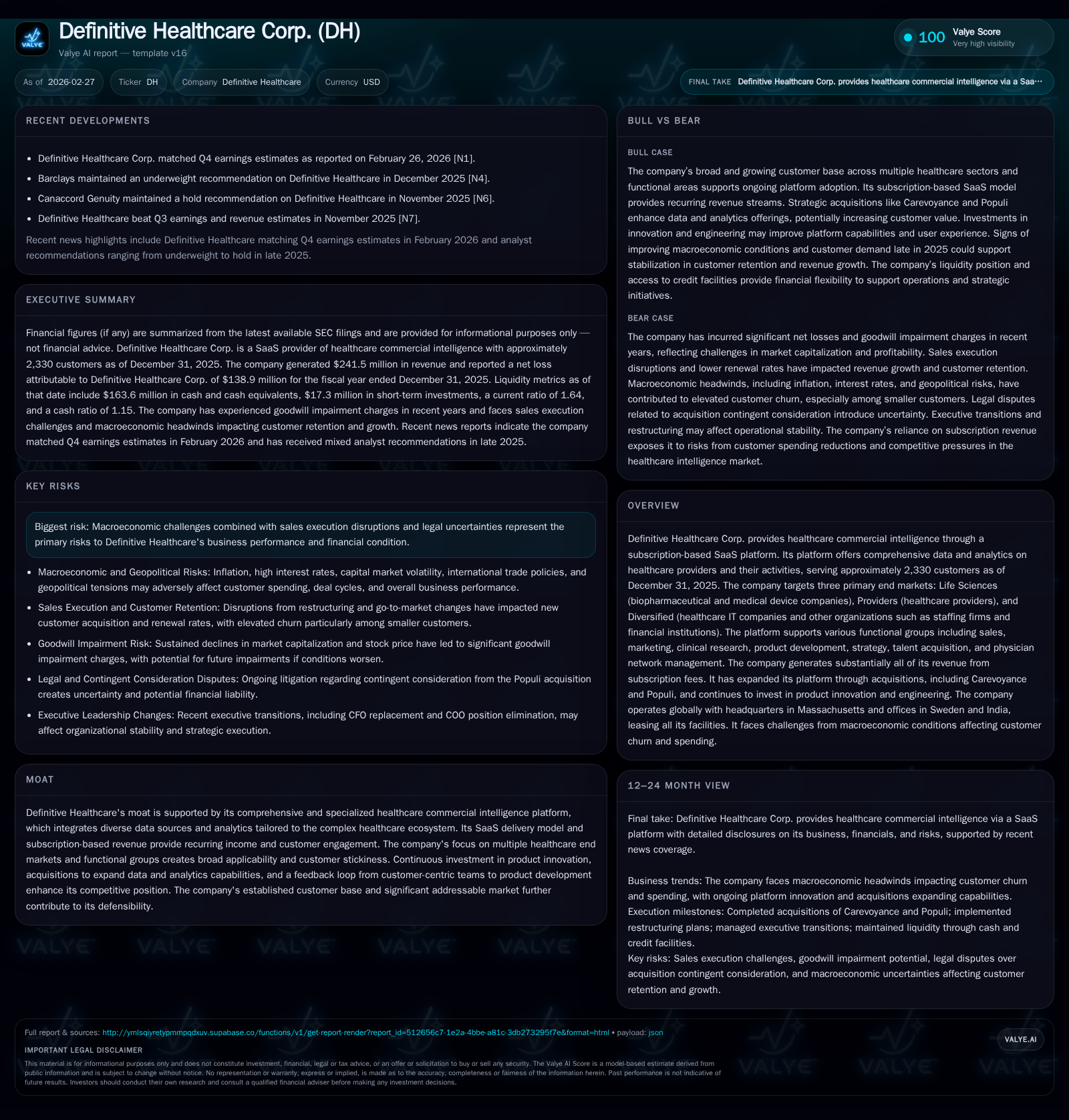
Definitive Healthcare Corp. experienced a slight revenue decline in 2025 driven by lower enterprise customer counts and sustained macroeconomic pressures that dampened sales execution. Despite a decrease in top-line to $241.5 million, the company generated positive operating cash flow and aggressively returned capital through share repurchases. Its SaaS platform remains differentiated by comprehensive healthcare data integration, supporting key verticals like life sciences and providers, while acquisitions such as Carevoyance and Populi remain central to expanding platform capabilities. Looking ahead, revenue is expected to soften further in 2026 due to current challenges, but opportunities exist in deepening existing client engagements and broadening use cases across healthcare stakeholders.
Business Overview
Definitive Healthcare Corp. operates a subscription-based SaaS platform providing commercial intelligence focused on the healthcare ecosystem. The company's offering integrates diverse healthcare provider data and analytics to support strategic planning, marketing, clinical research, product development, talent acquisition, and physician network management across its primary end markets: Life Sciences (biopharmaceuticals and medical devices), Providers (healthcare delivery systems), and Diversified segments including healthcare IT firms and financial institutions .
Historical Financial Performance
Since its IPO-backed growth trajectory before 2022, Definitive Healthcare substantially grew its revenue base from around $60.6 million in 2022 to over $252 million by 2024 [F1]. However, the company faced significant goodwill impairments totaling $688.9 million in 2024 which drove an operating loss of over $710 million that year.
In 2025, revenue dipped slightly to approximately $241.5 million, marking a -4.2% decline from the prior year attributed largely to challenges acquiring new customers amid economic softness and churn among smaller accounts disproportionately affected by macro headwinds [F1][S11][S12]. The number of enterprise customers—accounts generating more than $100,000 ARR—decreased marginally by eight to 511 during the year.
Despite persistent losses on the income statement ($138.9 million net loss in 2025), operating income improved sharply as impairment charges reduced from prior-year levels [F1]. Operating cash flow remained positive at approximately $53.8 million supported by subscription billing practices and deferred revenue growth facilitating working capital management [F1]. Capital expenditures rose notably to $16.7 million as investments were directed toward internal software development and data sourcing critical for platform innovation [F1][S14].
Financial Summary Table
Historical performance (annual)
| FY | Rev ($mm) | Net ($mm) | CFO ($mm) | OpInc ($mm) | Rev YoY | Net YoY |
|---|---|---|---|---|---|---|
| 2025 | 242 | -139 | 54 | -224 | -4.2% | +66.4% |
| 2024 | 252 | -413 | 58 | -711 | +0.3% | -104.1% |
| 2023 | 251 | -202 | 41 | -330 | +314.9% | -2151.6% |
| 2022 | 61 | 10 | 36 | -11 |
Source: SEC companyfacts cache [F1].
Capital returns and efficiency (annual)
| FY | Buybacks ($mm) | FCF ($mm) | ROE% |
|---|---|---|---|
| 2025 | 49 | 37 | -36.7 |
| 2024 | 22 | 46 | -68.0 |
| 2023 | 38 | -16.9 | |
| 2022 | 27 | 0.7 |
Source: SEC companyfacts cache [F1].
Platform Strengths and Moat
The company's moat arises from its comprehensive integration of multiple healthcare data sources into a unified SaaS delivery model that supports varied functional groups across three major sub-sectors within healthcare . The platform's ability to address complex customer needs—from life sciences targeting clinicians for product launches to healthcare providers managing physician networks—is reinforced by continuous investment in product innovation.
Strategic acquisitions such as Carevoyance—focused on MedTech prospecting—and Populi—enhancing provider-centric analytics—have expanded both dataset breadth and platform functionality enabling deeper market penetration [S22]. Continuous feedback loops from client-facing teams inform product development ensuring relevance and stickiness.
Customer Dynamics and Future Growth Prospects
Customer expansion has softened under current macroeconomic conditions that have elevated sales execution difficulties and tightened corporate budgets across healthcare sectors [S6][S11][S12]. Total customer count declined modestly from approximately 2,500 at end-2024 to about 2,330 at end-2025 with smaller customers experiencing disproportionate churn.
Growth opportunities remain tied primarily to expanding usage within existing enterprise accounts—as evidenced by a net dollar retention rate of roughly 85% for enterprise clients down from prior highs near 90%—and broadening application of the platform into new functional areas [S12]. The company estimates an addressable market exceeding 100,000 potential customers throughout healthcare but notes that near-term revenue may further decline given these challenges [S11][S12].
Ongoing improvements in data acquisition amidst market disruptions—particularly regarding claims data sources—and price negotiations suggest active mitigation efforts are underway but risks persist in maintaining cost stability [S6][S11].
Operational Efficiency & Capital Allocation
Cost of revenue scaled with investments into professional services teams supporting client engagements plus infrastructure expenses including cloud hosting costs; these are expected to remain substantial due to ongoing product expansion efforts [S6]. Gross margin pressure is anticipated in fiscal year 2026 stemming from revenue declines combined with fixed platform costs.
The company continues disciplined capital deployment with a focus on shareholder returns through buybacks; nearly $49.5 million was utilized for share repurchases in fiscal year ending December 31—a marked increase over previous years demonstrating strong balance sheet liquidity usage alongside deleveraging efforts with $77.8 million debt repayment during the same period [F1][S9][S15].
Cash balance of approximately $163.6 million along with undrawn revolver capacity ensures stable funding for operational needs and strategic initiatives through at least the next twelve months barring unforeseen disruptions [F1][S7][S29].
Risks And Legal Considerations
Significant risks include persistent macroeconomic weakness impacting customer spending patterns and sales productivity as well as legal uncertainties related notably to contingent consideration disputes arising from past acquisitions such as Populi ,[S21].
Additionally cybersecurity remains an area of scrutiny with executive-level oversight ensuring ongoing risk management given the sensitivity of proprietary healthcare data collected on the platform .
Outlook & What To Watch
While no explicit forward guidance was provided for FY26 revenues or earnings management signals expectations for a modest revenue decline due primarily to less favorable sales conditions paired with effects from one-time contractual credits not repeating [N1][S6]. Observers should monitor renewal rates within large enterprise customers outcomes of legal disputes affecting contingent liabilities progress on diversifying data sources amidst claims market disruptions and continued capital allocation trends reflecting shareholder return versus reinvestment tradeoffs.
The company’s ability to innovate through AI-driven data enrichment modules or expand penetration into provider networks beyond traditional life sciences users could serve as catalysts for reacceleration if macroeconomic pressures ease.
This report is based solely on publicly available information as of early calendar year 2026 including SEC filings and relevant news sources cited herein. It does not constitute investment advice or recommendations but aims to provide a comprehensive analysis grounded in verified data points.
Disclaimer: This is research-only, informational analysis and not investment advice. It may include AI-generated interpretation and general industry context. Always verify important details using primary sources.

Comments