
Ginkgo Bioworks Maps Path from Steep Losses to Synthetic Biology Scale-Up
The company’s narrowing losses and strategic asset spin-off reflect efforts to balance innovation investment with financial discipline in synthetic biology.
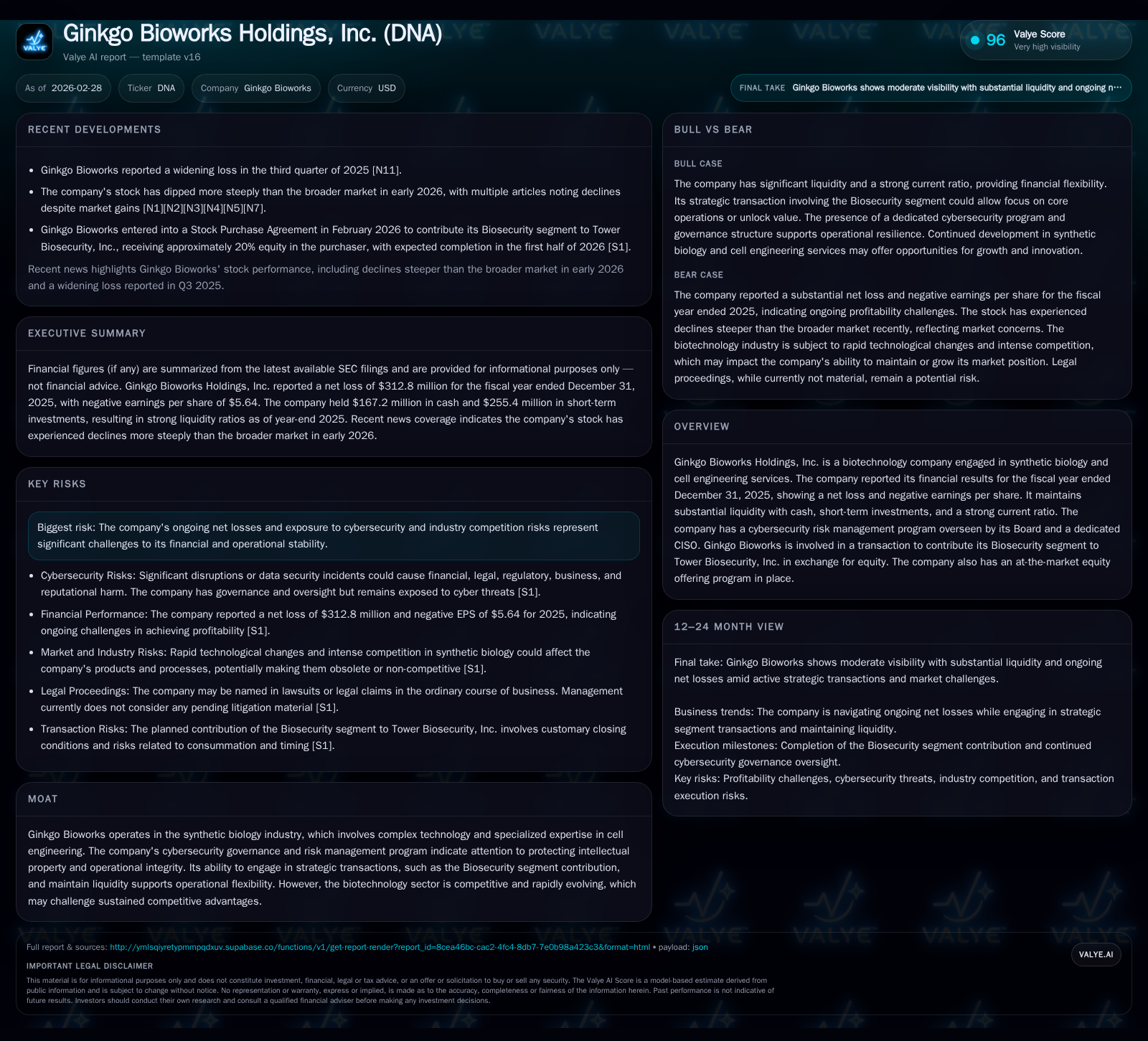
Ginkgo Bioworks continues to operate at a loss but has made considerable progress in reducing its net and operating income deficits over recent years. The company’s decision to contribute its Biosecurity segment to Tower Biosecurity signals a focus on core synthetic biology services and capital recycling. Despite ongoing negative cash flows, sharply lower capital expenditures suggest a transition toward operational efficiency. Ginkgo maintains a robust liquidity position supported by an active at-the-market equity program amid no current shareholder dividends or buybacks. Rigorous cybersecurity governance underlines the company’s protection of proprietary cell engineering technologies, a key intangible moat. While formal forecasts are unavailable, future growth will hinge on commercialization execution, customer adoption shifts, and sustained capital access.
Financial Trajectory: From Rapid Loss Escalation to Moderation
Ginkgo Bioworks has experienced a notable shift in its loss profile over the past several years. The company reported an operating income loss of approximately -$315 million for fiscal year 2025, representing an improvement of 43.7% compared to -$560 million in 2024 [F1]. Likewise, net losses narrowed by 42.8% from -$547 million to about -$313 million during the same period [F1]. This significant reduction reflects the company’s steady movement away from exceptionally high losses recorded in 2022 when net losses exceeded $2 billion [F1].
Despite these improvements, Ginkgo continues to operate at a substantial loss level common among synthetic biology firms that are scaling R&D-intensive platforms such as cell engineering capabilities. The path from heavy initial investment toward eventual operational leverage is typical given long product development cycles and infrastructure buildout inherent in the biotech sector.
Historical performance (annual)
| FY | Net ($bn) | CFO ($mm) | OpInc ($bn) | Capex ($mm) | Net YoY |
|---|---|---|---|---|---|
| 2025 | -0.3 | -171 | -0.3 | 8 | +42.8% |
| 2024 | -0.5 | -320 | -0.6 | 63 | +38.7% |
| 2023 | -0.9 | -295 | -0.9 | 41 | +57.6% |
| 2022 | -2.1 | -252 | -2.2 | 52 |
Source: SEC companyfacts cache [F1].
Capital returns and efficiency (annual)
| FY | FCF ($mm) | ROE% |
|---|---|---|
| 2025 | -179 | -61.5 |
| 2024 | -382 | |
| 2023 | -336 | |
| 2022 | -304 | -121.2 |
Source: SEC companyfacts cache [F1].
Table notes: Operating income and net income show strong downward trending losses; capex dropped materially in FY25 signaling shift from capital build phase.[F1]
Synthetic Biology Market Position and Growth Engines
Ginkgo Bioworks commands a specialized position within synthetic biology through its pioneering cell engineering services—an area focusing on designing and programming living cells for diverse applications ranging from pharmaceuticals to agriculture [S1]. Revenues have historically been driven by a mix of contracted research services and emerging value-share structures such as royalties and milestone payments tied to client product successes [S10].
The company aims to capitalize on industry trends favoring outsourced biomanufacturing models where clients relinquish part or full production of engineered cell lines instead of maintaining costly internal R&D capabilities [S10]. This transformation reflects broader sector dynamics with rapid technological advancements mandating flexible partnership ecosystems rather than vertically integrated players alone.
However, competitive pressures grow as new entrants with proprietary technology platforms emerge globally, requiring Ginkgo not only to expand the scale but continuously innovate its platform functionality while managing IP risks efficiently [S5].
Transactional Strategy: The Biosecurity Segment Spin-Off
A pivotal strategic move during early 2026 was Ginkgo’s contribution of its Biosecurity segment—previously comprising substantial operations—to Tower Biosecurity Inc., receiving equity interest approximating 20% ownership as consideration [S18]. The transaction expected completion in first half of 2026 aligns with efforts to sharpen corporate focus onto core synthetic biology service offerings while recycling capital tied up in non-core assets.
This spin-off illuminates how segment consolidation enables resource reallocation towards scaling proprietary cell design platforms and automated lab infrastructure [S3]. By externalizing Biosecurity under a dedicated entity yet retaining material upside via equity stake, Ginkgo balances risk distribution with potential synergistic opportunities within overlapping tech scopes.
Operating Cash Flows and Capex Contraction: A Financial Prism on R&D Scaling
Ginkgo’s operating cash flow deficit improved markedly in fiscal year 2025 reaching roughly -$171 million versus nearly double that outflow of -$320 million seen one year prior [F1]. This trend can be interpreted as early signs of spending discipline or operational maturation common in biotech firms post initial heavy capital ramp-ups.
Supporting this observation is the dramatic reduction in capital expenditures which plummeted almost 88% year-over-year from $62.5 million down to just $7.7 million [F1]. Such capital intensity decline tends to evidence transitions beyond foundational lab buildouts towards outsourcing components or leveraging existing facilities for volume-driven output increases — thereby increasing cost efficiency without compromising R&D throughput.
Combined, these cash flow patterns describe a company attempting to balance growth investments with rigorous financial stewardship amid uncertain commercialization timelines.
Capital Structure, Liquidity, and Shareholder Returns Dynamics
Strong liquidity remains a defining feature for Ginkgo entering fiscal year-end 2025, bolstered by approximately $167 million in cash and equivalents alongside total current assets near $472 million against current liabilities below $96 million — culminating in an impressive current ratio near 4.92x [F1]. This financial buffer supports continued operations despite recurring negative cash flows.
Notably absent are shareholder distributions through dividends or share buyback programs which is unsurprising given persistent losses reflected by an approximate return on equity around -61.5% as measured by latest net income relative to shareholders’ equity levels [F1]. Instead, capital allocation priorities evidently favor reinvestment into technology expansion and working capital needs.
Further evidencing capital formation efforts is an active 'at-the-market' equity offering program permitting opportunistic dilution-managed sales of Class A common stock aimed at funding day-to-day operations and innovation pipelines without fixed-date traditional offerings [S21], [S23], [N1].
Risk Management Focus: Cybersecurity Governance as an Intangible Asset
Given Ginkgo’s deep reliance on proprietary biological designs and automated data-driven workflows powering cell engineering innovations, cybersecurity oversight constitutes a critical intangible asset protection domain. The Board exercises rigorous governance with quarterly presentations by the Chief Information Security Officer (CISO), supplemented by continuous dialogue aligning security priorities with evolving business risks [S1], [S8].
This oversight mechanism extends beyond technical control implementations into executive-level risk assessment and compliance assurance — vital for safeguarding trade secrets amid intensifying global IP theft attempts targeting biotech advances.
Moreover, Ginkgo’s Disclosure Committee involves cross-functional leadership collaboration guiding timely determination of cyber incident materiality ensuring informed regulatory filings that preserve stakeholder trust [S1].
Outlook Considerations: What to Monitor Beyond Official Forecasts
While Ginkgo has not provided explicit forward guidance or milestone targets recently [N2], investors should vigilantly track several variables impacting medium-term trajectory:
- Progression of revenue generation across expanding outsourced biomanufacturing partnerships versus legacy ‘on-premise’ R&D engagements,
- Pipeline of prospective customer contracts converting experimental collaborations into repeatable service arrangements,
- Regulatory developments particularly affecting synthetic biology applications that could alter market access or costs,
- Continued ability to raise external capital under favorable terms as signaled by at-the-market programs,
- Synergies realized or challenges encountered following Biosecurity segment deconsolidation affecting operational complexity.
Each element collectively informs whether Ginkgo can evolve its platform economics toward break-even scalability amidst sustained sector volatility [S10],[N2],[S7].
Disclosure: This document is an analytical report based solely on publicly available information extracted from official SEC filings and reputable news sources up to February 28, 2026. It does not include investment advice or price projections but aims to provide a comprehensive understanding of Ginkgo Bioworks Holdings Inc.’s financial performance, strategic initiatives, risk framework, and industry context.
Disclaimer: This is research-only, informational analysis and not investment advice. It may include AI-generated interpretation and general industry context. Always verify important details using primary sources.

Comments