
DocuSign Inc: Navigating Growth Challenges in a Competitive Digital Agreement Market
DocuSign remains a dominant player in digital agreement software but faces strategic inflection points amid evolving technology and market dynamics.
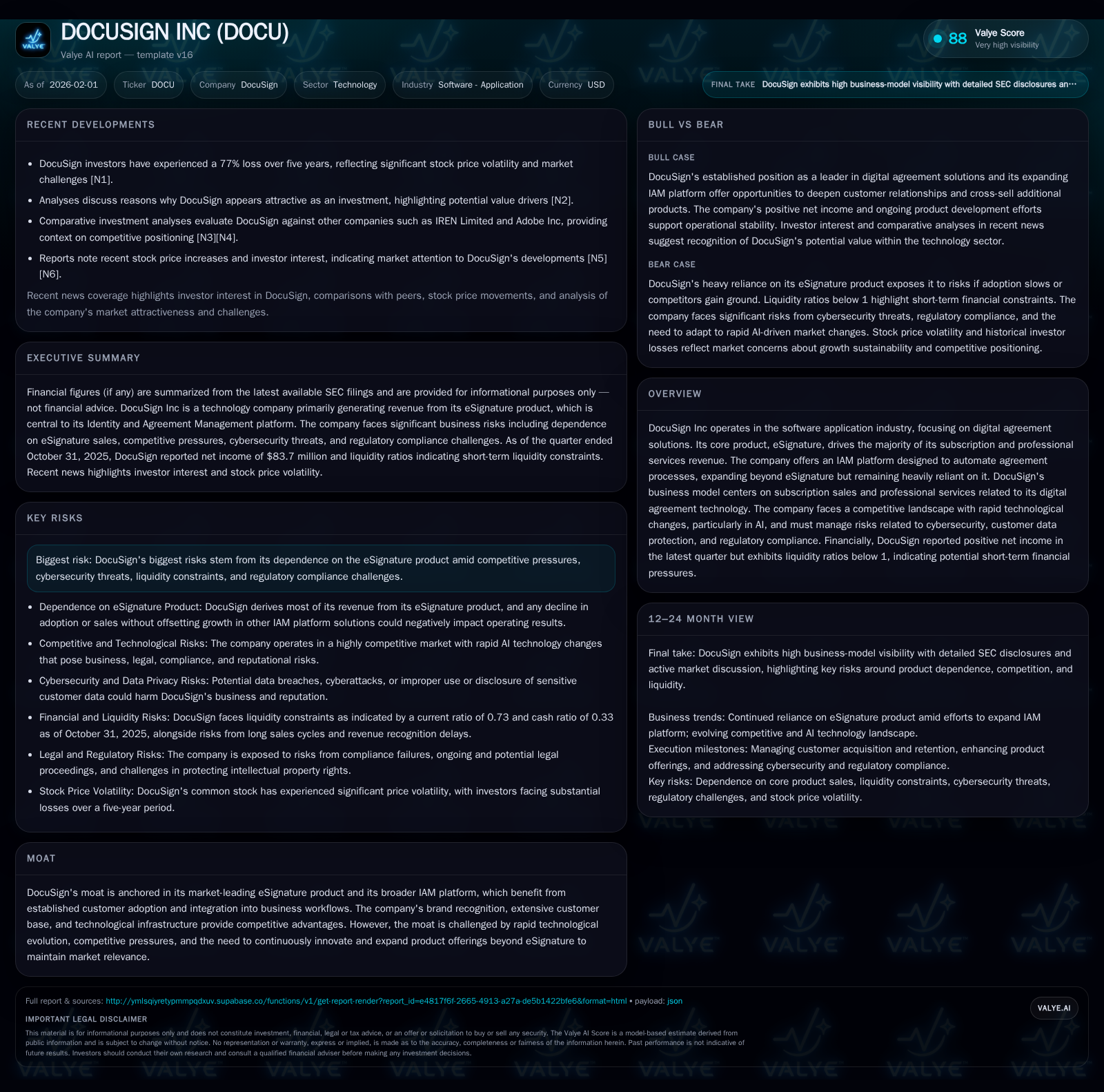
DocuSign’s business hinges heavily on its flagship eSignature product, which continues to generate the bulk of its subscription and professional services revenue. The company is expanding its Identity and Agreement Management (IAM) platform, yet the transition beyond eSignature remains nascent and critical for sustained growth. Recent positive net income contrasts with liquidity pressures, a long sales cycle, and intensifying competition, especially from AI-driven entrants. Maintaining market share requires navigating cybersecurity risks, regulatory complexities, and evolving customer needs in a rapidly changing digital workflow landscape.
What Changed Recently
DocuSign’s stock movement attracted notable investor attention in early 2026, driven by speculation around its strategic positioning relative to competitors like Adobe and emerging market entrants [N1][N2][N3]. Positive net income reported in the latest quarter has been a bright spot for the company, contrasting with a historical pattern of losses and contributing to renewed market interest [N5]. However, underlying operational challenges remain, including liquidity concerns evidenced by a current ratio below 1, which underscores potential short-term financial pressures despite cash reserves of approximately $583 million as of October 2025 [S9]. Investor discourse highlights the tension between DocuSign's dominant eSignature offering and the need to expand its IAM platform to capture a larger share of the digital agreement lifecycle [N4]. The company’s stock performance over the past five years reveals significant volatility and overall investor losses, reflecting market skepticism about its growth trajectory amid intensifying competition [N6].
Business Model as a System
DocuSign operates primarily as a subscription-based software-as-a-service (SaaS) provider, with its eSignature product accounting for the majority of both subscription revenue and professional services income [S3][S5]. This core product enables customers to electronically sign documents securely, expediting agreement workflows that traditionally involved paper and manual processes. Beyond eSignature, DocuSign has built an Identity and Agreement Management (IAM) platform aimed at automating broader aspects of the agreement process, including contract lifecycle management and compliance workflows. Yet, the company acknowledges that for the foreseeable future, its financial results will remain heavily dependent on eSignature demand and market acceptance [S4].
This dependency creates a business model that is both subscription-driven and reliant on professional services linked to the core technology. The sales cycle can be long and unpredictable, requiring significant upfront sales and marketing investment before revenue recognition occurs due to subscription accounting norms [S6][S9]. Additionally, DocuSign’s model requires continuous investment in technical infrastructure, including cloud services, to maintain uptime and security, which are critical to customer trust and platform reliability.
Risk factors embedded in this model include cybersecurity threats, potential data breaches, and regulatory compliance across multiple geographies [S1][S7]. Furthermore, the company’s reliance on third-party cloud providers introduces performance risk. The integration of AI into its offerings adds another layer of complexity, introducing legal, reputational, and operational risks that must be managed carefully [S1][S7]. Finally, retention of highly skilled personnel is essential to innovate and sustain the platform’s competitive edge [S1].
Industry Map & Competitive Battlefield
The digital agreement software industry sits at the intersection of SaaS enterprise software, workflow automation, and increasingly, AI-powered process intelligence. DocuSign has historically been the market leader in electronic signature solutions, benefiting from early mover advantages, brand recognition, and a vast installed customer base integrated into business workflows.
Competition has intensified from multiple fronts:
- Established Software Giants: Adobe Sign (part of Adobe Document Cloud) offers a strong alternative integrated with Adobe’s broader document management ecosystem, appealing to enterprises seeking end-to-end document workflows [N2].
- Vertical and Niche Providers: Specialized vendors targeting sectors like real estate, legal, or finance deliver tailored workflow solutions, sometimes integrating AI-powered analytics.
- AI-Enabled Startups: New entrants leverage generative AI and machine learning to automate contract drafting, negotiation, and compliance checking, potentially leapfrogging traditional eSignature-centric models.
The competitive battlefield is thus shaped by a shift from simple digital signing to comprehensive agreement lifecycle management driven by AI and workflow automation. Customers increasingly demand platforms that reduce manual intervention, improve compliance, and integrate seamlessly with their existing enterprise ecosystems.
Regulatory scrutiny over data privacy, electronic signature legality, and cross-border data flows further complicates competition, as global providers must tailor offerings to comply with varied regimes. Cybersecurity concerns are paramount, given the sensitive nature of agreements and customer data.
Where the Economics Become Real
DocuSign’s unit economics revolve around subscription pricing tiers, usage volumes, and professional services upsells. The high fixed cost structure includes R&D investments in platform development, cloud infrastructure expenses, and sales and marketing outlays necessary to acquire and retain customers.
Margins are influenced by:
- Customer Acquisition Cost (CAC): Long sales cycles and high competition drive up CAC, especially when targeting enterprise clients.
- Customer Retention and Expansion: Subscription renewals and cross-selling to existing customers are critical to improving lifetime value and offsetting CAC.
- Infrastructure and Support Costs: Maintaining platform uptime and security requires ongoing investment, particularly as AI features are integrated.
- Professional Services Revenue: Implementation, customization, and training services complement subscriptions but add complexity and cost variability.
DocuSign’s current liquidity ratio below 1 suggests working capital constraints that may pressure operational flexibility [S9]. The company’s ability to forecast revenue accurately is challenged by the timing of contract signings and multi-year subscription accounting. This creates potential volatility in reported financials despite underlying recurring revenue streams.
The economics also hinge on successfully expanding the IAM platform usage beyond eSignature. Failure to do so could lead to revenue stagnation if eSignature adoption plateaus. Conversely, successful platform expansion could enhance average revenue per user (ARPU) and deepen customer stickiness.
Diligence Questions / Disconfirming Signals
- How effectively can DocuSign accelerate adoption of its broader IAM platform, reducing dependence on the eSignature product?
- What is the customer churn rate, and how is it trending across product segments and geographies?
- How significant are the cybersecurity incidents or near-misses, and what investments are being made to mitigate these risks?
- What are the contractual terms and renewal rates for large enterprise customers, and how do they impact revenue visibility?
- How is DocuSign managing AI integration risks, including legal and reputational exposures?
- Given the current liquidity constraints, what are the company’s plans for capital raising or operational cost management?
- How does DocuSign’s pricing model evolve to compete with AI-driven workflow automation startups?
- Are there any indications of customer migration to competitor platforms or internal digital agreement solutions?
- What is the pace of international expansion, and how is the company addressing regional regulatory challenges?
- How resilient is the sales pipeline given long and unpredictable sales cycles?
This analysis is based on publicly available information and recent company disclosures. It is intended for informational purposes and does not constitute investment advice or recommendations. Readers should conduct their own due diligence and consult professional advisors before making any investment decisions.
Disclaimer: This is research-only, informational analysis and not investment advice. It may include AI-generated interpretation and general industry context. Always verify important details using primary sources.

Comments