
Dover Corp Advances Profitability and Digital Innovation with Solid Q1 2026 Demand
Dover reported stronger-than-expected Q1 results driven by organic growth, operational excellence, and digital transformation initiatives.
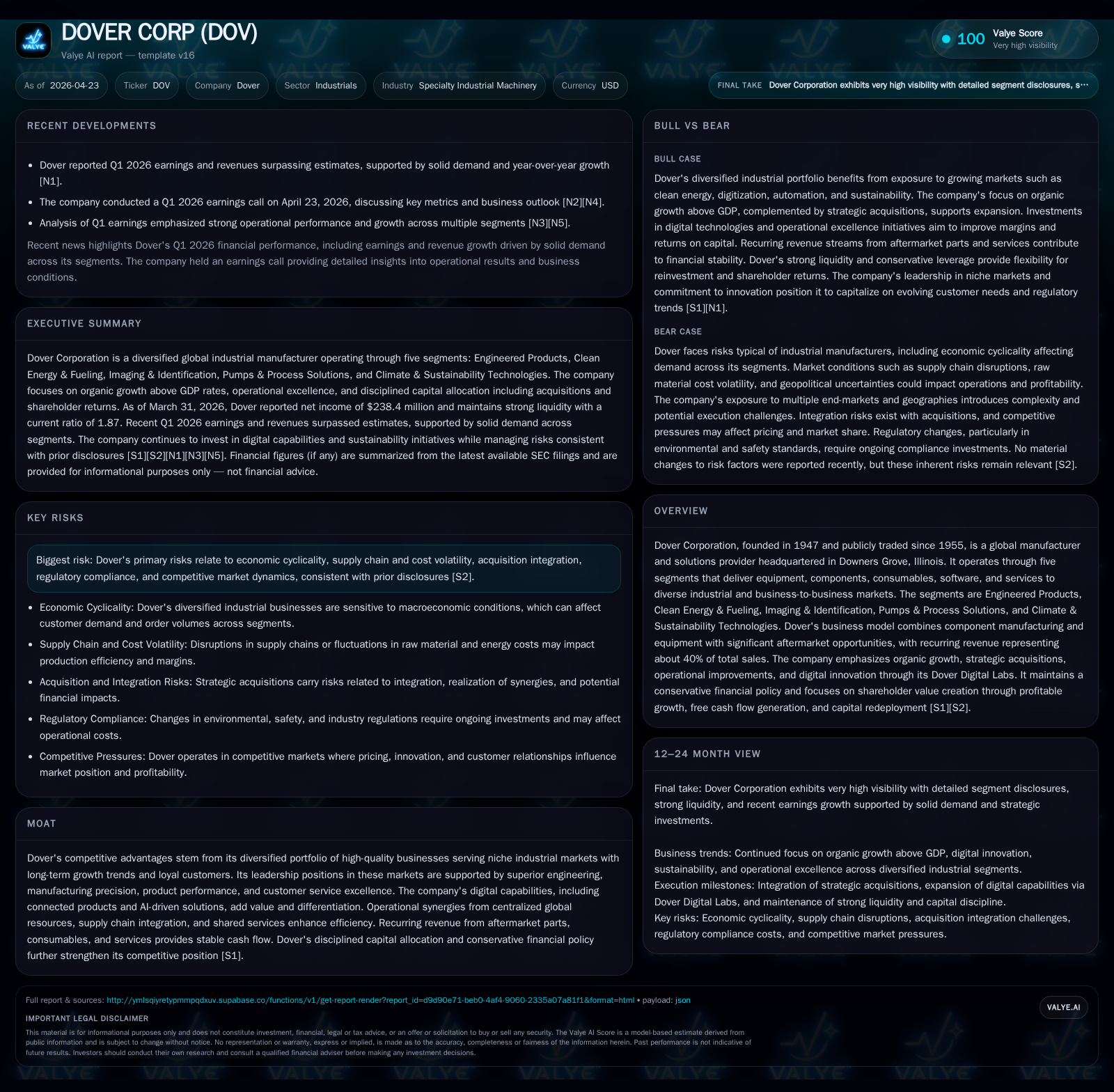
In its latest quarter ending March 31, 2026, Dover Corp (DOV) delivered earnings surpassing estimates, supported by resilient demand across its diversified industrial machinery segments. The company leverages a balanced business model combining equipment manufacturing with significant recurring aftermarket revenue streams, underpinning stable cash flow. Dover's competitive moat is bolstered by market-leading positions in niche specialty machinery sectors and ongoing investments in digital capabilities through Dover Digital Labs. Key growth avenues include industrial digitization, sustainability-driven product innovation, and targeted acquisitions, though exposure to cyclicality and labor market pressures remain notable risks. Monitoring execution on operational efficiencies, organic sales momentum, and margin trends will illuminate Dover’s path forward.
Recent Operating Update
Dover Corp’s most recent quarterly filing (10-Q as of April 23, 2026) reveals a quarter marked by resilience despite macroeconomic uncertainties. The company posted earnings that outperformed analyst estimates due to solid demand and effective pricing strategies across its portfolio [S2][N1]. Management reported sustained organic growth alongside operational improvements reflecting ongoing margin expansion initiatives centralized under Dover Business Services. Additionally, the company secured a new $1.5 billion five-year unsecured revolving credit facility replacing an earlier $1 billion arrangement, enhancing liquidity and financial flexibility through April 2031 [S8][S9]. Risk factors remained consistent with prior disclosures without material changes for this period [S2]. This operating context sets the stage for continued disciplined capital deployment focused on shareholder returns.
Business Model
Dover operates with a diversified industrial machinery business model structured into five operating segments: Engineered Products; Clean Energy & Fueling; Imaging & Identification; Pumps & Process Solutions; and Climate & Sustainability Technologies [S1]. The enterprise generates revenues through the sale of equipment and components complemented by substantial aftermarket parts consumables and services accounting for approximately 40% of total sales — a critical source of recurring revenue that stabilizes cash flows against cyclical order volatility.
The Engineered Products segment targets complex niche markets such as aerospace components and fluid dispensing systems where long-term customer relationships drive repeat business. Clean Energy & Fueling stands at the intersection of traditional fuels and emerging clean energy infrastructure (e.g., hydrogen fueling systems), benefiting from increasing regulatory focus on safety and sustainability. The Imaging & Identification segment caters to product traceability needs in packaged goods sectors through integrated hardware-software offerings. Pumps & Process Solutions serve diverse industrial process demands including biopharma single-use applications undergoing structural growth. Climate & Sustainability Technologies focus on energy-efficient commercial refrigeration and HVAC markets tied to emerging climate regulations.
This multifaceted approach allows Dover to mitigate overreliance on a single market while leveraging shared manufacturing expertise and cross-segment digital platforms developed by Dover Digital Labs — an internal center driving IIoT-enabled products, remote diagnostics services, AI-based analytics models, automation enhancements in production facilities, and improved security for connected products [S15]. Such integrated capabilities create differentiation beyond basic mechanical solutions.
Industry Structure and Competitive Position
Dover occupies leadership roles across specialty industrial machinery niches characterized by moderate fragmentation but high technical complexity. Its competitive moat derives from engineering rigor delivering superior product reliability/performance combined with deep aftermarket service networks fostering customer stickiness [S1]. Across segments, clients value not only equipment but also embedded software for real-time monitoring that enhances operational uptime — increasingly important as industries adopt digitization.
Furthermore, the company’s center-led initiatives optimize operational footprint utilization globally while centralized procurement under Dover Business Services enables supply chain efficiencies at scale [S4]. The India Innovation Center adds shared R&D capacity focused on advancing next-generation product platforms aligned with customer sustainability requirements. Market structure trends favor vendors who can provide integrated end-to-end solutions rather than discrete components; Dover’s asset-light corporate center complements its entrepreneurial businesses to navigate these evolving demands.
Growth Drivers and Constraints
Fundamental drivers underpinning Dover’s long-term growth trajectory include:
- Expanding global industrial manufacturing volumes linked to infrastructure modernization.
- Accelerated adoption of automation and AI-driven process controls.
- Heightened regulatory mandates emphasizing energy efficiency/safety stimulating upgrades in fuel dispensing/storage equipment.
- Growth of middle-class populations in emerging economies driving consumption-related equipment demand.
- Structural shifts toward sustainable technologies embedded within legacy industrial applications.
Nevertheless, Dover remains exposed to cyclical downturns common within capital goods industries where capital spending decisions slow during recessions or trade disruptions [S1]. Labor market tightness poses another persistent challenge given its implications on skilled workforce availability affecting productivity and wage costs. Management highlights continued inflationary headwinds requiring disciplined pricing actions to protect margins without sacrificing competitiveness [S2].
Moreover, integration risk from past acquisitions necessitates rigorous execution ensuring newly acquired businesses contribute synergistically without diluting focus or operational standards [S2]. Lastly, rising trade barriers or complex regulatory landscapes could constrain geographic expansion or elevate compliance costs given the company’s sizable international revenue base (~46%) [S1].
What to Watch Next
Market participants should closely monitor several key indicators for cues on Dover’s trajectory:
- Bookings momentum across segments especially Clean Energy & Fueling given rapid industry evolution.
- Execution cadence on digital product rollouts from Dover Digital Labs impacting aftermarket revenue growth.
- Operating margin progression amid input cost pressures reflecting pricing efficacy.
- Operational metrics such as factory utilization rates measuring success of centralized footprint optimization programs.
- Progress on acquisition pipeline including strategic buys enhancing exposure to high-growth niches or geographic diversification.
- Updates on labor negotiations or workforce retention strategies influencing cost structures.
- Quarterly guidance for insights into demand outlook against broader macroeconomic trends.
Financial Profile
Dover’s financials reflect steady profitability supplemented by strong free cash flow generation that fuels balanced capital allocation policies. The latest available annual data confirms:
Historical performance (annual)
| FY | Net ($bn) | CFO ($mm) | OpInc ($mm) | Capex ($mm) | Net YoY |
|---|---|---|---|---|---|
| 2025 | 1.1 | 1373 | 220 | -59.4% | |
| 2024 | 2.7 | 1206 | 168 | +155.2% | |
| 2023 | 1.1 | 1336 | 1366 | 193 | -0.8% |
| 2022 | 1.1 | 806 | 1379 | 221 |
Source: SEC companyfacts cache [F1].
Capital returns and efficiency (annual)
| FY | Div ($mm) | Buybacks ($mm) | FCF ($mm) |
|---|---|---|---|
| 2025 | 283 | 541 | |
| 2024 | 283 | 500 | |
| 2023 | 284 | 0 | 1144 |
| 2022 | 288 | 585 | 585 |
Source: SEC companyfacts cache [F1].
As per recent filings through Q1’26 end:
- Current assets stood at $4.68 billion vs current liabilities of $2.51 billion yielding a current ratio of approximately 1.87 — indicative of ample short-term liquidity capacity [F1].
- Cash plus equivalents totaling ~$739 million (most recent available figure).
- Approximate net debt position near $2.32 billion factoring total debt around $3.06 billion minus cash resources suggests manageable leverage consistent with conservative policies described formally by management [F1][S8][S9].
Capex runs roughly around ~2% of revenue consistent with stated strategy emphasizing internal expansions focused on productivity enhancements alongside targeted bolt-on acquisitions enhancing portfolio breadth or niche penetration opportunities [S6][F1]. Dividend policy maintains steady payouts supporting shareholder return objectives while share repurchase activities accelerated lately indicating confidence in underlying free cash flow resilience despite some earnings volatility year-over-year due partly to acquisition amortization effects among other factors [F1][S6].
This analysis synthesizes publicly available SEC filings up to April 23, 2026, combined with recent market disclosures regarding Dover Corporation (ticker: DOV). It offers an informed overview suitable for institutional assessment but does not constitute investment advice or recommendations.
Disclaimer: This is research-only, informational analysis and not investment advice. It may include AI-generated interpretation and general industry context. Always verify important details using primary sources.

Comments