
DarkPulse's Patented Sensor Technology Faces Cash Crunch and Growth Imperative
Recent quarterly disclosures highlight acute liquidity challenges for DarkPulse, juxtaposed with its unique BOTDA dark-pulse sensor technology and global operational footprint.
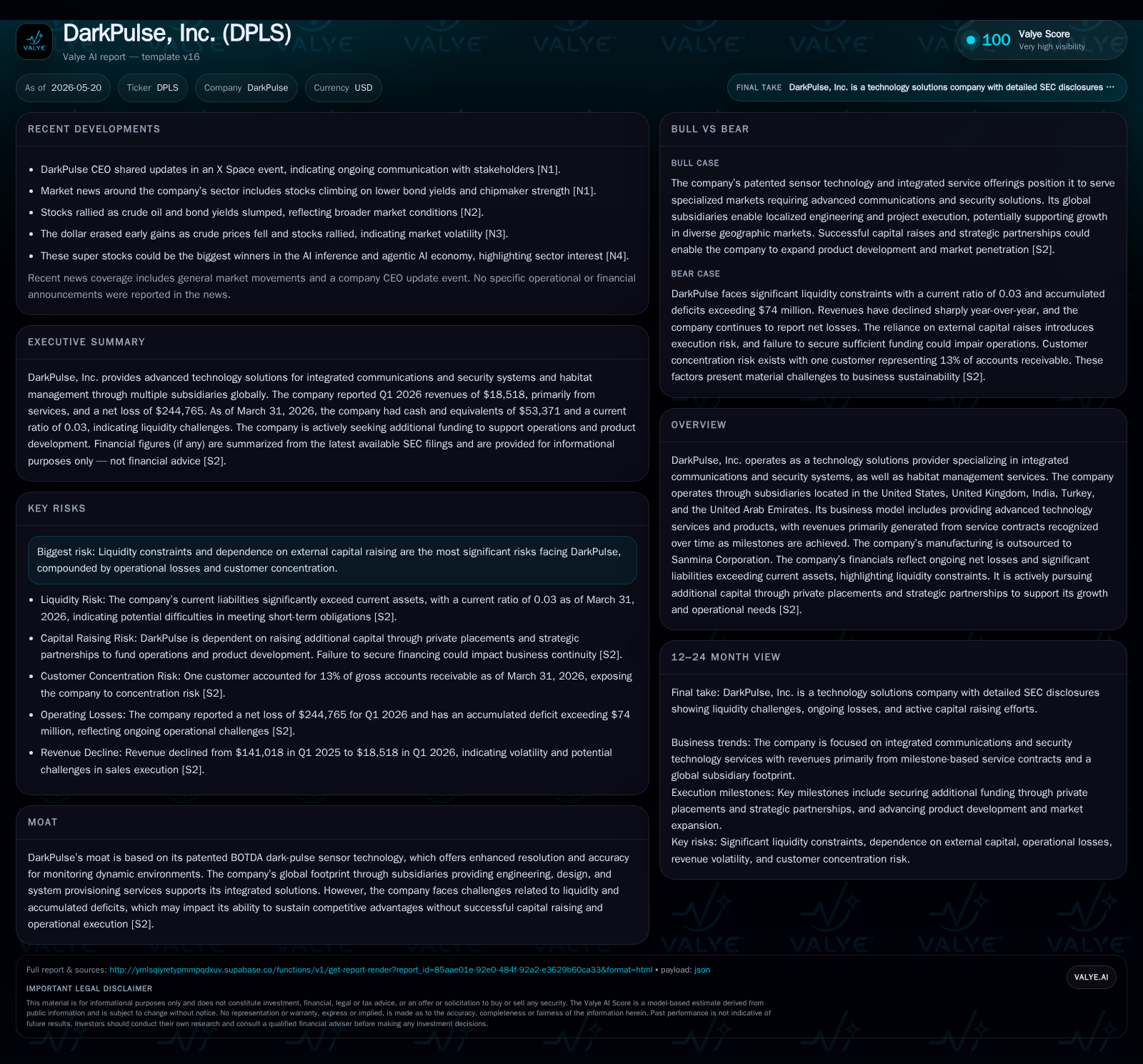
DarkPulse’s latest 10-Q reveals severe liquidity constraints with cash reserves dwindling to just over $53,000 against current liabilities exceeding $20 million, raising substantial doubt about its going concern status. The company operates through subsidiaries spanning the U.S., U.K., India, Turkey, and UAE, delivering integrated communications and security systems primarily powered by its patented BOTDA dark-pulse sensor technology, which enables superior dynamic environment monitoring. While it maintains a technological moat supported by exclusive licenses such as with the U.S. Navy, its growth is heavily dependent on successful capital raises amid ongoing operating losses. Monitoring progress in private placements and milestone-driven contract developments will be critical to assessing DarkPulse’s path forward.
As of March 31, 2026, the company held $53,371 in cash against current liabilities totaling approximately $20.2 million—a significant imbalance reflected in a current ratio of roughly 0.03 [S2], [F1]. This financial snapshot underscores the need for additional capital to support ongoing operations.
The net loss during Q1 2026 was $245,958, consistent with prior year levels but nonetheless reflecting sustained operating expenses outweighing revenues [S2]. Moreover, operating cash flow was negative at $(340,593), signaling ongoing cash burn that further pressures liquidity [S2].
Management disclosed active efforts targeting private placements and strategic partnerships aimed at closing funding gaps to sustain operations over the next twelve months [S2],[S4]. This urgency for capital raise prioritizes short-term survival alongside longer-term growth propositions.
Business Model and Product Quality: The BOTDA Dark-Pulse Advantage
DarkPulse generates revenue primarily through service contracts tied to its patented Brillouin Optical Time Domain Analysis (BOTDA) dark-pulse sensor technology. This technology enables precision monitoring of dynamic environments by measuring changes along fiber-optic cables with greater resolution and accuracy than conventional quasi-static distributed fiber optic sensing solutions which suffer from poor precision and slow data acquisition times [S1], [S7].
Milestone-based revenue recognition is standard; payments correlate with defined project stages or performance thresholds achieved over contract terms. This model reflects a complex integration process involving engineering design, provisioning, deployment support and ongoing service maintenance typically extending across multiple months or years in infrastructure security domains [S1], [S2].
The business outsources manufacturing operations entirely to Sanmina Corporation—an established contract manufacturer—enabling DarkPulse to maintain an asset-light profile focused on R&D innovation and systems integration rather than capital-intensive production facilities [S7]. However, this also limits flexibility in scaling production or rapidly responding to supply chain fluctuations.
Subsidiaries located in the United Kingdom (DarkPulse UK Ltd), India (Optilan India Pvt Ltd), Turkey (Optilan Communications & Security Systems Ltd), and United Arab Emirates (DarkPulse Technologies – FZCO) bolster global delivery capabilities by providing regional engineering expertise, system provisioning services, and facilitating contract bidding efforts across key international markets [S7]. These subsidiaries form a geographically diversified operational footprint aligning with clients’ regional needs yet add complexity to consolidated management.
Industry Structure and Competitive Positioning
Within the broader technology solutions arena—spanning integrated communications systems and security monitoring—DarkPulse occupies an innovation-driven niche centered on advanced fiber optic sensing hardware combined with software analytics capabilities. This hybrid offering targets applications where real-time environmental monitoring enhances safety or operational reliability such as border security installations or pipeline integrity assurance.
Its moat derives chiefly from proprietary BOTDA dark-pulse patents holding an edge in dynamic environment sensing over legacy long-term structural health monitoring techniques that lack sufficient resolution or speed for certain critical infrastructure scenarios [S1], [S7]. The recent material definitive license agreement executed exclusively with the United States Navy Naval Air Warfare Center Weapons Division (NAWCWD) further validates technological relevance while imposing commercialization constraints including domestic manufacturing commitments under U.S. trade regulations [S3].
However, DarkPulse remains a relatively small player in comparison to larger integrated systems providers equipped with deeper pockets and broader distribution networks. Liquidity vulnerabilities curtail pricing leverage despite possessing differentiated intellectual property. Customer concentration is notable—with one client representing about 13% of gross accounts receivable—which introduces demand risk concentrated exposure typical for smaller tech integrators reliant on milestone contracts from select government or commercial customers [F1], [S9].
Regulatory compliance burdens related to defense contracting and export controls especially around sensitive technologies introduce execution risk layers beyond normal market competition dynamics.
Growth Drivers: Capitalizing on Technology and Global Footprint
Key growth vectors for DarkPulse hinge upon commercializing BOTDA technology through expanded contracts within homeland security sectors and industrial infrastructure monitoring globally. The exclusive licensing deal with the US Navy potentially unlocks long-term recurring royalty streams tied to minimum annual payments starting modestly at $10k escalating to $20k after three years—with upfront nonrefundable fees establishing initial cash inflows—and mandates practical implementation milestones creating revenue timing checkpoints unique among peers [S3]
International subsidiaries provide avenues for geographically diversified order intake enabling tender responses in Europe (Turkey/UK), India subcontinent, Middle East (UAE), thereby mitigating some geopolitical concentration but also requiring tailored regional strategies reflective of infrastructure modernization priorities locally.
Current liabilities outstripping current assets by nearly $19.7 million render solvency highly conditional on imminent capital injections or alternative financing arrangements. Future funding pathways retain uncertainty given market appetite for microcap tech firms facing net losses exceeding $74 million since inception including similar sizable Q1 operating deficits evident again in 2026 first quarter results [S2], [F1].
Customer concentration risk compounds vulnerability as reliance on milestone-based contracts inherently introduces episodic revenue timing volatility alongside credit risk considerations addressed under recently adopted CECL accounting standards effective from January 2023 however without relief given customer concentrate size constituting ~13% accounts receivable—commonplace but notable corporate risk dimension nonetheless[S2],[F1],[S9].
Continued dependence on third-party OEM manufacturing limits agility while regulatory complexities stemming from defense licensing agreements could delay commercialization initiatives if compliance hurdles intensify amid geopolitical tensions or export control shifts.
Management consensus acknowledges these existential threats openly citing ‘going concern’ uncertainty; failure to secure appropriate funding would precipitate curtailed R&D investment perhaps impairing technological edge necessary for competitive relevance even if capital availability improved subsequently.
What to Watch Next: Financing Milestones and Commercial Traction
Immediate near-term focus should be placed on outcomes surrounding ongoing private placement efforts as management actively pursues strategic partners willing to mobilize capital supporting product development acceleration alongside commercialization drive highlighted by recently formalized licensing arrangement with NAWCWD US Navy facility signaling important reference customer validation point promising incremental royalty income streams conditioned upon practical milestone achievements including domestic manufacture clauses effective within four years post agreement date[S3],[S2],[S4].
Tracking revenue recognition progression linked directly to contractually obligated benchmarks offers insight into actual uptake beyond theoretical pipeline activity given historical quarters have shown modest topline results (~$18k service revenue in Q1 2026 vs higher prior periods demonstrating decline) emphasizing still nascent commercial scale establishment phase[S2],[S21]. Monitoring expanding customer base outside concentrated top client signals growing diversification essential both operationally and financially.
Finally assessing working capital trends via quarterly updates along with any disclosures regarding debt refinancing attempts or convertible note conversions signals financial flexibility adjustments capable of alleviating some existing balance sheet strain enabling sustained innovation investments going forward.
Financial Overview: Current Balance Sheet Stress and Capital Needs
As per the March 31st 2026 balance sheet corroborated via filing facts,[F1] DarkPulse holds cash equivalents totaling $53,371 juxtaposed against total current assets aggregating roughly $524k which are dwarfed by total current liabilities approximating $20.2 million dominated by accounts payable ($18.75M) reflecting accrued expenses underpinning significant short-term payables obligations.[F1]
Total debt stands near half a million dollars ($545k) including convertible notes/current loans yielding net debt marginally below that level (~$492k) after adjusting for cash reserves.[F1] Operating losses persist encumbering shareholder equity evidenced by accumulated deficit surpassing $74 million illustrating multi-year unprofitability traceback whereas net losses continued during Q1 2026 at approximately $(246k)[S2],[F1].
Liquidity snapshot encapsulates significant distress requiring urgent capital infusions; absence thereof threatens disruption of continuing operations given mismatch between liquid resources relative to imminent payables stressing refinancing capability imperative [S2]
This analysis synthesizes comprehensive SEC reports contextualizing DarkPulse’s innovative yet precariously funded position within advanced fiber-optic sensing solutions for security infrastructure markets. Investors should carefully monitor upcoming financing developments alongside patent license commercialization progress as critical indicators shaping viability beyond immediate fiscal stress.
Disclaimer: This document is an analytical report crafted solely for informational purposes based on publicly available filings as of the stated dates without offering investment advice or research views.
Disclaimer: This is research-only, informational analysis and not investment advice. It may include AI-generated interpretation and general industry context. Always verify important details using primary sources.

Comments