
DSwiss Inc Elevates Private Label Manufacturing Through Strategic Expansion and Innovation
The latest quarterly update reveals operational execution against a backdrop of liquidity challenges, underscoring DSwiss’s focused growth in turnkey private label health and beauty manufacturing.
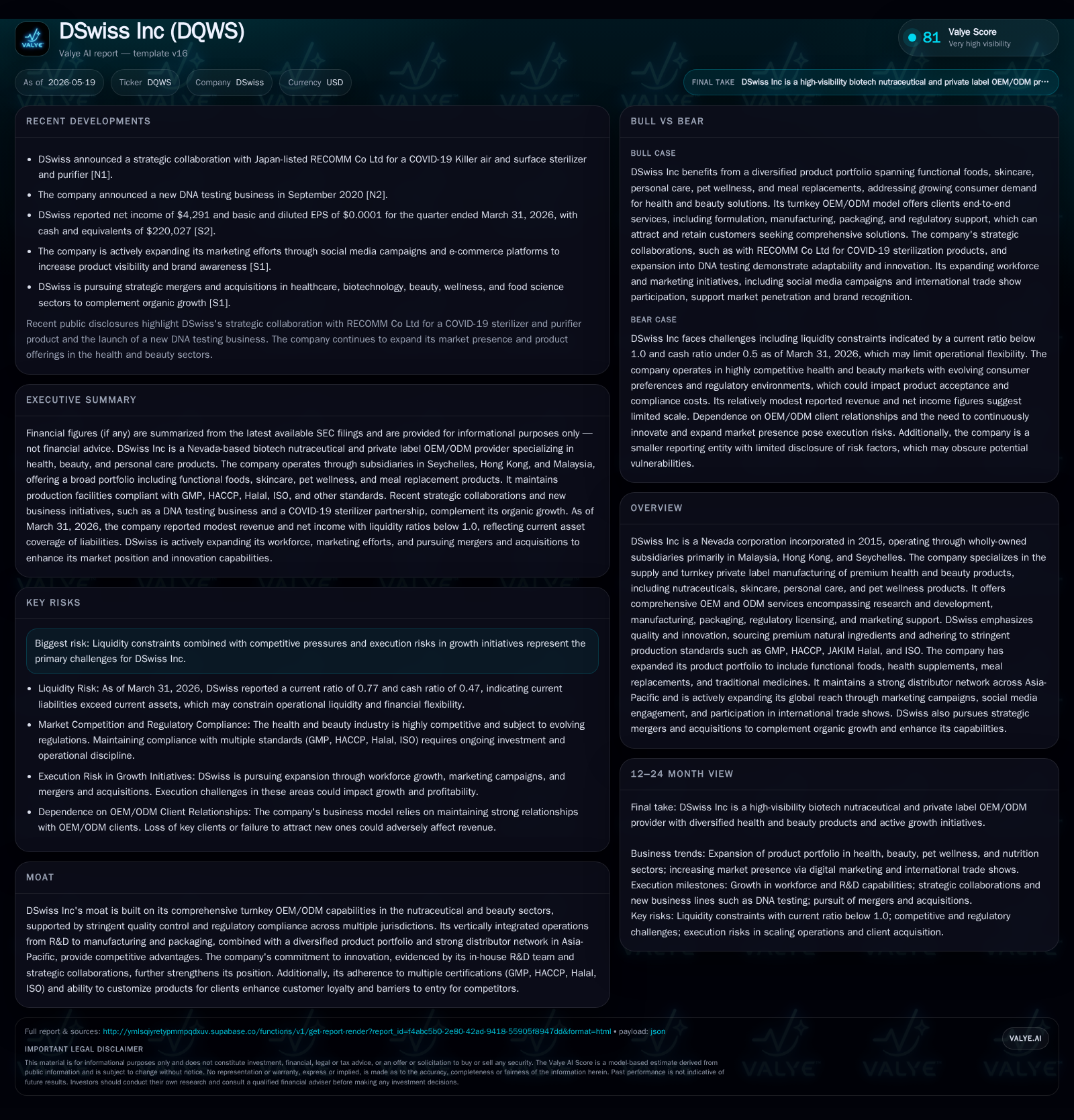
DSwiss Inc’s 2026 first-quarter filing highlights ongoing operational development amidst liquidity constraints, with a current ratio of 0.77 signaling tight near-term working capital management. The company’s core strength remains its comprehensive OEM/ODM services for premium nutraceuticals, skincare, personal care, and pet wellness products, supported by rigorous quality controls and expansive regulatory compliance. Strategic initiatives emphasize innovation-driven R&D, digital marketing expansion, and selective mergers and acquisitions to enhance capabilities and extend geographic reach across Asia-Pacific and beyond. However, execution risk compounded by financial limitations and competitive pressures present key challenges to scaling growth sustainably.
Latest Quarterly Update: Operational Highlights and Near-Term Challenges
This financial tension underscores management’s balancing act: pushing growth initiatives such as market expansion and R&D innovation while ensuring operational discipline. Such duality is typical among smaller specialty manufacturers facing competitive pricing pressures within fragmented health and beauty markets [S18]. The absence of significant new material legal proceedings suggests operational focus remains largely uninterrupted despite these constraints [S3].
Business Model and Product Offering: Premier Turnkey OEM/ODM Solutions
At its core, DSwiss operates as a turnkey private label manufacturer specializing in nutraceuticals, skincare/personal care products, pet wellness supplements, and recently expanded meal replacement foods [S1]. Revenue is primarily generated through comprehensive ODM/OEM contracts where clients pay for customized formulations developed through DSwiss’s in-house research teams coupled with high-grade manufacturing capabilities.
The company’s value proposition lies in providing end-to-end solutions spanning research & development (R&D), formulation science, raw material sourcing of premium natural ingredients, production scaled to GMP/HACCP/JAKIM Halal/ISO standards, packaging design consulting with sustainability considerations, regulatory licensing support across multiple Asian jurisdictions (Malaysia MOH certification a core competency), and logistics/shipping services [S5],[S14].
This vertical integration facilitates strong switching costs—the seamless orchestration reduces client complexity compared to piecemeal outsourcing—and supports higher quality control over product outcomes. Moreover, DSwiss emphasizes scientific validation alongside natural ingredient sourcing to meet consumer trends valuing efficacy coupled with purity [S15].
Competitive Environment and Industry Dynamics
DSwiss operates within a highly dynamic OEM/ODM space marked by fast-evolving consumer preferences demanding continual product innovation—especially within skincare and functional nutraceuticals sectors. Established competitors range from large multinational contract manufacturers offering scale advantages to regional specialized producers leveraging local ingredient knowledge or specific regulatory certifications.
In this context, DSwiss leverages its certifications (notably JAKIM Halal for Malaysia) as critical enablers of market entry across Muslim-majority countries in Asia-Pacific—a demographic increasingly demanding halal-certified health products [S5]. The stringent adherence to internationally recognized standards such as GMP and HACCP helps maintain credibility amid heightened regulatory scrutiny common in health-related consumables.
Distribution heavily relies on an extensive network of brand partners and regional distributors across Asia-Pacific—including Malaysia, Singapore, Indonesia—and expanding into China and US markets signaling global ambitions [S8],[S10]. Given the intensifying competition particularly around cost competitiveness from lower-tier manufacturers in the region, retaining differentiation via advanced R&D capabilities and end-to-end consulting services is crucial for sustaining margins.
Growth Drivers: Innovation, Market Expansion, and Strategic M&A
DSwiss clearly prioritizes growth through several interlinked vectors. First is innovation-led product development driven by a growing internal biotechnology-focused R&D team tasked with pioneering novel formulations informed by cutting-edge science coupled with consumer insights [S6],[S9]. This bolsters differentiation potential critical for commanding pricing power beyond commoditized private label offerings.
Second is geographic market expansion supported by intensified digital marketing strategies deploying targeted social media campaigns aiming to double engagement rates by end-2026 with influencer partnerships forming a key pillar [S13]. Participation in strategic trade events such as Vitafoods Asia is part of their outreach plan designed to strengthen brand visibility while forging new B2B relationships [S13].
Third are strategic mergers and acquisitions intended to address supply chain inefficiencies or augment R&D capabilities that complement organic growth ambitions. Dealmaking targets firms struggling with procurement networks or outdated tech platforms—allowing DSwiss to accelerate operational optimization while embedding newer technologies or specialized talent swiftly [S6].
Finally workforce scaling is notable with plans to expand headcount by approximately 50% this year focusing on biotech scientists alongside hires in sales/marketing functions specializing in digital channels; partnerships with top Malaysian universities foster talent pipelines aligned with long-term innovation needs [S6]
Key Risks and Constraints: Liquidity, Competition, and Execution
Despite promising strategic initiatives, DSwiss faces notable risks anchored around financial sustainability. The reported current ratio below unity clearly signals liquidity pressures limiting flexibility [F1]. This raises caution about the company’s ability to fund aggressive growth without capital structure enhancements or improved cash flow conversion from current sales.
Competitive risk stems from deepening price competition amidst many well-funded OEM/ODM peers offering overlapping product ranges particularly in standard nutraceuticals or personal care categories where technical differentiation narrows quickly [S3],[S18]. Maintaining premium positioning necessitates consistent innovative output without compromising cost structures—no small feat given investment needed for advanced biotech research.
Execution risk also manifests due to the complexity of international market entry combined with nascent e-commerce integration efforts. Scaling digital sales channels demands robust technology investments plus specialized know-how; missteps here could delay revenue ramp-ups or inflate customer acquisition costs beyond projections [S18]
Upcoming Milestones and What to Watch Next
Key near-term indicators include monitoring quarterly progress on operational execution and market expansion initiatives. Signs of stabilization in working capital management would underpin confidence in execution capacity.
Tracking social media engagement metrics versus stated goals will provide insight into the effectiveness of the digital marketing acceleration strategy—success here is vital for building brand awareness needed to fuel channel diversification beyond traditional distributors.
Further international regulatory approvals especially for re-entry into complex markets like China or US would be important milestones signaling scaling capability. Similarly participation outcomes from planned global trade shows like Vitafoods Asia will offer tangible customer pipeline development evidence [S13].
Advancements from ongoing R&D projects leading toward commercial launches—including novel biotech-derived formulations—warrant scrutiny as these represent longer horizon drivers underpinning sustainable margin enhancement.
M&A developments should be scrutinized for signs of accretive transactions that meaningfully improve supply chain robustness or technical breadth—transparent disclosure around integration progress will also signal managerial bandwidth.
Financial Profile: Balance Sheet Snapshot and Profitability Context
As of March 31, 2026 quarter-end, DSwiss reported cash & equivalents of approximately $220K against current liabilities nearing $472K resulting in a current ratio of roughly 0.77 [F1], indicative of tight liquidity conditions constraining day-to-day operations. Revenues remain modest relative to industry peers at about $2.9 million annually per latest indications—all sourced from OEM/ODM sales across nutraceuticals and healthcare consumables segments [S4].
Capital structure details point toward a small reporting company profile lacking significant leverage but also limited cushion for absorbing external shocks or funding aggressive growth absent equity raises or debt financing adjustments [F1]. Continued focus on improving receivables collection cycles and inventory turnover could help alleviate pressure on working capital metrics.
Disclaimer: This analysis is prepared solely for informational purposes reflecting publicly available filings as of May 19, 2026. It does not constitute investment advice nor an endorsement of any securities mentioned herein.
Disclaimer: This is research-only, informational analysis and not investment advice. It may include AI-generated interpretation and general industry context. Always verify important details using primary sources.

Comments