
Darden Restaurants Balances Multi-Brand Scale Against Inflation and Margin Pressures
Latest quarterly results highlight steady revenue growth offset by rising costs in a competitive full-service dining landscape.
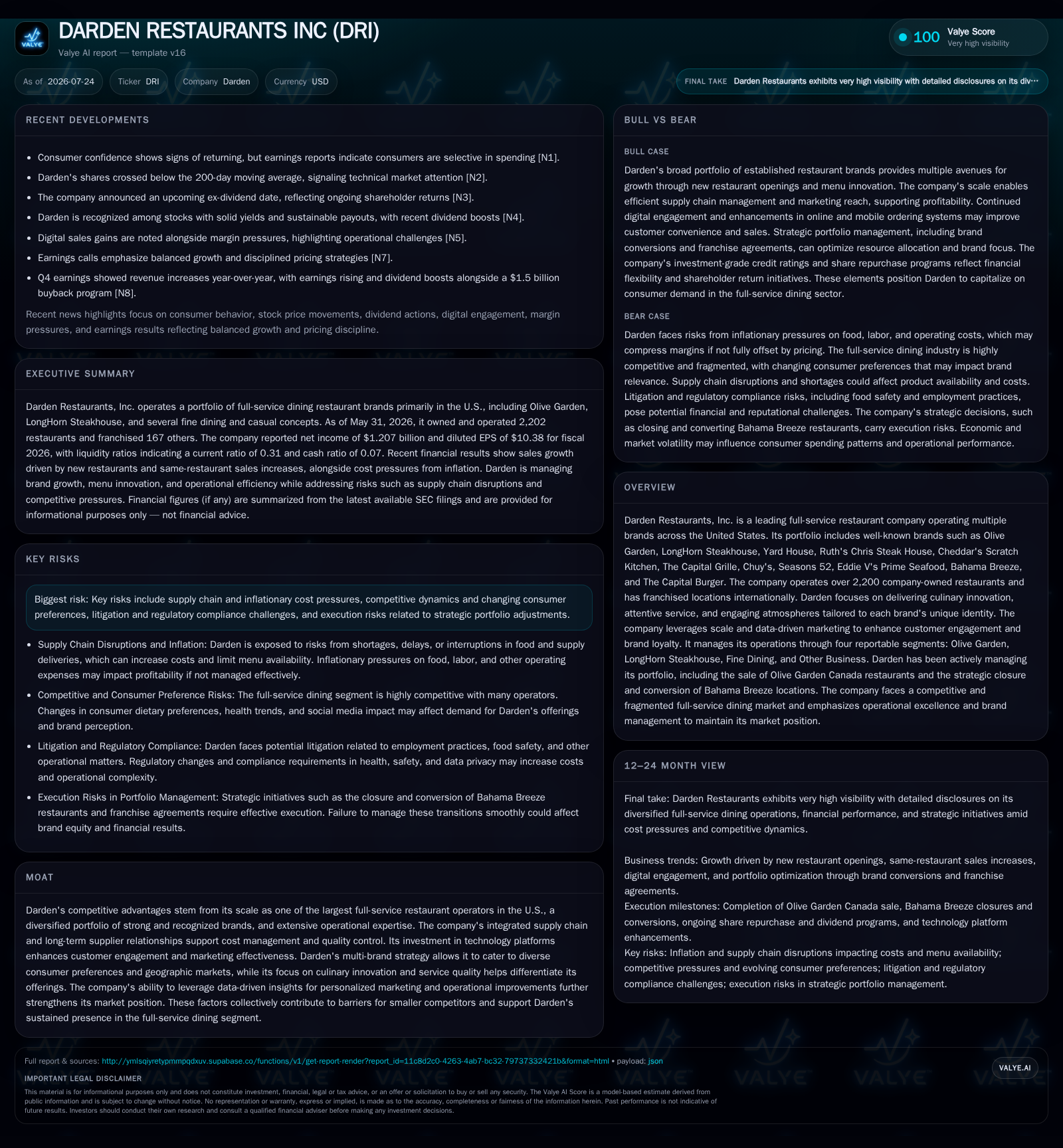
Darden Restaurants Inc. reported a 5.9% increase in quarterly sales driven by positive same-store sales and restaurant unit growth, reflecting ongoing consumer demand in its full-service segment. However, food and labor cost inflation pressured operating margins, resulting in a modest decline in operating income year-over-year. The company’s diversified portfolio of brands supports resilience through market cycles, but continued cost management and pricing discipline remain critical amid macroeconomic headwinds. Capital allocation priorities emphasize dividend increases and share repurchases while balancing elevated debt levels from recent acquisitions.
Recent Operating Update
The decline in operating profit reflects intensifying input costs: food and beverage expenses surged 7.7%, largely due to inflation in commodities such as beef, seafood, cheese, and produce; restaurant labor costs increased 5.2%, influenced by wage pressure across various jurisdictions where minimum wages exceed federal baselines [S2][S1]. These cost headwinds outpaced the pricing gains realized via menu adjustments, indicating constrained margin expansion potential in the near term. Marketing expenses were up over 11%, reflecting continued investment in customer engagement initiatives including digital ordering platforms and targeted loyalty programs—a move aimed at driving frequency and average check size amidst evolving consumer behavior patterns [N3][S2].
Business Model Analysis
Darden operates primarily as an owner-operator of full-service restaurants under a diversified brand umbrella covering casual dining (e.g., Olive Garden, LongHorn Steakhouse), fine dining (The Capital Grille, Ruth's Chris Steak House), and emerging concepts such as Cheddar's Scratch Kitchen and Chuy's—all totaling over 2,200 company-owned units domestically plus approximately 170 franchised restaurants internationally [S1]. Revenue is mainly derived from direct food and beverage sales within these establishments, supported by franchising fees from independent operators abroad.
The value proposition leverages culinary innovation tailored to distinct brand identities coupled with attentive service standards designed to enhance guest experiences—important differentiators in full-service segments where ambiance, food quality, and perceived value strongly influence repeat visitation rates. Darden deploys sophisticated supply chain management centralized through its restaurant support center in Orlando, enabling scale-derived cost efficiencies and quality control across ingredients sourcing [S1]. Additionally, its multi-brand setup offers diversification benefits that mitigate revenue cyclicality tied to any single concept or demographic segment.
Revenue mechanics hinge on driving positive same-store sales growth through menu engineering that balances price increases against consumer price sensitivity; managing guest traffic flow via marketing activations; and expanding restaurant footprint selectively where market conditions are favorable. Costs feature prominently around food input percentages—typically sensitive to commodity market volatility—and labor expenses driven by tight markets for service talent in the U.S., varying by state-level minimum wage laws [S1]. Pre-opening costs related to new unit launches add short-term expense volatility but support long-term unit base growth.
Darden stands among this upper tier due to its sizable unit base exceeding 2,200 restaurants under well-established brand names known nationally.[S1]
Competition ranges from other casual dining operators focusing on volume-driven promotions (e.g., Dine Brands with Applebee's/IHOP) to fine dining specialists targeting affluent consumers with premium experiences (e.g., Ruth's Chris competes directly here). Darden’s integrated supply chain is a material barrier for smaller competitors lacking equivalent economies of scale or sophisticated procurement operations—providing relative cost stability crucial amid inflationary pressures.
Digital transformation capabilities set Darden apart somewhat from traditional peers still developing online ordering or loyalty infrastructure. The company's investments have captured share of growing off-premise sales channels increasingly important post-pandemic but still reliant on strict operational execution within physical stores [N3]
Capital availability backed by investment-grade credit ratings facilitates disciplined growth via new unit openings at established brands as well as acquisitions (e.g., recent addition of Chuy’s).[S6] This structural flexibility affords optionality over peers hamstrung by weaker balance sheets or concentrated brand portfolios.
Growth Drivers
Key growth vectors for Darden include:
- New Unit Expansion: Incremental openings particularly at LongHorn Steakhouse and Olive Garden drive incremental revenue streams while expanding geographic footprints across underserved markets [S2].
- Same-Store Sales Growth: Menu innovation combined with data-driven personalized marketing aims to lift average checks and guest frequency within existing units.
- Digital Ordering & Loyalty Programs: Enhancements in digital platforms streamline ordering convenience driving higher basket sizes; loyalty initiatives foster customer retention critical for consistent revenue generation amidst shifting consumer preferences[N3].
- Portfolio Optimization: Strategic acquisitions (e.g., Chuy's) diversify offerings into Mexican-themed cuisine broadening demographic appeal beyond core steakhouse/pasta segments[S3].
- Operational Efficiencies: Leveraging supply chain scale reduces cost volatility impact while continued workforce training programs aim to improve service speed/quality critical for guest satisfaction[S1].
- Menu Adaptation: Responding to health-conscious trends through menu revisions supports sustained relevance among evolving consumer dietary preferences.
Risks and Constraints
Principal risks stem from persistent inflationary pressures affecting raw materials (beef prices notably volatile) and intensified competition limiting full pass-through of price increases without dampening guest traffic[S18]. Labor market tightness raises wage expense unpredictability compounded by regional minimum wage variability.
Economic downturns could suppress discretionary spending impacting full-service visits more than quick service formats due to higher per-check prices. Execution risk also arises from integrating acquisitions smoothly while preserving brand integrity amidst simultaneous remodels or new openings.
Regulatory environment uncertainties—such as health & safety mandates or employment laws—increase compliance cost burdens.[S18] Further litigation exposure related to employment practices or food safety incidents poses reputational risks affecting customer loyalty.
Balancing capital deployment between growth-oriented investments versus shareholder returns must be prudent given elevated net debt near $1.97 billion as of May 31, 2026; servicing this debt amid variable interest rates requires sustained cash flow generation capacity [F1]
What To Watch Next
Financial Profile Discussion
As of May 31, 2026, Darden reported cash and equivalents of approximately $219.5 million against total debt nearing $2.19 billion[F1], yielding a net debt position close to $1.97 billion indicative of meaningful leverage typical for large multi-unit operators investing aggressively through acquisition-fueled expansion. Despite this leverage level, the firm maintains investment-grade credit ratings (Moody’s Baa2 / S&P BBB) providing access to reasonably priced financing sources critical for sustaining remodeling projects, pre-opening expenditures (~$8.8 million quarterly), and working capital needs[S23].
Financial position in context
Companyfacts shows current assets of $942.9 million and current liabilities of $3.01 billion as of 2026-05-31, implying a current ratio near 0.31x [F1]. This reflects a liquidity profile typical for the industry but underscores the importance of ongoing cash flow generation to meet short-term obligations.
Disclaimer: This is research-only, informational analysis and not investment advice. It may include AI-generated interpretation and general industry context. Always verify important details using primary sources.

Comments