
Resources Connection Navigates Profitability Challenges with Cost-Cutting and Portfolio Simplification
Despite solid revenue, Resources Connection faces operating losses amid restructuring and divestitures as it refines its professional services model.
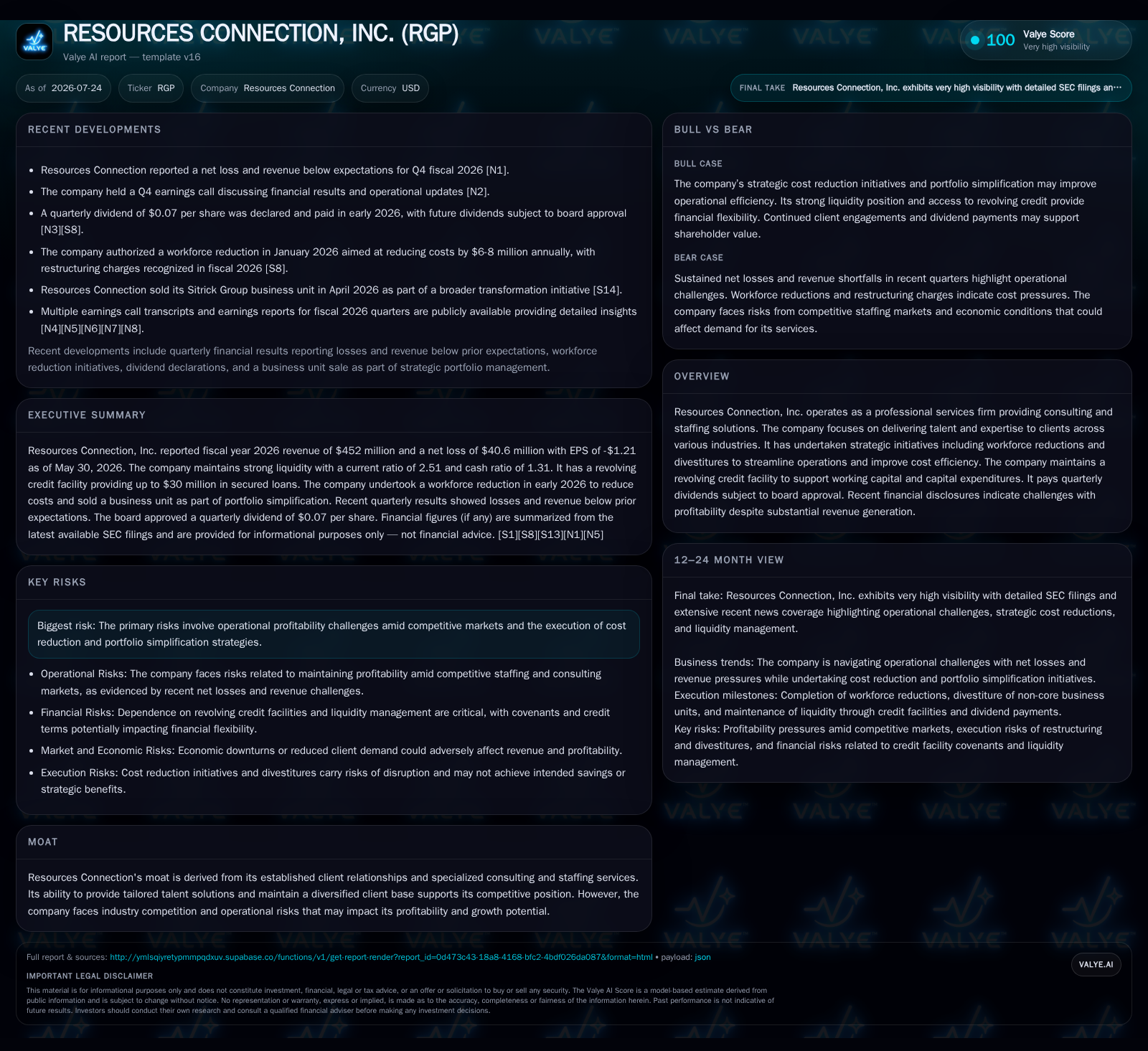
Resources Connection, Inc. reported continued pressure on profitability in fiscal 2026 despite generating $452 million in revenue. The firm is executing a strategic transformation involving workforce reductions and portfolio simplification through divestitures, notably selling its Sitrick Group unit. These efforts aim to streamline operations and reduce costs but have yet to stabilize operating margins. Its business model centers on consulting and staffing services, where utilization rates, billing rates, and client retention critically influence financial performance. The company maintains a revolving credit facility supporting liquidity, positioning it to fund transformation initiatives, while dividend distributions remain subject to board discretion. Monitoring utilization improvements, margin trends, and successful completion of portfolio moves will be key near-term indicators.
Recent Operating Update
Complementing restructuring measures is a strategic portfolio simplification initiative highlighted by the sale of the Sitrick Group membership interests. This divestiture aims to streamline Resources Connection's business focus by shedding non-core assets; proceeds are expected between $1.4 million and $2.3 million with transaction closure anticipated within 45 days from April 7, 2026 [S8]. Such portfolio pruning reduces operational complexity and potentially sharpens management attention on core consulting and staffing offerings.
At the same time, Resources Connection improved its liquidity position by entering into a new revolving credit agreement mid-2026 providing up to $30 million in secured revolving loans usable for working capital needs, capital expenditures, letters of credit obligations, and dividend financing [S11]. The facility’s borrowing base ties capacity to eligible receivables reflecting alignment with typical professional services cash-conversion characteristics where client billing efficiency strongly impacts liquidity.
Business Model Analysis
Resources Connection functions predominantly as a professional services firm providing consulting expertise alongside contract staffing solutions across various industry verticals [S1]. It monetizes through hourly or project-based fees charged to end clients for deploying skilled consultants on temporary assignments or managed engagements. Central operational levers include utilization rate—the percentage of total consultant hours billed to clients—which directly affects revenue per consultant and gross margin outcomes.
The firm’s business model requires carefully balancing headcount capacity against fluctuating demand while managing contractual terms with both clients and talent pools. Client retention remains crucial since longer-term engagements sustain steady revenue streams and improve billing rate visibility.
Cost structure elements include salaries for employed consultants versus subcontractors or freelancers impacting gross margins. The ability to command premium billing rates depends on specialized skills offered—often IT or management consulting-related—which grants pricing power but also invites competition from larger peers such as Robert Half International or Kforce Inc.
The recent workforce reductions targeting overhead expenses indicate resource reallocation toward more profitable segments or investment areas while the Sitrick sale aligns with refocusing on markets where differentiated consulting/contract staffing capabilities exist rather than peripheral businesses.
Industry Structure and Competitive Position
Professional services and staffing is a highly fragmented sector where firms range from global large-scale players like ManpowerGroup and Robert Half International to specialized boutiques focusing on niche talent segments. Competition hinges on service quality differentiation, speed of delivery (critical for contract staffing), price competitiveness, client relationship strength, and geographic coverage.
Resources Connection's moat derives from established client relationships cultivated over years combined with tailored consulting/staffing expertise enabling flexibility across multiple industries [N1], [S1]. Nonetheless, its profitability difficulties highlight structural challenges in achieving consistent utilization improvements amid competitive pricing pressures.
Compared to larger peers with extensive distribution channels and scale benefits that help optimize fixed cost absorption, Resources Connection must rely on operational execution such as streamlined workflows from portfolio simplification efforts.
Growth Drivers
Key tailwinds include growing demand for flexible workforce solutions driven by clients’ desires to modulate labor costs without permanent headcount increases. Continued expansion into high-demand skill areas like digital transformation IT consulting offers above-average billing rate potential. Regulatory complexity around labor compliance incentivizes outsourcing workforce management tasks — favoring professional service providers.
Furthermore, economic recovery trends support stronger hiring activity among corporate clients which fuels contract volume growth. Strategic client diversification reduces concentration risk ensuring steadier bookings.
Value-added offerings including managed services or consulting retainers could provide more predictable revenue profiles complementing traditional billable-hours models if pursued effectively.
Risks and Watchpoints
Profitability constraints loom large given the interplay between pricing sensitivity driven by competitive bidding dynamics and maintaining high utilization rates. Execution risks surround achieving targeted cost savings from workforce reductions without impairing service delivery.
Client concentration remains a watchpoint due to potential revenue volatility if key clients reduce spending or switch providers. Credit risk on receivables also requires monitoring to avoid liquidity stress amid extended payment terms.
Completion speed of the Sitrick Group divestiture affects expected streamlining benefits while any transitional liabilities expose short-term operational risk.
Macro-level economic downturns pose downside risks by curbing overall corporate spending on external consultants and staffing services.
What To Watch Next
Investors and industry watchers should track sequential quarterly changes in utilization rates as an early indicator of operational alignment improvement alongside average billing rate trends relative to industry benchmarks.
Progress updates on fully implementing headcount reductions beyond FY26 should clarify cost structure robustness. Announcements confirming final closing or any earnings impact from completed divestitures will shape perceptions about portfolio optimization effectiveness.
Financial Profile Discussion
Available total debt figures do not appear elevated relative to cash resources although specific updated debt metrics post-credit facility establishment were not detailed explicitly [S11]. The newly minted revolving credit line supplemented liquidity flexibility for working capital funding needs enabled through borrowing base formulas tied directly to accounts receivable quality, aligning well with typical cash flow mechanics in professional staffing operations.
However, persistent operating losses magnify free cash flow challenges highlighting the importance of improving core operational metrics such as utilization rates and billing realization for a sustainable financial trajectory going forward.
This analysis solely synthesizes publicly disclosed regulatory filings and reported data relevant through mid-2026 for Resources Connection Inc., illustrating the company's operating challenges amidst structural initiatives common in professional staffing sectors without imparting investment guidance or research views.
Financial position in context
As of 2026-05-30, companyfacts shows $82mm in cash and equivalents [F1]. Current assets of $170mm and current liabilities of $67mm imply a current ratio near 2.51x for 2026-05-30 [F1].
Disclaimer: This is research-only, informational analysis and not investment advice. It may include AI-generated interpretation and general industry context. Always verify important details using primary sources.

Comments