
Selective Insurance Group Sustains Strong Underwriting with Strategic Growth and Capital Discipline
Selective Insurance Group delivered robust Q2 2026 operating returns, supported by disciplined underwriting and strategic capital management amid evolving market dynamics.
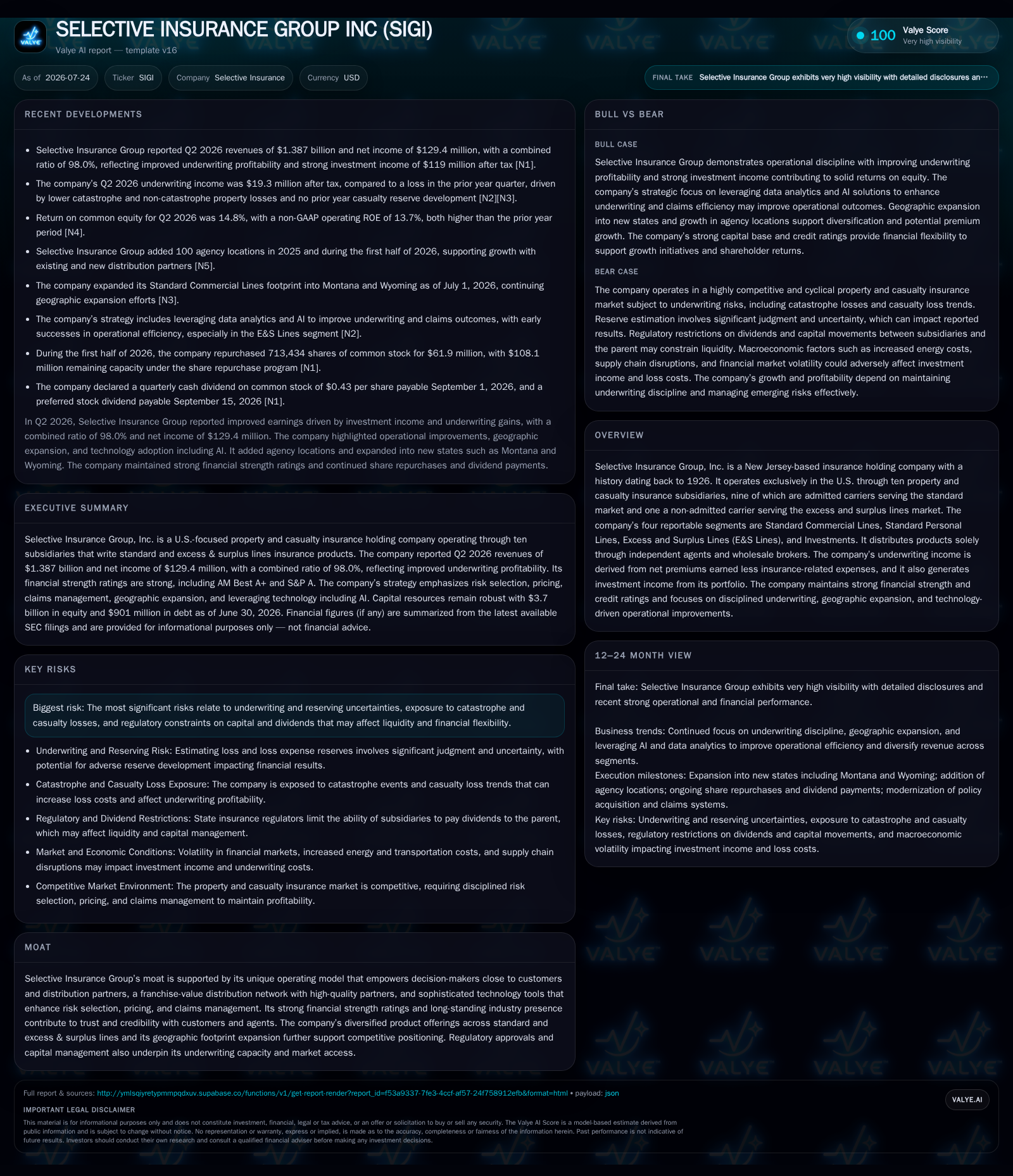
In the second quarter of 2026, Selective Insurance Group (SIGI) reported its eighth consecutive quarter of double-digit operating return on equity at 13.7%, bolstered by steady underwriting income and investment gains. The company’s unique operating model, empowered local decision-makers, and strong agency relationships underpin its competitive moat within the U.S. property and casualty insurance market. Key growth drivers include geographic expansion, product diversification across standard and excess & surplus lines, and technology enhancements leveraging AI to improve underwriting precision and claims management. While Selective maintains a solid capital base with a debt-to-capital ratio near 20% and ample liquidity, risks remain from catastrophe exposures, regulatory constraints on dividends, and evolving loss cost trends that bear close monitoring going forward.
Latest Operating Update
Selective Insurance Group (SIGI) reported solid operating results in the second quarter of 2026 with an operating return on equity of 13.7%, continuing a streak of eight consecutive quarters exceeding double-digit returns [S2]. This reflects consistent underwriting profitability combined with stable investment income. The company returned $58 million to shareholders through dividends and opportunistic share repurchases during the quarter [S2]. Notably, adjusted book value per share rose to $60.56 excluding unrealized gains/losses — an indicator of underlying earnings power even amid interest rate pressures impacting fixed income securities [S17].
The company’s reinsurance programs were renewed effectively in mid-2026, including a casualty excess of loss treaty retaining a smaller portion (8% coparticipation down from 20%) of the first loss layer but reflecting increased premium rates [S2]. This adjustment indicates prudent risk transfer aligned with firm underwriting appetite and capital preservation objectives.
Business Model Overview
Selective operates exclusively within the U.S., distributing property & casualty insurance products through an exclusive network of independent agencies and wholesale brokers [S1]. Its portfolio spans four reportable segments: Standard Commercial Lines, Standard Personal Lines, Excess & Surplus Lines (E&S), and Investments [S1][S2]. Nine subsidiaries are admitted carriers operating in regulated standard markets while one non-admitted carrier writes E&S business for higher-risk customers unable to obtain coverage in standard markets [S1].
Revenue stems primarily from net premiums earned—collected from policyholders via independent agents—with profitability hinging on disciplined underwriting that balances pricing adequacy against loss costs plus expense control [S1][S2]. The company’s underwriting income reflects premiums earned less incurred claims and related expenses. Investment income complements underwriting gains by generating yield on substantial invested float from premiums held before claim payouts [S1].
The firm’s hallmark is an empowered localized underwriting model placing decision-making authority near customers and distribution partners. This approach enables nuanced risk selection tailored to diverse regional exposures while reinforcing agency relationships that embody meaningful franchise value [S1]. Technology assets—including advanced analytics and emerging AI applications—support these front-line teams by improving risk pricing precision, claims processing speed, and overall operational efficiency [S19].
Industry Structure and Competitive Position
As a midsize U.S.-based property and casualty insurer ranked among AM Best's top 40 groups by net premiums written, Selective competes in a fragmented but intensely competitive environment focused on rigorous underwriting discipline, claims management effectiveness, capital adequacy, and trusted distribution relationships [S1]. Its diversified mix across commercial lines, personal lines, and excess & surplus lines provides resilience against segment-specific cycles.
The company’s strategy emphasizes comprehensive catastrophe risk management using sophisticated modeling techniques calibrated against recognized industry frameworks such as ISO's Property Claim Services data [S1]. Despite advances in catastrophe modeling, uncertainties persist due to escalating frequency/severity of weather-related events attributed to climate change—a foundational challenge for all P&C insurers requiring vigilant reserve adequacy assessments.
Peer insurers like W.R. Berkley (WRB), Cincinnati Financial (CINF), and The Hanover Insurance Group similarly leverage decentralized underwriting authority paired with robust independent agency distribution networks. Selective distinguishes itself by its focused technology integration strategy deploying AI-enhanced analytics earlier than many peers—a factor facilitating improved loss ratio control alongside prudent rate adjustments informed by granular risk insight.
Growth Drivers
Selective’s forward growth relies principally on geographic expansion, product diversification especially within the E&S segment during hard insurance cycles, digital innovation increasing operational leverage, and deepening agency relationships enhancing retention rates [S19]. Since 2017 the company has added fourteen states including recent additions Montana and Wyoming starting July 2026. Expansion states now represent approximately 9% of total direct premium volume, illustrating fruitful market penetration work that may accelerate going forward [S19].
Leveraging AI tools is an emergent driver: early deployments have delivered measurable gains in accuracy of risk assessment as well as faster claim decisions—two critical variables that impact expense ratios and customer satisfaction simultaneously. Modernizing core claims/policy administration systems—particularly notable within the E&S segment—lays groundwork for scalable growth without proportional headcount increases supporting margin leverage objectives [S19]
Risks and Watchpoints
Selective faces typical insurance-sector risks intensified by catastrophe volatility including hurricanes along the Eastern U.S., convective storms like hail/tornadoes, wildfires, winter storms, earthquakes, terrorism events—and variable inflation impacts on repair/replacement expenses complicating loss reserving judgments [S1]. Catastrophe models remain imperfect proxies given escalating climate change uncertainty; unforeseen events can materially disrupt projected outcomes.
The company's ability to maintain flexible dividend policies is subject to regulatory approval at both Insurance Subsidiary domiciles as well as Parent-level constraints linked to credit agreements covenants protecting lenders—potentially limiting capital returns during stress periods despite operating cash flows [S12][S5][S7]
Investments carry interest rate risk evident in increased unrealized losses on fixed income portfolios driven by Treasury yield moves during early 2026 periods—stress-testing asset quality amid shifting macroeconomic landscapes is ongoing but mitigated by portfolio diversity emphasizing high credit quality securities plus alternatives exposure backing long-tail liabilities [S18][S16]
Claims inflation fueled in part by labor/material shortages post-catastrophe creates upward pressure on loss costs beyond initial estimates impacting reserving adequacy over time; surveillance on casualty reserve development remains critical given prior-year reserve releases no longer providing tailwind comparatives [S20]. Additionally, competition-induced price pressure mandates continuous refinement of underwriting models balancing growth ambitions against profitability thresholds.
What to Watch Next
Key metrics to monitor include combined ratio trends particularly the breakdown between loss ratio including catastrophe impacts versus expense ratio efficiency improvements [S20]; policy retention levels indicative of agency/channel health amidst modest pricing moderation; net premiums earned growth reflecting new business capture against renewals attrition; reserve development signals informing actuarial judgment accuracy; investment yield performance amidst volatile markets; regulatory developments affecting dividend capacity or solvency requirements; share repurchase activity signaling confidence levels; as well as technological adoption pace limiting operational costs while raising risk selection quality.
Upcoming quarterly disclosures should reveal progress integrating AI tools more broadly beyond pilot phases alongside proof points concerning geography-wise premium scaling particularly from newest expansion states Montana/Wyoming which will test replicability of historical expansion success stories.
Financial Profile Discussion
As of June 30, 2026, Selective maintained GAAP stockholders' equity plus statutory surplus around $3.7 billion alongside contractual obligations to invest up to approximately $918.5 million in various securities, which the company expects to fund through normal operating and investing activities as they come due [S2]
Debt maturities are manageable with principal repayments forecasted including a key $60 million note due December 2026 while revolving credit facilities remain unused apart from nominal validation borrowings indicating disciplined liquidity usage [S2]. The company maintains an established target for the Parent to hold liquid investments of at least twice its expected annual net cash outflow needs, supporting capital deployment flexibility and financial strength [S2]. Compliance with credit covenants related to minimum consolidated net worth ratios continues unabated ensuring access to favorable funding channels if needed alongside regulator-approved intercompany loan agreements allowing efficient capital deployment optimizing group-wide financial flexibility while safeguarding subsidiary solvency status obligations critical under state insurance regulations [S7][S11].
This analysis synthesizes latest reported quarterly data alongside annual disclosures contextualizing Selective Insurance Group’s sustainable operating model within broader property & casualty insurance industry dynamics driven by underwriting rigor coupled with strategic technology adoption supporting growth initiatives amid notable risks from catastrophic event uncertainty and regulatory capital constraints. It aims solely to inform understanding of SIGI’s operational positioning without offering investment advice or research views.
Disclaimer: This is research-only, informational analysis and not investment advice. It may include AI-generated interpretation and general industry context. Always verify important details using primary sources.

Comments