
Charter Communications’ Network Expansion Strengthens Bundled Service Franchise
Charter’s Q2 2026 update spotlights strategic network investments and bundled product execution amid capital intensity and competitive pressures.
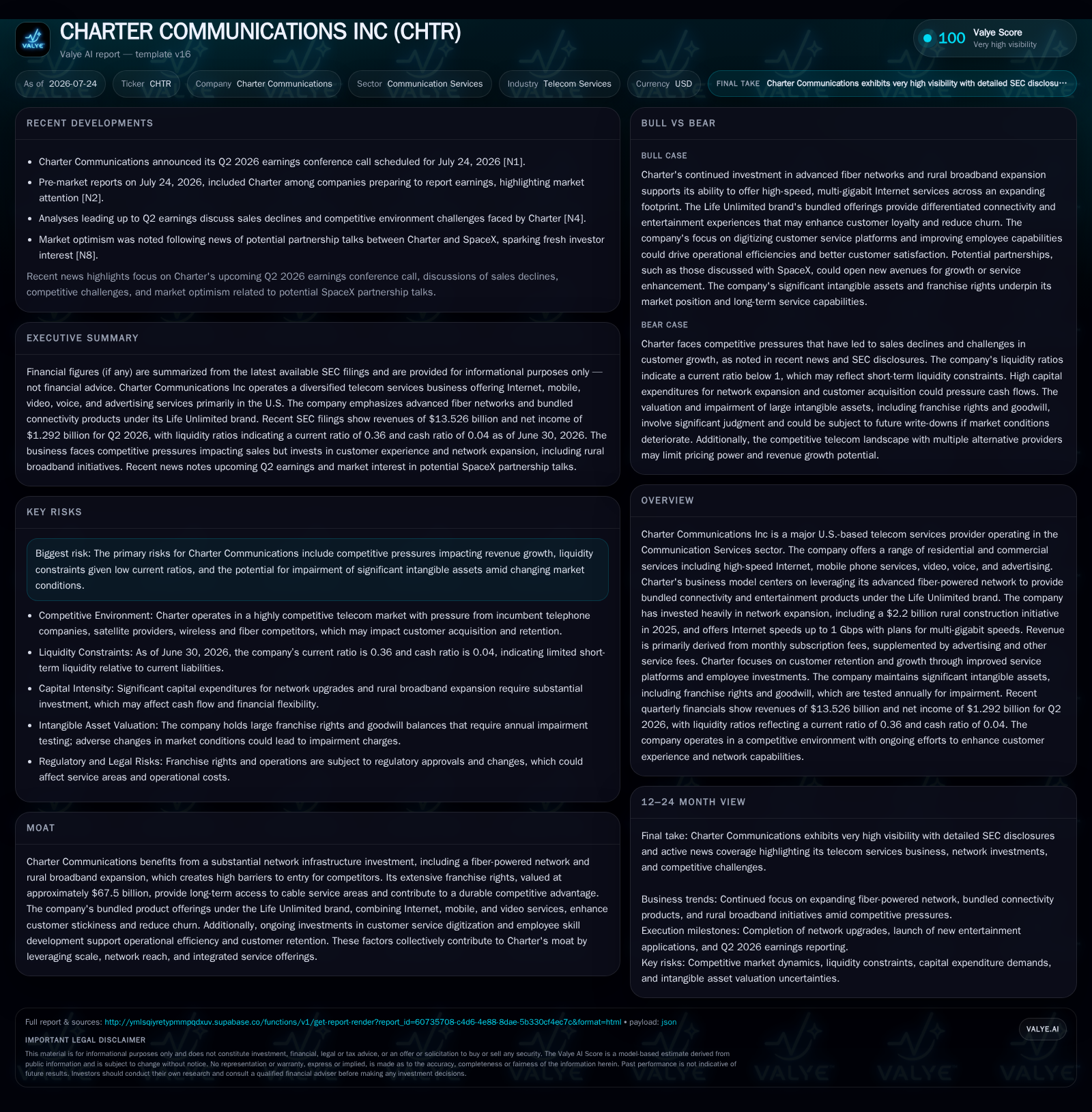
In its latest quarterly filing, Charter Communications highlights ongoing progress in expanding its fiber-powered network, particularly through a $2.2 billion rural broadband initiative, supporting coverage of nearly 59 million homes. The company’s bundled Life Unlimited service platform integrates Internet, mobile, video, and voice offerings to enhance customer retention and average revenue per user (ARPU), although competitive pressures continue to challenge revenue growth. Charter balances growth investments with cost controls in programming and field operations but operates with a tightly stretched liquidity profile given a sub-0.4 current ratio and $93.9 billion in net debt. Near-term milestones include monitoring subscriber trends across segments and advancing multi-gigabit internet rollouts to sustain engagement.
Q2 Operating Update: Network Investments Meet Bundling Execution Challenges
While video and Internet subscriber losses moderated compared to previous periods, growth in mobile subscribers partially offsets these declines per the latest annual overview [S1]. This mix dynamic exerts pressure on traditional content programming spend but helps stabilize overall adjusted EBITDA, which grew slightly last year driven by expanding mobile revenue outpacing associated direct costs [S1]. The incremental expense structure tied to mobile lines reflects typical telecom industry dynamics where wireless service additions contribute incremental margin despite upfront cost absorption.
Life Unlimited Platform: Bundled Services as a Customer Retention Lever
Central to Charter’s strategy is the Life Unlimited platform, offering bundled Spectrum Internet, Mobile, TV, and Voice services under simplified pricing designed to increase ARPU and reduce churn [S1]. Bundling creates a network effect enhancing customer stickiness by integrating connectivity products that span fixed broadband and mobile access—commonly referred to as fixed-mobile convergence in telecom sectors—while also embedding streaming applications at no extra cost within certain TV packages.
The introduction of the Spectrum App Store provides customers with a digital storefront experience facilitating streaming app management—a value-added service that differentiates Charter from more commoditized ISP offerings [S1]. This digital engagement enhances customer satisfaction by simplifying service upgrades or additions without frictional switching barriers common in traditional cable ecosystems.
Operationally, bundling reduces promotional spending pressure as customers face fewer incentives to churn due to limited effective substitutes combining seamless Internet and mobile access with entertainment bundles [S1]. Employee investments targeting wage increases and skill development further underpin service quality improvements instrumental in retaining subscribers amid competitive markets.
Rural Broadband Expansion: Strategic Footprint Growth Driving Long-Term Value
The company’s $2.2 billion subsidized rural construction initiative activated roughly 483,000 new passings during 2025, broadening coverage into historically underserved markets [S1]. This expansion not only meets regulatory mandates promoting broadband access but strategically erects high barriers for competitors due to the capital intensity of fiber deployments coupled with franchise rights protections.
Offering up to 1 Gbps speeds across all markets—with selective deployment of multi-gigabit symmetrical services—positions Charter competitively against wireless alternatives often constrained by spectrum limits or inconsistent throughput [S1]. The ongoing network evolution anticipates full rollout of multi-gigabit speeds aligned with customer demand for bandwidth-intensive applications like streaming and online gaming.
Rural market penetration also diversifies revenue streams beyond saturated urban corridors while enhancing brand equity as a connectivity enabler across economic strata.
Competitor Context: Charter Among Cable and Telecom Peers in Bundling Dynamics
Within the U.S. telecom services landscape, Charter’s fiber-rich infrastructure rivals Comcast’s integrated cable and broadband model by emphasizing bundled services that combine entertainment with connectivity to drive ARPU gains. Compared with AT&T and Verizon—leaders in wireless fixed-mobile convergence—Charter remains primarily cable-anchored but increasingly leverages its mobile segment expansions to emulate converged offerings.
Regional players like Cox Communications operate on a smaller scale with more limited network reach; Charter’s investment scale provides it considerable leverage negotiating programming contracts and deploying next-generation networks. However, competition from OTT streaming providers weakens pay-TV bundles industry-wide, demanding innovation like the Spectrum App Store for sustained differentiation.
Growth Catalysts: Customer Service Digitization and Multi-Gigabit Internet Rollout
Digital transformation initiatives aimed at customer service platforms digitization reduce transaction costs and improve responsiveness—a critical factor lowering churn when combined with service reliability enhancements stemming from employee skill investments [S1][S2]. These operational efficiencies are essential given the thin margin environment shaped by content costs and promotional competition.
Moreover, the gradual deployment of symmetrical multi-gigabit Internet speeds satisfies growing consumer demand for high-throughput connectivity supporting multiple devices and applications simultaneously. While rollout progress is measured at this stage, widespread adoption could boost ARPU through tiered pricing models tied to enhanced bandwidth tiers [S1]
Supporting these technical advancements is an evolving software ecosystem enabling seamless device connectivity management via digital storefronts—a frontier space where customer retention increasingly hinges on user experience beyond raw speed metrics.
Risks on the Horizon: Pricing Pressure Amid High Leverage and Content Costs
Competitive pressures continue eroding subscriber acquisition rates outside mobile lines; stagnant or declining revenues within legacy Internet or video products temper overall top-line growth despite incremental mobile subscription gains [S1][S2]. Content programming cost inflation further compresses margins even as total programming spend receded modestly in Q2 compared to last year [S2].
Importantly, liquidity constraints surface prominently due to Charter’s low current ratio of approximately 0.36 as of June 30, 2026—reflecting working capital tightness stemming from high current liabilities relative to assets—and massive net debt load near $93.45 billion after accounting for cash reserves [F1][S2]. This capital structure characteristic is common among capital-intensive telecom operators but elevates refinancing risk if credit markets tighten or interest rates rise unexpectedly.
Additionally, intangible asset impairment risk looms over significant franchise rights valued around $67.5 billion underpinning exclusive market access—a vulnerability if technological shifts or aggressive competitor entry disrupt established territories.
What Investors Should Watch Next: Subscriber Trends and CapEx Milestones Through Q3
Forward-looking focus centers on post-Q2 subscriber trends particularly monitoring whether mobile net additions continue offsetting losses in traditional Internet or video segments [S3][N1]. Seasonal effects often influence quarterly results; thus sustained momentum would validate bundle strategy efficacy amid macroeconomic uncertainties.
CapEx pacing toward multi-gigabit footprint expansion—especially scaling beyond currently served locales—will serve as a tangible milestone demonstrating commitment to future-proofing infrastructure amid industry evolution [S1][S2]. Likewise, pricing strategy adjustments enacted alongside bundle packaging may reveal impacts on ARPU trajectory or churn moderation.
Refinancing activity should be observed closely given substantial debt maturing over the medium term compounded by relatively low liquidity buffers documented at quarter-end [F1][S2]. Market conditions influencing borrowing costs or covenant flexibility remain important variables affecting Charter’s financial maneuverability.
Financial Profile Discussion: Sustaining Capital Base Amidst Investment Demands
At June 30, 2026, Charter held approximately $509 million in cash against total debt carrying value near $93.96 billion—the dominant component comprising senior secured notes ($54.9 billion) and senior unsecured notes ($26.7 billion)—highlighting sizable leverage balanced partly by intangible asset-backed collateral [F1][S2]
Capital expenditures remain elevated aligned with prior years’ run rates supporting rural broadband expansion initiatives along with fiber-to-premises upgrades necessary for multi-gigabit capability rollout [S1][S2]. Adjusted EBITDA near $22.7 billion for full-year 2025 exhibits closeness to operating income levels suggesting effective overhead containment though pressured by content-related expenditure inflation [S1].
Disclaimer: This is research-only, informational analysis and not investment advice. It may include AI-generated interpretation and general industry context. Always verify important details using primary sources.

Comments