
Philip Morris International's Strategic Shift Boosts Smoke-Free Growth Amid Global Challenges
PM’s H1 2026 results underline ongoing transition to smoke-free products, leveraging brand strength and regulatory approvals while navigating geopolitical and regulatory risks.
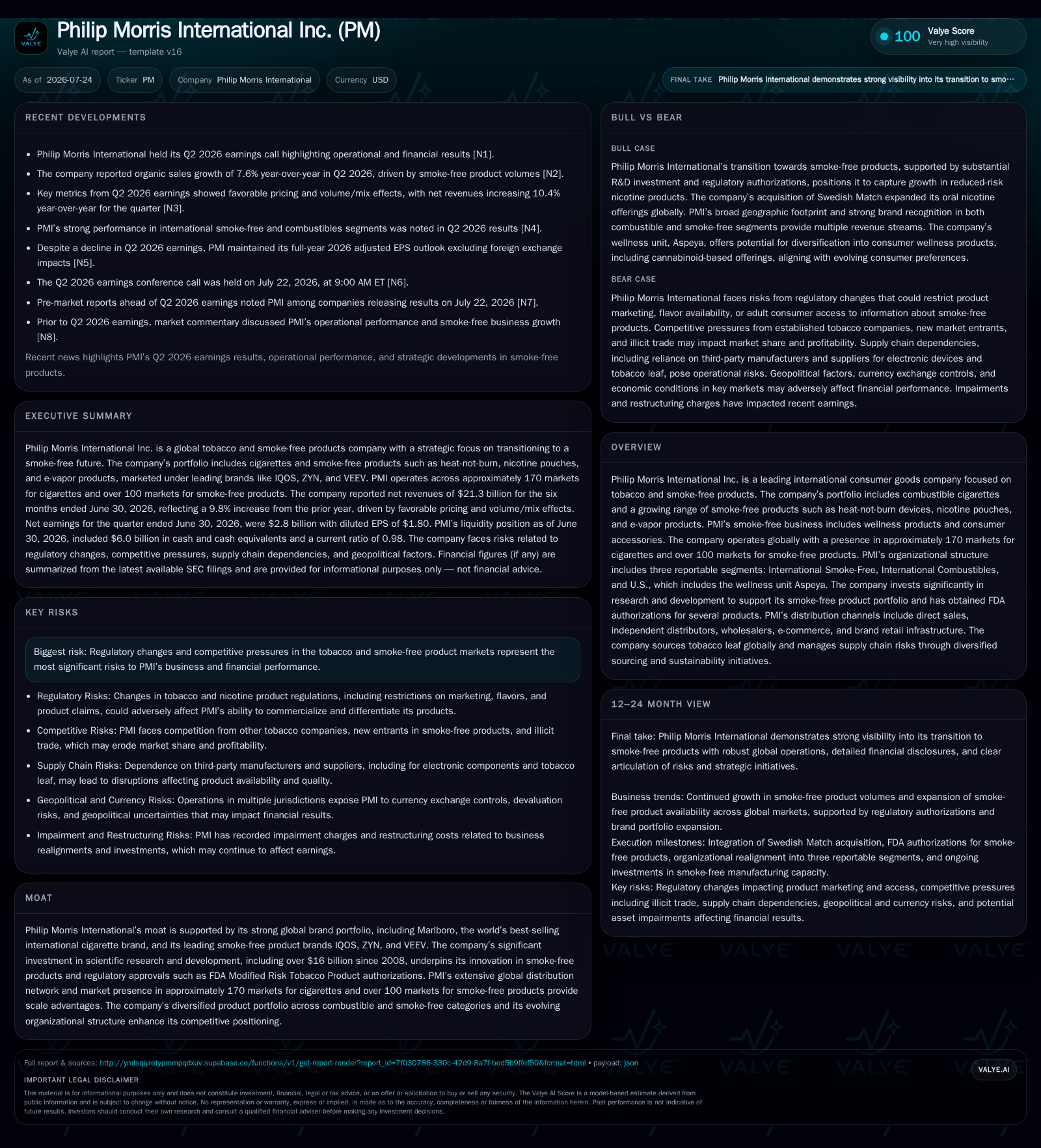
Philip Morris International (PM) reported a 9.8% net revenue increase in the first half of 2026, driven by favorable pricing and expanding smoke-free product volumes despite lower combustible cigarette volumes in key regions. The company restructured its reporting segments to better reflect the growing smoke-free business, now spanning over 100 markets with brands like IQOS, ZYN, and VEEV at the forefront. PM’s global footprint and FDA authorizations for reduced-risk products underpin its competitive moat but expose it to geopolitical instability, currency fluctuations, and regulatory scrutiny. Cash flow generation remains robust amid inflationary pressures and supply chain complexities, supporting long-term R&D investment in innovations and wellness initiatives.
Recent Operating Update
Philip Morris International's latest quarterly filing for Q2 2026 highlights key strategic shifts underpinning its performance and market positioning. The company reorganized its reporting structure effective January 1, 2026, consolidating prior geography-based segments into three units: International Smoke-Free; International Combustibles; and U.S., which also includes wellness operations via Aspeya [S2]. This reorganization reflects PMI’s clear directional pivot towards smoke-free products (SFPs), signaling growing importance of these categories within overall operations.
In the first half of 2026, PMI reported net revenues of approximately $21.3 billion—a 9.8% year-over-year rise—driven primarily by favorable pricing strategies within international combustibles alongside volume improvements in the smoke-free segment internationally [S2][S16]. However, these revenues were partially offset by declining volumes in international combustibles and combustible products in the U.S., illustrating the transitional state of their product portfolio mix. Smoke-free products under notable brands IQOS (heat-not-burn devices), ZYN (nicotine pouches), and VEEV (e-vapor) are now commercialized in over 100 markets globally as of mid-2026—a strong indicator of successful geographic penetration beyond traditional combustible domains [S2].
Operating income expanded substantially—over 20% on a year-over-year basis in Q2—propelled by price realization and cost discipline including reduced restructuring charges compared to prior periods; this despite mounting input costs from inflationary pressures across manufacturing factors such as energy, labor, and logistics.
Business Model Analysis
Philip Morris operates primarily by manufacturing and marketing tobacco products—split notably between combustible cigarettes sold internationally across approximately 170 markets and an expanding portfolio of smoke-free alternatives aimed at harm reduction [S1][S2]. Revenue streams stem from wholesale shipment volumes coupled with nuanced pricing tiers drawn from distinct brand segments: premium Marlboro variants alongside mid- and low-price local brands. Excise taxes substantially influence reported revenues as they are subtracted after gross sales; hence PMI emphasizes net revenue metrics inclusive of shipments net of excise duties.
The company has dedicated significant financial resources—over $16 billion since 2008—to research, development, scientific substantiation, and commercialization efforts focused on reduced-risk products including heat-not-burn (HNB) technology embodied in IQOS devices as well as nicotine pouches (ZYN) and vaping systems (VEEV) [S1]. This strategy serves dual purposes: capturing evolving consumer preferences moving away from smoking combustible cigarettes toward perceived safer alternatives while also securing regulatory approvals such as FDA Modified Risk Tobacco Product (MRTP) authorizations essential for marketing claims differentiation particularly within U.S. jurisdictions.
Beyond pure nicotine delivery, PMI established a wellness business arm under Aspeya targeting oral consumer wellness goods with initial focus on medical/non-recreational cannabinoids including CBD; however, revenue contributions here remain nascent currently with regulations posing entry barriers [S2]. Distribution channels encompass direct sales to distributors/retailers globally; PMI must navigate complex import/export controls (notably capital control regimes emerging from countries like Russia) that can affect subsidiary dividend flows back to headquarters impacting overall liquidity [S20].
Industry Structure & Competitive Position
The global tobacco industry confronts dual dynamics: persistent regulatory tightening paired with shifting consumer trends favoring harm reduction through smoke-free alternatives. PMI faces competition across both legacy combustible categories from companies like British American Tobacco (BAT) and Japan Tobacco International (JTI), while innovation frontiers overlap more directly with BAT's smoke-free portfolio as well as regional players specializing in oral nicotine like Swedish Match (now part of PMI).
PMI's moat is anchored in its premier international cigarette brand Marlboro plus leadership in progressive SFP brands IQOS (heat-not-burn), ZYN (nicotine pouches), and VEEV (vaping devices), supported by extensive R&D capabilities that produced FDA MRTP authorizations—a regulatory milestone few peer companies have attained [S1][S2]. Geographic breadth grants scale advantages both for distribution reach (cigarettes sold in ~170 countries; SFPs marketed in ~109 countries) and diversification against local market shocks or regulatory clampdowns. However, market share erosion risks persist amid competitive pricing pressures especially from lower-cost illicit trade channels or new entrants innovating oral nicotine.
Regulatory environment remains the most significant risk factor—ongoing legislative efforts worldwide enforce stricter climate on advertising restrictions, packaging mandates (plain packaging laws), increased excise taxation rates impacting retail pricing elasticity—and introduce administrative challenges like litigation exposure related to health impacts of tobacco/nicotine consumption [S8][S14][S18]. These dynamics create structural headwinds despite the growing acceptance of reduced-risk alternatives potentially easing some regulatory scrutiny.
Growth Drivers
Evolving consumer adoption patterns toward smoke-free nicotine consumption underlie PMI’s multi-front growth engine. First, incremental market penetration of IQOS devices expanding beyond early adopters signals rising smoker conversion potential supported by robust brand equity cues anchored on Marlboro heritage quality perceptions aligned with advanced technology usage [N1][N2]. Second, oral nicotine pouches like ZYN cater to users desiring convenient discreet nicotine intake without combustion health concerns or social stigma.
Furthermore, PMI benefits from categorically unique regulatory approvals enabling explicit modified risk claims that foster informed consumer switching incentives unavailable to competitors lacking similar clearances—this bolsters potential volume growth trajectories crucial for category transition success [S1][N1]. Geographic expansion into developing/emerging markets with large adult smoker populations presents a substantial addressable opportunity though offset by regulatory complexity.
Synergies realized post-Swedish Match acquisition expand product breadth into established oral nicotine verticals complementing smokeless portfolios albeit entailing integration execution risk but also broadening consumer engagement possibilities in wellness domains via cannabinoid-forward experiments under Aspeya.[S2] Continuous innovation pipeline efforts centered on product iteration quality improvements drive retention/customer loyalty dimension important amidst rising competitive pressure.
Risks & Constraints
Key vulnerabilities include geopolitical instability notably from Russia-Ukraine conflict which has induced punitive tax proposals affecting effective tax rates plus exchange rate volatility that acts disproportionally against operating margins given divergent currency exposure between sales receipts versus cost bases [S2][S20]. Inflationary cost pressures additionally challenge gross profit sustainability necessitating agile price optimization tactics without eroding demand elasticity materially.
Legal environment poses chronic downside risks spanning ongoing tobacco-product litigation historically costly industry-wide plus emerging oral nicotine-specific lawsuits initiated since early 2024 potentially impeding marketing freedom or prompting financial settlements restricting capital deployment flexibility if imbalanced rulings occur [S10][S13][S14]. Supply chain disruptions stemming from raw material shortages or logistical constraints could impair manufacturing continuity amid current macroeconomic uncertainties correlated with broader global trade tensions.
Regulatory frameworks evolve unpredictably introducing prescription-like compliance burdens which may affect timely product launches or restrict promotional activities impacting revenue momentum sustainably especially for new SFP introductions requiring extensive clinical substantiation to meet MRTP standards validated by public health authorities.
What To Watch Next
Critical benchmarks include quarterly shipment volume data juxtaposed across combustibles versus smoke-free categories indicating conversion velocity among adult smokers; progression of additional FDA or other global regulatory approvals facilitating new product introductions or broader marketing claims; updates on geopolitical developments especially affecting key markets where tax policies or sanctions might tighten.
Execution milestones surrounding KT&G collaboration on heat-not-burn device commercialization outside South Korea driven via agreed exclusive distribution through periodical performance-review cycles will provide additional revenue diversification vectors for the next decade horizon [S9][S12], as will progress scaling Aspeya’s wellness portfolio.
Monitoring excise tax policy changes across major jurisdictions remains vital given sensitivity to unit economics; cost inflation pass-through measures reflecting ability to maintain margin profiles warrant focus alongside any significant restructuring announcements reflecting operational agility.
Financial Profile Discussion
As of June 30, 2026, Philip Morris holds $6.0 billion in cash and cash equivalents against roughly $49.0 billion total debt as of December 31, 2025, predominantly fixed-rate instruments with long-dated maturities consistent with stable investment-grade credit ratings [F1][S7][S20]. Current assets of $26.0 billion and current liabilities of $26.5 billion as of June 30, 2026, imply a current ratio near 0.98x, reflecting balanced working capital management [F1].
Liquidity buffers include unused committed revolving credit lines aggregating $6.2 billion across U.S./Europe banks with no outstanding borrowings affording flexible capital adequacy amid macro volatility while avoidance of collateral posting covenants underscores financial covenant discipline adherence reducing refinancing risk exposure presently [S7][F1]. Currency translation effects remain a material earnings volatility source affecting consolidated reported performance given global footprint invoiced largely outside U.S. dollar functional currency environment necessitating ongoing hedging strategy refinement.
Overall financial health allows Philip Morris to maintain sufficient runway for continued strategic investments targeting accelerated smoke-free business rollout complemented by operational resiliency initiatives against external shocks.
This analysis synthesizes Philip Morris International's recent quarterly disclosures through an industry-aware lens elucidating critical shifts toward expanded smoke-free product penetration while contextualizing inherent sectoral risks related to regulation, litigation, geopolitical uncertainties alongside inflation pressure dynamics underpinning ongoing financial stewardship priorities. No investment advice herein is provided or implied.
Disclaimer: This is research-only, informational analysis and not investment advice. It may include AI-generated interpretation and general industry context. Always verify important details using primary sources.

Comments