
GrafTech’s Vertical Integration and Contract Discipline Cushion Steel Cyclicality
GrafTech’s Q2 2026 results reveal ongoing steel market cyclicality counterbalanced by raw material integration and pricing strategy.
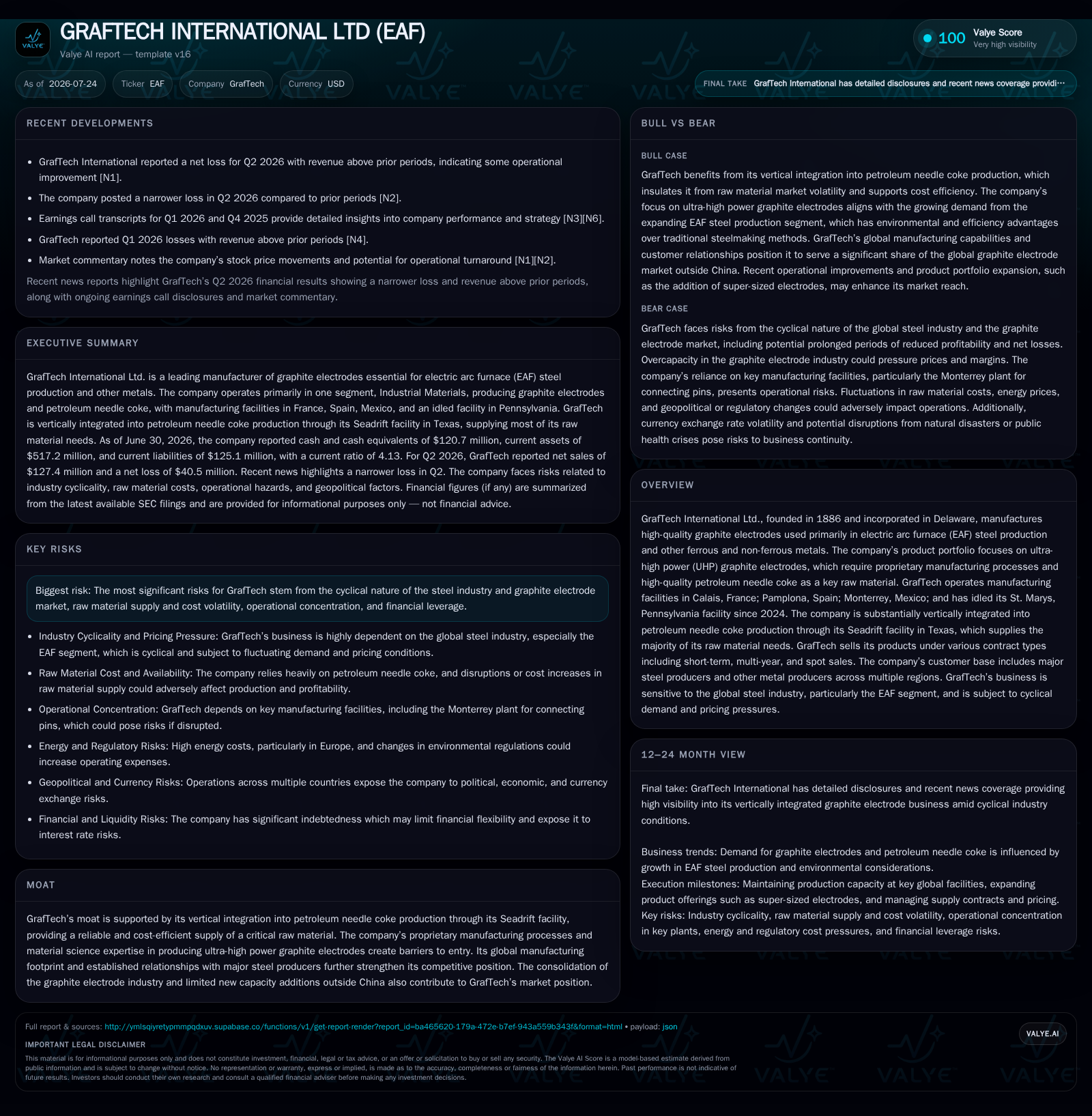
GrafTech International Ltd. reported a narrower net loss in Q2 2026 despite a 3% year-over-year decline in sales, reflecting lower realized graphite electrode prices offset partially by higher volumes. The company leverages its unique vertical integration into petroleum needle coke supply and a disciplined contract mix to manage raw material cost volatility and cyclical steel demand. Operationally, manufacturing assets in Europe and Mexico remain core, while its Pennsylvania facility is idled. Liquidity stands healthy with $253 million available despite leverage exceeding $1.2 billion. GrafTech’s growth outlook hinges on structural gains from rising EAF steel production globally amid persistent cyclicality and competitive pressures.
Latest Operating Update: Q2 2026
GrafTech International Ltd. reported a narrower net loss of $40.5 million in Q2 2026 compared to a $86.9 million loss in the same period last year, reflecting operational resilience amid ongoing steel market cyclicality [S16]. Sales declined 3% year-over-year, primarily due to lower realized average graphite electrode prices, partially offset by increased shipment volumes. Cost of goods sold fell 4%, supported by favorable prior inventory valuation adjustments and lower cash COGS per metric ton, indicating effective raw material cost management [S16]. Selling and administrative expenses also decreased slightly, driven by reduced stock-based compensation expenses [S16]. Operating losses remained relatively stable at approximately $14.6 million, underscoring disciplined cost control in a challenging pricing environment.
GrafTech’s recent pricing initiatives, launched near the end of Q1 2026, achieved weighted-average price increases exceeding 15% compared to earlier contracts, signaling improved pricing discipline and contract mix optimization [S24]. The company continues to operate three primary graphite electrode manufacturing plants located in Calais (France), Pamplona (Spain), and Monterrey (Mexico), while the St. Marys, Pennsylvania facility remains idled since early 2024 as part of capacity rationalization efforts aligned with operational efficiency objectives [S1].
Business Model: Vertical Integration and Contractual Strategy
GrafTech’s core business is the manufacture and sale of ultra-high power (UHP) graphite electrodes, essential consumables in electric arc furnace (EAF) steelmaking. These electrodes conduct electricity to generate the intense heat required to melt scrap metal and iron units in EAFs, a steel production method favored for its environmental efficiency and cost-effectiveness compared to basic oxygen furnace (BOF) technology [S1]. The company’s electrodes also serve steel refining ladle furnaces and non-ferrous metal refining processes.
Revenue is generated primarily from sales to global EAF steel producers operating mini-mills, through a diversified contract portfolio comprising spot sales, short-term agreements, and multi-year contracts [S1]. This contract mix balances flexibility and revenue stability, enabling GrafTech to navigate the inherent cyclicality of steel demand and electrode consumption rates
A distinctive competitive advantage is GrafTech’s vertical integration into petroleum needle coke production via its Seadrift, Texas facility, which supplies the majority of its raw material needs. Petroleum needle coke quality critically affects electrode electrical conductivity and durability, making this integration vital for cost control and supply reliability amid volatile raw material markets [S1]. This integration mitigates exposure to external needle coke price fluctuations, a key driver of graphite electrode production costs.
GrafTech’s proprietary manufacturing processes produce low electrical resistivity UHP electrodes that meet stringent customer reliability standards, reinforcing its position as a preferred supplier to global EAF operators. Capacity utilization and plant operating efficiency are closely monitored KPIs given the capital-intensive nature of graphite electrode production [S1]. As of end-2025, GrafTech’s production capacity across its three active plants was approximately 178 thousand metric tons, with the idled St. Marys facility excluded
Industry Structure and Competitive Environment
The graphite electrode industry is characterized by high barriers to entry due to technical complexity, capital intensity, and critical raw material dependencies, particularly petroleum needle coke availability. Limited capacity expansion outside China and recent industry consolidation have further constrained supply, supporting pricing discipline [S1]. GrafTech is among the few industry leaders with substantial vertical integration into needle coke production, reducing procurement risks compared to peers reliant on external suppliers.
Demand for graphite electrodes is closely tied to global EAF steel production, which is cyclical and influenced by macroeconomic factors affecting end markets such as automotive, construction, and machinery manufacturing [S1]. Electrodes are consumed at an average rate of approximately 1.7 kilograms per metric ton of steel produced via EAFs, with consumption rates fluctuating based on furnace operating hours and production cycles.
Contractual dynamics differentiate competitors; companies like GrafTech that maintain a balanced mix of multi-year and short-term contracts benefit from revenue predictability during downturns, while spot sales provide upside during tight supply or rising steel prices but increase earnings volatility.
Growth Drivers
GrafTech’s growth prospects are underpinned by the global shift toward EAF steelmaking, driven by sustainability mandates and economic efficiencies relative to BOF methods [S1]. Incremental EAF capacity additions outside China, coupled with throughput increases at existing mini-mills, support steady growth in UHP graphite electrode demand, estimated at a mid-single-digit CAGR through the coming decade.
Technological advancements enhancing electrode durability and reducing consumption rates contribute to lowering steel production costs, encouraging adoption among marginal mini-mills and new geographic markets. Additionally, diversification into non-ferrous metal refining broadens the company’s addressable market.
On the supply side, capacity rationalization—including the idling of the St. Marys plant—helps maintain pricing discipline amid volatile raw material costs, particularly petroleum needle coke, which remains sensitive to oil market dynamics and geopolitical factors.
Risks and Watchpoints
Key risks include the cyclical nature of steel production, which directly impacts electrode consumption volumes and pricing power, potentially leading to margin compression and intermittent net losses as historically observed [S1]
Raw material cost volatility, especially in petroleum needle coke pricing, poses margin risks if not offset by timely price adjustments or hedging strategies. Operational risks stem from reliance on three active manufacturing sites; unplanned outages could disrupt supply commitments.
Competitive pressures persist from Chinese graphite electrode producers, who can influence global trade flows through export volumes. Technological substitution risks remain low but warrant monitoring.
Environmental regulations related to petroleum needle coke processing impose compliance costs that may incrementally increase fixed operating expenses.
Key Metrics to Monitor
Order backlog and contracted volume changes will provide early signals of demand sustainability following recent price increases. Tracking weighted-average realized prices alongside shipment volumes quarterly will clarify the durability of pricing improvements.
Capital expenditure trends will indicate whether investments focus on maintenance or capacity expansion, influencing medium-term production capabilities.
Liquidity and debt maturity profiles warrant close observation given the company’s significant financial obligations and the potential impact of adverse market conditions.
Industry developments such as new capacity announcements or shifts in needle coke supply economics could reshape competitive dynamics and affect GrafTech’s market positioning.
Regulatory disclosures and litigation outcomes related to environmental or labor matters may also affect cost structures and reputational risk.
Financial Profile
As of June 30, 2026, GrafTech reported current assets of approximately $517 million and current liabilities of about $125 million, yielding a strong current ratio of 4.13x, indicative of solid short-term liquidity [F1]. Cash and cash equivalents stood at approximately $121 million as of June 30, 2024 [F1]. Total debt was estimated at roughly $1.125 billion as of December 31, 2025, with net debt near $1.004 billion at that date [F1].
Capital expenditures are projected at approximately $35 million for full-year 2026, focused primarily on asset maintenance and sustaining capacity utilization rather than expansion, consistent with the company’s strategy to optimize existing manufacturing footprint [S21]
This financial positioning supports ongoing operations and strategic flexibility, though leverage levels require monitoring in the context of steel market cyclicality and raw material cost volatility.
Disclaimer: This analysis is for informational purposes only and does not constitute investment advice. All data are sourced from company filings and public disclosures.
Disclaimer: This is research-only, informational analysis and not investment advice. It may include AI-generated interpretation and general industry context. Always verify important details using primary sources.

Comments