
NOODLES & Co. Battles Liquidity Pressure While Refining Its Niche Casual Dining Model
The latest quarterly filing reveals acute liquidity challenges and operating losses that test the resilience of NOODLES & Co.'s focused noodle-centric casual dining approach amid competitive and inflationary headwinds.
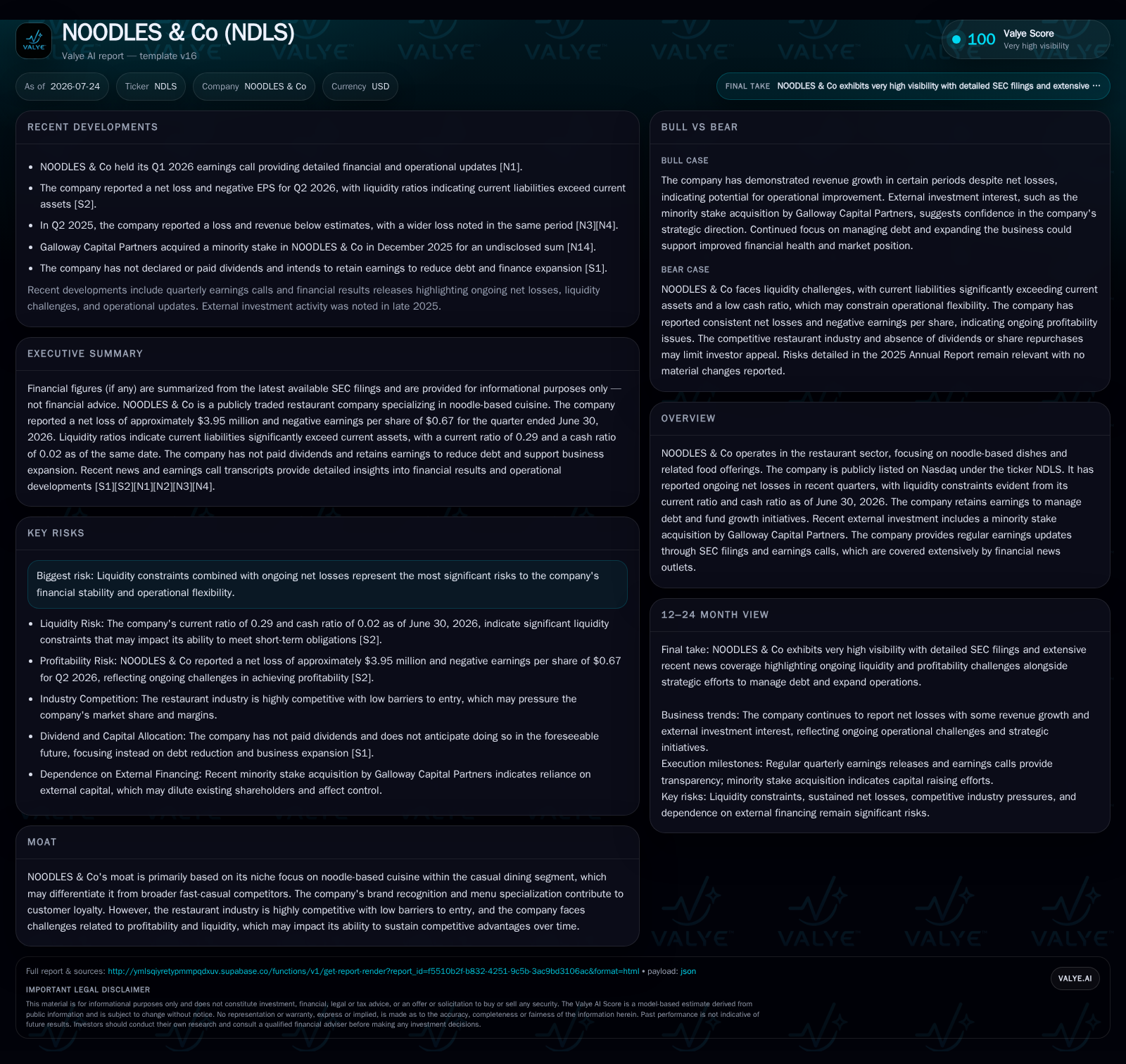
NOODLES & Co.'s recent 10-Q highlighted an acute liquidity crunch with a current ratio of just 0.29 and cash reserves around $1.3 million against substantial current liabilities exceeding $62 million, underscoring strained short-term financial flexibility [S2], [F1]. The company’s business model centers on a niche offering of noodle-based dishes through company-operated casual dining locations, a strategy that drives brand recognition but constrains diversification and amplifies sensitivity to traffic downturns and cost pressures [S1], [S2]. Competitive dynamics are challenging, with broader fast casual peers like Chipotle and Panera leveraging scale, menu breadth, and digital channels more effectively, making it difficult for NOODLES & Co. to defend margins in the face of commodity inflation and labor cost pressures [S1]. Growth depends heavily on same-store sales driven by traffic and check size, but capital constraints limit unit expansion potential, while digital ordering penetration remains an essential yet underemphasized driver for throughput improvement [S1], [S2]. The company retains earnings for debt reduction rather than dividends, reflecting its priority on stabilizing financial health amid net losses and a net debt position approaching $31 million [S1], [F1]. Monitoring upcoming quarterly sales trends, cost management effectiveness, and any refinancing or capital raising will be critical to assessing stabilization progress [S2], [S3].
With cash and equivalents standing at approximately $1.3 million against current liabilities nearing $62.9 million as of June 30, the resulting current ratio of 0.29 underscores a precarious short-term financial posture far below industry norms where ratios above 1.0 are generally desired for cushioning unexpected expenses or funding working capital needs [S2], [F1]. This imbalance suggests the company struggles to cover maturing obligations without recourse to additional financing or operational improvements. The substantial gap between current assets (~$18.5 million) and liabilities signals stress in managing day-to-day cash flow demands.
Such liquidity strain compounds risk given NOODLES & Co.'s net debt position around $31 million when considering known debt balances less cash reserves, further tightening the company's runway for strategic investments or margin recovery initiatives [F1]. This landscape heightens scrutiny on management's ability to navigate both operational efficiency gains and capital structure optimization concurrently.
Noodle-Focused Casual Dining Business Model: Strengths and Vulnerabilities
NOODLES & Co. occupies a distinctive niche within the casual dining segment via its specialized focus on noodle-centric cuisine served primarily through company-operated locations—a strategy that cultivates brand recognition anchored on menu specialization rather than volume-driven scale diversification common among larger casual dining peers [S1]. This concentrated product focus tends to foster customer loyalty among diners seeking that specific category but simultaneously narrows the appeal spectrum compared to competitors offering broader menus.
From a revenue mechanics standpoint, the company depends critically on steady or growing customer traffic combined with stable average check sizes within each unit to drive same-store sales growth—a key KPI signaling revenue quality beyond mere expansion of unit count. However, this reliance elevates exposure to macroeconomic discretionary spending trends where dips in visits or shifts away from niche offerings can disproportionately impact top-line performance. Given the limited product variety relative to peers who may better hedge demand shifts across multiple cuisine types or price points, NOODLES & Co.'s customer base is relatively sensitive to competitive incursions or changing consumer preferences within casual dining environments [S1], [S2].
Menu specialization poses operating leverage risks as well; upward pricing adjustments face elasticity limits given the competitive intensity facing casual venues broadly offering quick service convenience or fast casual options with diverse menus.
Competitive Set Challenges: Positioning Against Fast Casual Giants and Full-Service Chains
The competitive environment for NOODLES & Co. is shaped by formidable peers ranging from fast casual chains like Chipotle Mexican Grill and Panera Bread—both renowned for menu innovation, digital platform sophistication, strong unit growth strategies—to full-service restaurants such as The Cheesecake Factory that benefit from more immersive guest experiences albeit higher operating costs.
Compared with these peers, NOODLES & Co.'s narrower menu focus restricts pricing power enhancements while also limiting appeal cross-sectionally across different consumer segments frequenting fast casual formats known for customization options coupled with robust digital ordering penetration.
Moreover, competitors have generally exhibited superior resilience against commodity inflation via scale-driven supplier negotiations and more agile labor deployment models. With rising food input costs prevalent industry-wide—especially impacting staple ingredients integral to noodles—and concurrent wage inflation exerting upward pressure on labor expenses (a major cost line in the restaurant P&L), NOODLES & Co. faces an uphill battle sustaining restaurant-level margins without either raising prices (which risks traffic decline) or absorbing margin compression.
Growth Prospects Hinged on Sales Dynamics, Unit Expansion, and Digital Channels
Future growth for NOODLES & Co. largely hinges on improving same-store sales via traffic gains or increased check sizes through menu innovation or effective marketing targeting loyal customers while cautiously controlling pricing amidst inflationary headwinds.[S1] However, capital constraints identified from the liquidity crunch sharply limit new unit development—a traditional growth engine in casual dining chains where market share expansion depends significantly on footprint scaling.[S2]
Digital ordering capabilities represent another lever with potential upside; increased penetration in delivery platforms could boost throughput without proportional increases in fixed costs inherent in dine-in service models. While evidence indicates digital channels remain underemphasized relative to some fast casual competitors who have invested heavily pre-pandemic to build out seamless omnichannel platforms, focusing here could mitigate some traffic sensitivity by broadening customer access points.
Without sufficient capital investment capacity following retained earnings earmarked for debt reduction,[S1] balancing growth investments alongside financial stabilization efforts represents an ongoing trade-off.
Constraints Ahead: Inflation Pressures, Traffic Sensitivity, and Funding Needs
Ongoing macroeconomic factors impose persistent headwinds for NOODLES & Co. Commodity price volatility inflates core food costs disproportionately given menu concentration on a few key ingredients prone to market swings. Simultaneously, labor shortages and wage inflation continue eroding operating leverage benefits common across the restaurant sector.
When combined with modest scale relative to larger competitors capable of amortizing fixed costs over wider unit bases or negotiating favorable supply contracts, this environment sustains pressure on already negative operating margins evident in recent filings.[S2]
Additionally, competition for discretionary spend amid shifting consumer dining preferences toward greater convenience options adds further uncertainty around sustaining stable customer traffic levels necessary to support fixed cost absorption in company-operated units.
Near-Term Milestones to Track Execution Capability and Financial Stabilization
Important upcoming markers for assessing execution will include quarterly updates on same-store sales trends shedding light on whether management’s initiatives translate into improved foot traffic or check size progression amidst ongoing inflationary conditions [S2]
Financially, any tangible progress toward easing liquidity pressures via refinancing activities or further equity injections post minority stake acquisition by Galloway Capital Partners would provide critical runway extension although such interventions have yet to fully offset near-term constraints [S3]
Operational margin improvements driven by effective cost management—in food sourcing efficiencies or labor scheduling optimization—would signal potential path toward profitability stabilization even if top-line growth remains challenged [S2]
The interplay between these dimensions will ultimately determine how effectively NOODLES & Co. can reconcile its niche strategy within competitive constraints while addressing solvency considerations.
Financial Profile Discussion: Liquidity, Leverage, and Cash Management Context
The balance sheet snapshot delineates a challenging financial profile characterized by a highly leveraged stance juxtaposed against minimal cash reserves.[F1] The low current ratio (0.29) stands well below conventional thresholds signaling adequate short-term coverage ratios (>1), flagging an urgent need for improved working capital management or external funding access.[F1]
Company policy clearly prioritizes retention of earnings toward outstanding debt reduction rather than shareholder distributions,[S1] likely reflecting recognition that deleveraging is paramount before returning value directly via dividends becomes viable.
Absent meaningful improvements in profitability or liquidity over ensuing quarters,[S2] solvency risks rise due to limited buffers amid volatile demand conditions typical within casual dining segments.
Overall, the financial picture corroborates operational narratives emphasizing constrained ability to pursue rapid growth absent material capital structure adjustments.
This analysis is based solely on publicly available SEC filings dated up to July 24, 2026 ([S1], [S2], [S3]) supplemented with contemporaneous balance-sheet metrics ([F1]) contextualized within sector standards drawn from restaurant industry knowledge layers.
Disclaimer: This is research-only, informational analysis and not investment advice. It may include AI-generated interpretation and general industry context. Always verify important details using primary sources.

Comments